Without art, what is your city?': Interview with Dave Malacari
Written by
AK07 launches in early March, with a stunning line-up of of international and local events. The Big Idea's Isaac Davison speaks with Festival Director David Malacari about what makes the Auckland festival special, and his vision for its future.
"Auckland ... is an incredibly disparate and exciting community. It is a Babel of a city, which I find incredibly exciting. The festival in Auckland will inevitably, whether we like it or not (and we love it!) reflect that."AK07 launches in early March, with a stunning line-up of of international and local events. The Big Idea's Isaac Davison speaks with Festival Director David Malacari about what makes the Auckland festival special, and his vision for its future.
"Auckland ... is an incredibly disparate and exciting community. It is a Babel of a city, which I find incredibly exciting. The festival in Auckland will inevitably, whether we like it or not (and we love it!) reflect that."Isaac Davison: What makes an Auckland Arts Festival? What about AK07 is unique to Auckland?
David Malacari: I am often asked 'how is the Auckland Arts festival going to be different from the Wellington one?'. It is actually a bit of a moot point: 'Who cares?'. Our festival could be a direct translation of the Wellington festival, and Auckland audiences would have a wonderful time, because many people do not know what goes on in the Wellington festival. However, we do not want replicate Wellington.
Wellington's arts festival has a unique flavour. A festival develops a personality based on where it is. Wellington is the capital, the centre of government, and it has a lot of public servants and politicians. Auckland on the other hand is an incredibly disparate and exciting community, which has no planning involved. It is a Babel of a city, which I find incredibly exciting. The festival in Auckland will inevitably, whether we like it or not (and we love it!) reflect that.
One of the things about Auckland which we want to seize upon is that it is the capital of the South Pacific. It is not just multicultural, but also the crossroads of so many small Pacific nations and Pacific Rim activity. There are a lot of roads leading to Auckland and the community reflects that.
Has there been a shift between the 2005 and 2007 festivals?
The Auckland Arts festival is a new event, so the first thing we are doing is making sure we exist next time. There is a lot of time spent on purely survival, and getting a community to recognise what a festival can offer.
A festival is like a litmus paper. If a city the size of Auckland is culturally rich and mature, then it will probably have a festival. If it does not, it may indicate some lack in what it is eating.
I used to say Auckland is the last city in the Asia Pacific to have a significant festival. But now I actually point out that Auckland was the first city in the region to have a large festival. Auckland hosted a festival from 1948 to 1982. In 1982 it atrophied and died. I suspect in the early 1980s there was a change in the way festivals were perceived. Up until 1980 they were hobbies for the people who understood cultural language. As these people lost some of their influence, festivals lost their currency. They were reinvented as a means for teaching people cultural language, rather than being a reflection of cultural language. But the original Auckland festival did not follow this mould, and it faded away.
It is a great credit to Auckland City that seven years ago the council reinvented a festival, based on the premise that Auckland is a rich, dynamic, diverse, important city. The first two festivals had teething problems, but now, with AK07, we like to think we have a modus operandi, a way of reflecting and working with the community which did not previously exist.
What is the vision for the festival?
I would like to see over time a strong artistic voice in Maori and Polynesian work, and also a voice amongst the immigrant communities - China, Korea, India. We want to build a few bridges, but also draw people out of themselves just a little, because I think there is some great stuff to be found if we can spark interaction between some communities which would not normally think of working with each other. That is a long-term vision.
In the short term we are just looking for interesting, terrific work which will find a place in the festival. Ideally it will be something that is exclusive to the AK07, so the festival provides a context for audiences to experience something a bit different.
We also want artists to feel challenged to produce stuff that they might not otherwise feel comfortable producing. A festival provides a context for cultural adventure on both sides of the coin - for both the artist and audience.
Does its creation mark a shift in culture?
I think so. Cities now see festivals in two ways. On one side, a festival provides opportunities for artists. As much as I would love it to be, a festival is not all about the art. The other side is the political motivations you must fulfil. We have to be mindful of why we are getting large amounts of funding. We must keep reminding people of how we exist. We have a role in making an economic impact - through bed nights, patronage in restaurants, taxes, and employment in the arts world.
There are also the intangible benefits of having a culturally healthy society. Arts, like education, sports, and healthcare, are part of a healthy cultural diet. Without art, what is your city? A soulless nothing.
What is the process of building up a festival programme?
I try and see everything. Any work that exists, I want to see it before we programme it. This is not possible in new work. There is a certain amount of risk, and instinct in building a programme. With new pieces, we look at the credentials of the artists, the script, and whether the work is at the populist or developmental end of the programme, and we take a gamble.
I ask myself 'what is going to provide a range of experience which interests people, includes people, and stimulates them to take further interest and further inclusion?'. Audience development and taking people on a journey is very important to a festival. To take people on a journey, you have to begin them on that journey, and not land them in the middle of a jungle. The populist programme is the first step on the journey, for people who are not comfortable with basically leaping off a cliff in terms of intellectual content.
Then there is the risky end of the programme, which hopefully people will get to at some point in their lives.
Penumbra is the major commission of the festival - how was this project conceived?
I first saw the project as a student production at Toi Whakaari in Wellington. I had only been the festival director a short time. The work never left my mind. I walked out of the play with a strong, epic story which really affected me. I started discussions soon after about turning it into a professional production. It is a very Auckland story, with singularly Auckland elements, such as a scene on Bastion Point. Everyone loves to see their own city's story on stage.
How long have you been in charge? What was your path to becoming a festival director?
I've been here for just over two years. I was at Adelaide Festival for 13 years, starting out as production manager. I was very lucky to find a pathway within one organisation, which does not happen often in the arts. You often have to cut and change jobs, finding opportunities and openings.
I managed to work my way into programming and directing festivals at Adelaide. I was very lucky in 1996 to direct a festival of Australian work in India. There was a big push by the Australian government to sell education and science to India, and someone thought to complement this with a cultural show. The festival was to show that we were not just about nuts and bolts, but were a sophisticated country.
Four years later in 2000, I directed a similar festival in London. I think I have developed and grown out of Adelaide, and now I am privileged to be directing in Auckland. Running a festival requires a certain skill set. People have asked 'what is an Australian doing running a New Zealand festival?' But as an outsider, you can come into a community and bring a certain clarity, and a different perspective to a city.
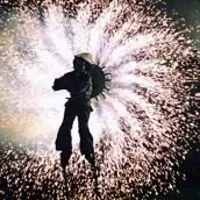
Image: A Little More Light, AK07's opening event by French pyrotechnics company Groupe F.