Welcome home my beautiful optimist at Artspace
Written by
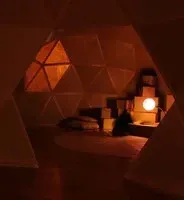
Welcome home my beautiful optimist is an installation of two cardboard geodesic domes by Dunedin-based artist Bekah Carran exhibiting at Artspace in November. Supported by counterculture movements in the 70s , the geodesic dome proved an efficient and affordable shelter and expressed a form for sustainable community living. Questioning the resurgent concerns of 70s idealism the work provides a place of escapism while simultaneously acknowledging the potency of this desire. Welcome home my beautiful optimist is an installation of two cardboard geodesic domes by Dunedin-based artist Bekah Carran exhibiting at Artspace in November. Supported by counterculture movements in the 70s , the geodesic dome proved an efficient and affordable shelter and expressed a form for sustainable community living. Questioning the resurgent concerns of 70s idealism the work provides a place of escapism while simultaneously acknowledging the potency of this desire.Exhibition dates: 14 - 25 November 2006 for two weeks only
Using simple packing materials, card and tape, the minimalism of the installation is welcoming. Welcome home my beautiful optimist is filled with a theatrical optimism; the light is left on anticipating your return, the window soften the outside with a warm glow and the sound of falling rain verifies a longing for retreat. In referencing the idealism ofthe geodesic dome Welcome home my beautiful optimist is hopeful for a sustainable interstitial space, without implying that this aspiration is either attainable or unobtainable. Carran forms a critical hopefulness.
Bekah Carran (b. 1976) is a Dunedin-based artist and mother to Ava Flora. She graduated with a BFA from Otago Polytechnic School of Fine Art in 1998. In 2003 she was the Olivia Spencer Bower Artist in Residence in Christchurch and was atrust member of Dunedin's Blue Oyster Gallery 2002-2006. Recent exhibitions include Prospect 2004, City Gallery Wellington, 2004, Welcome to Paradise, DunedinPublic Art Gallery, 2004 and Welcome home my beautiful optimist, The Physics Room Christchurch, 2006. She is one of two upcoming Physics Room Artists inResidence for 2007.
About geodesic domes: In the 1940s American engineer Richard Buckminster Fuller developed autopian model in architectural design - the geodesic dome. Supported by counterculture movements, the geodesic dome proved an efficient and affordable shelter and expressed a form for sustainable community living. In 1976, the largest and most impressive geodesic dome went up in flames. This burning dome became a symbol of the imminent failure of idealistic visions soon to be replaced by1980s market economies and sprawling suburbia.
Image: Bekah Carran: Welcome home my beautiful optimist Image courtesy the artist and The Physics Room. Photographer: Mark Gore.