Turuki Turuki! Paneke Paneki! When Maori Art Became Contemporary
Written by
By Caron Copek
Auckland Art Gallery's exhibition Turuki Turuki! Paneke Paneke! When Maori Art Became Contemporary pays tribute to a generation of senior Maori artists who exhibited 50 years ago in the first exhibition of contemporary Maori art in Auckland.
Fifty years on the Gallery is celebrating an historic moment in New Zealand's visual art and cultural history says indigenous curator Ngahiraka Mason (Ngai Tuhoe, Ngati Whakaue, Ngati Pango).
"The original exhibition captured the mood of the 1950s and drew attention away from Maori art displayed in museums and redirected that focus to another kind of Maori art." By Caron Copek
Auckland Art Gallery's exhibition Turuki Turuki! Paneke Paneke! When Maori Art Became Contemporary pays tribute to a generation of senior Maori artists who exhibited 50 years ago in the first exhibition of contemporary Maori art in Auckland.
Fifty years on the Gallery is celebrating an historic moment in New Zealand's visual art and cultural history says indigenous curator Ngahiraka Mason (Ngai Tuhoe, Ngati Whakaue, Ngati Pango).
"The original exhibition captured the mood of the 1950s and drew attention away from Maori art displayed in museums and redirected that focus to another kind of Maori art."Mason describes the exhibition as "a tribute to the teachers of that generation". The five artists were all teachers in Northland at the time of the June 1958 exhibition.
The exhibition presents the work of pioneering artists Ralph Hotere, Arnold Manaaki Wilson, Muru Walters, Katerina Mataira and the late Selwyn Wilson.
These senior Maori artists are now aged in their late 70s.
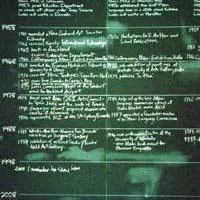
Turuki Turuki features a "whakapapa wall of friendship". Written on a blackboard, it acknowledges key dates, people and places. Mason says it contextualises the work of Maori artists as pioneering educators, and mentors during a time of change and social reform.
"These artists were innovating and experimenting as teachers, visual artists and craftspeople. I believe these artists were the founders of the contemporary visual Maori art culture that we have today."
None of the five were able to see their work in the 1958 exhibition says Mason.
"They were up in Northland, working and teaching. They couldn't just come down to Auckland. Their first and foremost duty was to be a teacher."
The 1958 show was curated by Matiu Te Hau and exhibited at the University of Auckland's Princes Street Adult Education Rooms.
A photograph featured in the exhibition shows the university building and describes it as the only public building in the city to have adopted Maori architectural features.
Turuki Turuki presents rarely seen works from the late 50s and early 60s, and draws heavily from a review in The Auckland Star from June 1958 as there is no list of the works that appeared in the original exhibition.
"While we're certainly not trying to recreate that moment, this is a telling of that moment that looks to the past and to also to the future," says Mason.
Turuki Turuki! Paneke Paneke! is on show until 24 August at the Auckland Art Gallery, New Gallery.
Image: The whakapapa wall of friendship
Photo: Caron Copek
11/06/08