Transitioning from play to screenplay - it's not just a 'cut and paste'
Written by
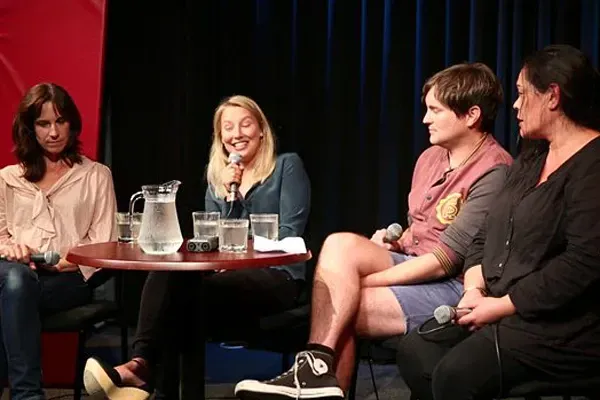
For the March 2014 Writer’s Room, a panel of actor/writers working across both film and theatre discussed how their theatrical backgrounds have influenced the way they approach the art of writing for the large and small screen. All three panellists have been praised for their original voice and the freshness they bring to their screen work.
Actor/playwright/screenwriters Tom Sainsbury (Basement, Super City ll), Sophie Henderson (I Heart Camping, Fantail), and Jackie Van Beek (Go the Dogs, My Brother and I are Pornstars) spoke to actress Rachel House (Boy, White Lies) about working across the mediums and what filmmakers and writers can take from theatre practitioners.
After a busy decade acting, writer/actor Sophie Henderson has been hailed for the strong voice in her feature debut Fantail (2013), which sold world rights to LevelK after its Rotterdam premiere. Prolific writer/actor Tom Sainsbury has written 30 plays over the last 9 years as well as co-writing TV comedy series Super City with Madeleine Sami, which sold North American rights to ABC. Jackie Van Beek is a writer/director/producer and actor in both theatre and film. Her plays and short films including My Brother and I are Pornstars and Go the Dogs have received festival attention around the world. Rachel House is a prominent NZ theatre and film actress best known for her work in Whale Rider, Eagle Vs Shark, Boy and White Lies. She also recently directed The Maori Troilus and Cressida which premiered at the Globe theatre.
Sophie’s feature Fantail started life as a monologue she wrote at drama school in her third year. “It started as a ten minute monologue with one character but then it developed and I played all of the characters. I always thought it would make a great play so after drama school I wrote the first draft, gave some public readings and applied for funding to develop a script and was rejected. I’m grateful for that as I would never have thought of Fantail as a film.”
She went on to apply for NZ Film Commission escalator funding with her drama idea, was selected for the final 12 and given three months to adapt her play into a screenplay and deliver a script. This precipitated a crash-course in ‘Screenwriting 101?.
“I had to teach myself how to write a screenplay. I read books about structure and writing for film and watched a lot of movies. The theatre form is always changing, quite innovative. I love the ambiguity of it … but I learned quickly that things have to be really obvious in film, very clear, because the screenplay has a defined structure you need to adhere to and it’s the blueprint for the shoot. When we were shortlisted for escalator the Film Commission said we were the ‘wild card’ because we were not experienced. That made us work extra hard to prove we could do it and that intensive approach has always worked for me. ”
Sophie also learned that adapting a play for film was not simply a matter of ‘cut and paste.’ “I had to see my play in pictures rather than words. My background is theatre and that’s always ‘wide shot’. You can’t tell the audience where to look. In film , you can say, ‘hey, have a look at this!’ using imagery as exposition. Film allows you to use a close up so you can see what someone is thinking and even in the most intimate theatre experience you can’t do that. I miss the ‘immediacy’ of theatre where the audience reacts right away. You learn where they will laugh or hold their breath.”
80% of ticket buyers at Auckland’s Basement Theatre are new to the live performance medium, showing support for the innovative and oft times ‘raw’ works that can be seen there. “You can put on a play for next to nothing,” said Jackie, “and that’s why I like going to the Basement because you never know what the play is going to be like. Some are so bad I just love it.”
In spite of the support for live theatre, Jackie felt younger people were staying away. “I think young people are scared of going to the theatre because they feel they have a direct relationship with the actors onstage and so can’t walk out without someone knowing. If it’s a bad film they can just get up and leave. I don’t mind people walking out of theatre shows and maybe if young people knew they could do that they might not feel so much like they’re trapped in there.”
Tom added, “If people go to a bad movie, they’ll still go to another in the future but if they see a bad play, they might not go to the theatre again for ten years.”
Jackie admitted that the transition from writing for the stage to crafting screenplays was ‘incredibly difficult’ for her. As a writer/actor or writer/director there was so much in her mind that was totally obvious to her … but not so for someone reading her screenplays.
“All my film scripts were dialogue, the metaphors were in dialogue and I’d throw in a few lines to give some action … way too much dialogue. One time I was trying to adapt a play, applied to Cinemart with a ten page treatment and they accepted my idea. I have to say, I was great at talking about my idea and had all of these distributors and sales agents interested … then they wanted to see a script and I said, ‘I’ll email you one.’ I came home, tried to write it and couldn’t do it. That’s when I became determined to learn how to write for the screen rather than theatre. I attended an Arista workshop once and they said the script is just the blueprint, it’s not a piece of art. Lay it out, make it clear and hand it over. It’s an instruction manual. The best advice I was given was if you’re trying to write a screenplay from a theatre background, try to write the whole thing without dialogue. Only use dialogue when you cannot tell that part of the story with images.”
Tom is a prolific writer with 30 plays to his credit as well as co-writing the TV comedy series Super City with Madeleine Sami. His theatre background had given him the assurance that the ‘writer is king’ and he had a rather rude awakening when he started writing for TV.
“I’d go to a theatre workshop where everyone was so respectful of my words and then I went into screenwriting and no one gave a s***. They just tear you down so I feel it’s a good thing to go back to theatre. Film knocks the ego out of you. The feedback can be ruthless and it comes from everyone – TV networks, producers - but it’s great if you can handle it.”
Jackie said she always liked having some control over her material. “That’s why I’m a writer/ director. I admire and respect those who write something, then hand it over and hope for the best. I need to have some control.”
She finds film ‘exciting and liberating.’ “I made a short film quite by accident. I was in Australia, came across these two aboriginal boys and I wanted to do a film. I fell into directing like that and my theatre background was so useful. I knew how to direct actors, knew what was needed to construct the story, working in the medium of film was great. You have so much freedom, can jump time and location in a split second. Film transports you immediately. You can be more abstract in theatre whereas film is very literal.”
Tom agreed saying he had learned so much by writing for theatre, giving him a firm foundation upon which to base his screenwriting. “If I hadn’t had that experience I would have made far more mistakes. I also learned things in film that aided my theatre work. Writing for TV has made me far more detailed in my play writing. I think every screenwriter should write for theatre too.”
All agreed that getting a film to the screen is far harder. ” I would not like to endorse safety in the creative arts but I do know that any creative person with a burning desire will take risks, hopefully great ones,” said Jackie. “Film is far more competitive. There is never enough money and of course you need so much more of that than in theatre. I self-funded most of my short films.”
Sophie felt that actors are taught to take risks, to be brave and innovative. “Actors making films are ready to take risks. We’re also used to rejection and criticism. We just keep trying. And if you’re having trouble getting funding for a screenplay, just write a play!”
Jackie said she often hears actors talk about film and theatre as being quite different but she believes that in terms of the performance, the two genres are the same. “People say they are a stage actor or a TV actor. Well, either they can act or they can’t. Same with writing. From your theatre background, you already know how to make a story and create a character and telling a story through pictures is what needs to be learned.”
When asked if there was a ‘magic formula’ for a great screenplay, Tom said, “If you can refine the idea into one sentence, tell it to someone and they get excited about it, then that’s a good formula.”
For Jackie, it is always a ‘question to self’: Can I create something that is engaging and compelling and stop people from walking out of the room? “If someone walks out, then I know I need to change that because it’s bad writing.”
A writer has to make a living – well, try to anyway – and Tom said there are up and down sides to that. “I find it hard to be a writer for hire if there is nothing in the story to be passionate about. However, as a ‘for hire’ you can come to a project with fresh eyes, bring a new perspective and be more objective and critical. The situation also allows you to learn a lot which you can then apply to your own work.”
Jackie spent seven years having children and making films and is now back to devising her first theatrical show in some time. “I relish everything you can do in theatre. There is so much to enjoy. It is so presentational and I’m making this ‘in your face’ theatre, something you can’t do in film. I’m also editing my first documentary at the moment. It’s a nightmare, rather like devising theatre. I was in Melbourne before Christmas last year. I had no money, shot for three days, got nine hours of footage and it felt like theatre. I was following whims. Now that I’m in the edit it’s all just brilliant and I think everyone needs to see everything which of course is not going to happen. At least when you write drama, even if you’re being spontaneous, you know which footage pertains to a scene in order to build the story but with documentary it’s a bunch of crazy crap that will make a great story if I can just get it there. And here’s a tip – if you get a chance to be in the edit suite, go in there. That’s the time when you can really see your own mistakes and learn from them.”
Sophie and Tom agreed but the lessons can be hard ones. “Sometimes it’s like killing your babies,” said Tom, “but if you can learn to let characters or scenes go, it’s a wonderful thing.”
“Pace was a big thing I learned,” said Sophie. We had a big scene at the end of Act Two in Fantail. It worked in the script but it had to go in the edit because we had to ramp the film up. Goodbye beautiful scene!”
When asked about their experiences with dramaturgs and script consultants, Tom replied,
” I love dramaturgs and have been asked to be one but I’m not very good. They have to be nurturing and I feel as if I am always imposing. As a writer, you have to be passionate about what you are writing but you also have to be prepared to throw everything out and start again. In spite of all that, a dramaturg or consultant is a great thing to have.”
Jackie is currently working with a great writer/director. “I had to throw my ego out the window in the first five seconds, We debated every single choice I made in my screenplay. Feedback is so important at every stage. When I am making a film, I try to do alot of test screenings with links to everyone and badger them into watching and feeding back to me.”
And there is never a dull moment for the talented trio. Sophie is writing a script called Manhunt about a woman who keeps choosing the wrong man so decides to make her own men out of household objects. Tom is still a writer for hire and currently working on a Vietnamese children’s show with maybe a Super City lll on the horizon. Jackie is finishing her short documentary, developing her feature film and performing in a sketch show called Flash Dance during the Comedy Festival. “I do love theatre,” said Jackie. “You never have to lock it off. You can always change. Plays can vary hugely every night … as long as the director is OK with it … or if they aren’t there …”
- Transitioning from play to screenplay, Auckland Writer’s Room, 11 May, 2014, written for Script to Screen by Jane Bissell.