To Suck the Kumara: John Reynolds at Peter McLeavey Gallery
Written by
By Mark Amery Courtesy of The Dominion Post 17/7/07
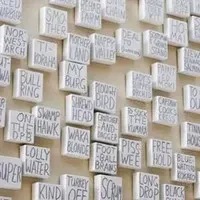
You know what 'whakapapa' and 'Waitangi Day' are about, will have an inkling of what 'Maori day off' or 'Maori Car' refer to, even in these PC times, but have you heard of a 'Maori Cannon' or a 'Ngati-Blow'? These words all chatter together as part of John Reynolds' installation of 1,100 odd small canvases on the walls of Peter McLeavey Gallery in Cuba Street.
Image: Cloud, 2006. Presented as part of the Sydney Biennale 2006.By Mark Amery Courtesy of The Dominion Post 17/7/07
You know what 'whakapapa' and 'Waitangi Day' are about, will have an inkling of what 'Maori day off' or 'Maori Car' refer to, even in these PC times, but have you heard of a 'Maori Cannon' or a 'Ngati-Blow'? These words all chatter together as part of John Reynolds' installation of 1,100 odd small canvases on the walls of Peter McLeavey Gallery in Cuba Street.
Image: Cloud, 2006. Presented as part of the Sydney Biennale 2006.The gallery is filled with each and every word or phrase containing Maori found in Harry Orsman's Dictionary of New Zealand English. There's a canvas per piece of language in Reynolds rough hand, silver marker on black paint.
Orsman's book, to quote its introduction, "records the history of words and particular senses of words which are in some way distinctively or predominantly, though not always exclusively 'New Zealand' in meaning or use".
Recognising how the dictionary reveals the human hotch-potch that is our language, the words has been selected from the dictionary, like a chance game with the one firm rule. It's indiscriminant, meaning Maori words get included just as easily because they crop up as placenames. A 'Takapuna Surprise' is a steak stuffed with oysters.
Unanchoring these words from their meaning (you have to bend down to pick up the book in one corner of the gallery and withdraw it from its leather sheath), Reynolds' lets New Zealand's bicultural history float down any poetic current you desire - as absurd and open-ended in this way as any of John Reynold's works with signposts or networks of line.
A familiar historical story is presented, but just as when he filled the walls of a room at Auckland Art Gallery with the names of artists in the gallery's guide book, you can choose how to read it.
Reynold's work is as politically charged as it is irreverent. If you were to call it a meditation on biculturalism, you'd need to acknowledge these are Maori words that have ended up in the English language and not vice versa. The work is in this regard about the cultural control of language. The racism of some terms are just an example of how for better or worse the work can be read as a bicultural history.
Reynolds has, Killeen-like, allowed McLeavey to hang these canvases as he wishes, and with relish McLeavey has given the conceptual grounding of the work an architecture. On the gallery's largest wall they have been laid out in the order they appear in the dictionary, but then McLeavey has cleverly removed a rectangle and some corners to make it resemble the door and façade of a wharenui. These removed tiles have then been laid in the same pattern as lifted onto the facing wall in the other room.
Above the doorway between them is a pare, or lintel bearing the name of the work. Traditionally the pare marks the boundary between two worlds, and in the arrangement of the tiles between these two rooms is play between positive and negative space. Perhaps McLeavey was thinking of Gordon Walters' adopation of the koru as he did so, which he showed here many years ago. The result is a Pakeha meeting house, the walls containing any number of stories to be read in the weaving.
It would also be nice to see these works hung to be read more freely as a block or swarm, like a constellation of stars to navigate by, or the shreds of the silver fern that adorns the dictionary's cover. As text on blackboard this work is less about the nationbuilding of old as about shattering it into shards. While McCahon's Victory Over Death (that also once hung in this space) says "I AM", this work says "WE ARE".
It follows Cloud (pictured), presented as part of the Sydney Biennale last year on a wall in the lobby of the Art Gallery of New South Wales, which featured almost 7000 small white canvases made up of the 6000 headwords from the dictionary and a selection of the 9300 subentries. That work then was less defined, as changeable in its silver on grey as cloud vapour, but thoroughly identifiable as New Zealand's long white cloud.
Reynolds' work is a celebratory dance between history and chance, between the reverent and irreverent and the contained and uncontainable, and recognises that such occasions always provide a play between light and dark. This is underlined by the inclusion in the exhibition of 11 verses from the poem the work takes its title from, Allen Curnow's "Looking west, late afternoon, low water". It is taken from a book of poetry published the year of Curnow's death and the dictionary's publication.
Printed up large, it encourages us to think of Curnow and Orsman together and feel empowered to play with the power of words to shape language. The poem starts with a definition from the 'desk encyclopedia' of tidal range, and goes on to describe a walk out across the tidal flats at a freak low tide to reveal those things that are usually hidden. Those things like words that are shaped by the ebb and flow of time.
And in case you are still wondering: a 'Maori cannon' is a blunder at billiards and 'Ngati Blow' a rather charged piece of contemporary slang for being 'Ngati Porou'.
18/7/07