The World at Dawn: Geoff Thornley at Mark Hutchins Gallery
Written by
By Mark Amery Courtesy of The Dominion Post
Entering Mark Hutchins Gallery in Willis Street last week I was propelled through the door by a furious chilly wintry blast into a calm, warm white chamber. On the walls were five superb new abstract paintings by established New Zealand painter Geoff Thornley.
At first glance these works seemed super cool and restrained, crystallisations of that outside air. I soon however found myself losing track of time, and having difficulty moving away from even the first of these works. Slowly, these paintings generate heat from within. They come to resemble a light filled membrane - a glass between the room's interior and the world outside, informed by both but containing a life of their own. By Mark Amery Courtesy of The Dominion Post
Entering Mark Hutchins Gallery in Willis Street last week I was propelled through the door by a furious chilly wintry blast into a calm, warm white chamber. On the walls were five superb new abstract paintings by established New Zealand painter Geoff Thornley.
At first glance these works seemed super cool and restrained, crystallisations of that outside air. I soon however found myself losing track of time, and having difficulty moving away from even the first of these works. Slowly, these paintings generate heat from within. They come to resemble a light filled membrane - a glass between the room's interior and the world outside, informed by both but containing a life of their own.Thornley is one of New Zealand's most respected and senior painters, first exhibiting with Auckland's Barry Lett Galleries in 1967. He has been known since the 1970s for his dedication to a pure painting that boldly but beautifully, decisively but quietly, pushes ideas about form and structure around and into new ground. The initial impression can be of a cold hard-edged formal minimalism, but a little time spent will deliver through line, colour and structure exquisite lyricism and melody.
Music is a good analogy. The viewer needs to look as they listen, letting the floating forms at play mingle. You become aware that you are receiving information in layers of carefully built up waves, a meld of a variety of sources.
Considering the changes in contemporary art since the 1970s it's not hard to see why Thornley has been so routinely overlooked. Yet as dedicated as he has been to his cause, he has also consistently surprised. To say Geoff Thornley is due a major survey exhibition is, like one of his works, a large understatement.
The surprise with this show, after the particularly restrained and quiet recent work last seen at Mark Hutchins Gallery (from Thornley's 'First Episode: Listening to Sight' series) is how animated, vibrant and impressionistic these works are by comparison. The calligraphy that dances across their pool-like surfaces reminds you of Oriental brush painting, and there is strong immediate relationship to the watercolour play with water, light and plant-life of Monet's waterlily ponds. Yet like Monet's garden at Giverny, this is a meticulously structured wilderness, with its own cultured language.
In the first work in the show (White Lines #13) the colours of land, water and sky (browns, greens and blues) slowly come into appearance as if this was a song about the emergence of the world at dawn. Across the surface there is a rhythmic swooping dance of white wings or quavers, woven across a vertical drag of blue, evoking the title of one of the other works, 'Birds Chatter'. Thornley apparently found some inspiration for these paintings listening to that unruly but beautiful screen of noise that is the bird's dawn chorus.
Figures are vaporous and emergent in these works, in a dreamlike state of coming through light into being. This world is complete but feels between things. In 'White Line #12' I find myself chasing shapes in clouds before falling into the grid that softly, formally underpins these passing swan-like trails. I also become slowly aware how serpentine line elegantly snakes through the grid. Ballet-like there is a vital tension between the freedom of flight and structure, the grid emerging and then, just as it does, beginning to fall away.
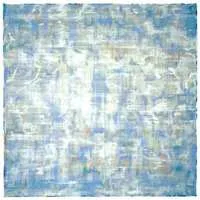
From a distance these works may seem to share the same cool, scoured surfaces (reproduction on this page will do them absolutely no justice), but the underlying experimentation with colour is audacious enough for each of these five paintings to be an entirely different world to fall into.
Below the surface of each is a patchwork of blotched colour rising to sing together. The warmth of these colours mingles with a coolness on the surface to create pools of shimmering vibrations. In 'White Line #15' I drift as if in vapour at the famed Pink and White Terraces, a cascade of water over a series of brims, containing in its depths greens and blues.
To walk past one of these works is to see it change. To turn away and turn back again is to be smitten by how different they have become, and what a light and life lives within them.
White Line, Geoff Thornley, Mark Hutchins Gallery, until 20 August
Picture:
Geoff Thornley
White Line # 7, 2007
Oil on canvas, 117 x 117cm
01/08/08