The Political is the Personal: Dutch photographer Anoek Steketee
Written by
By Mark Amery Courtesy of The Dominion Post
Contemporary New Zealand photography has seemed somewhat shy of people, reveling still in what empty spaces have to say - be they landscapes, Masonic lodges or shopping malls. 2002 Walter's Prize winner Yvonne Todd, and current nominee Edith Amituanui are the exception to that observation, and demonstrate what the subject of this week's column, Dutch photographer Anoek Steketee also does so well - that the personal is a charged space for the political. By Mark Amery Courtesy of The Dominion Post
Contemporary New Zealand photography has seemed somewhat shy of people, reveling still in what empty spaces have to say - be they landscapes, Masonic lodges or shopping malls. 2002 Walter's Prize winner Yvonne Todd, and current nominee Edith Amituanui are the exception to that observation, and demonstrate what the subject of this week's column, Dutch photographer Anoek Steketee also does so well - that the personal is a charged space for the political.Steketee's exhibition at Newtown's Suite gallery features individuals plucked off the streets in Iran. It left me thinking about how strong Steketee undertaking such an exercise down Adelaide Road would be. Does the absence of a cross section of our society in our photography reflect generally an apolitical stance in our art?
Perhaps it takes an Ans Westra outsider eye. Westra was a Dutch immigrant and in film and photography the Dutch continue to demonstrate an outward looking sensitivity to the nuances of the documentary.
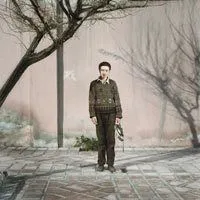
Steketee traveled to Iran curious about the ordinary individuals missing from the media images of Iran. The exhibition is called Frontstage, which is to suggest that part of its purpose is to bring those usually kept backstage out front. Using a camera with a wide-angle lens, a tripod and a set of lights, Steketee set up her equipment in public places asking passers-by if they would be willing to pose for the camera.
What could be taken as either a photo-documentary project or a contemporary take on the 19th century studio portrait (with its contrivances and fetish for the exotic) in fact plays beautifully between the two. This series feels at once both more theatrical and more honest than what we're accustomed to, questioning the position of the camera in relation to its subject. Its closest relation in New Zealand is the work of Margaret Dawson.
Steketee uses artificial lighting in broad daylight, and she also clearly strongly directs the positions and poses of her subjects. These individuals become actors in their own lives, yet they are stilled in such a way as to allow them to hold on tight to their sense of themselves. Bold lighting brings them to us as if in a glossy magazine spread. But rather than opened out to us for consumption like models, their faces reveal there is a complexity of emotion which we can't access. They appear as if pausing mid-journey, looking out beyond us as if in the process of escaping confinement, and the photographer's frame.
There is a beautiful tension between the spontaneous and the staged, an orchestration of the ordinary. While Steketee plucks out passersby, the scenes themselves are very considered - like an old Dutch master carefully lit, situated and full of detail. With mystery they engage you in the drama of someone undergoing change. These are the details revealed behind state uniformity. A young woman holds a fashion magazine with a woman's head on it to create a revealing double portrait, while Converse All Stars are revealed beneath her burqa.
I love how these images use the artifice of photography to create a poetry between reality and theatre. Each image feels flat, with a beautiful combination of artifical and natural light, dividing foreground and background in a way which makes you swear sometimes the background must be a backdrop in a photographer's studio.
In one image a woman with her shopping pauses against a brick wall as if considering her options in flight. She is fully lit, as if in her spotlight about to burst into song. A mottled light falls over a wall that fills most of the foreground as if it were a stage set, but we get a peek at the background street beyond in which a bus moves away. It's only the presence of scummy snow on the ground that drives home that this is a real setting.
The use of light is even more playful in an image set in a lush, dark woodland where a young woman's head pops out from behind a heavily trimmed tree - as if she were a fairy in a fantasy sequence. While the foreground is a dark forest scene with tree spotlit, in the background we can see how this dark fantasy world has in fact been made in daylight. In each of these photographs an individual escapes into their own personal woodland.
Steketee isn't shown here for the first time in Australasia with an impressive heap of reviews or a huge exhibition history to recommend her. This is an emerging artist from the other side of the world. Yet there is something refreshing about this global networking that young gallery Suite are doing between here and the Netherlands, with a mix of Dutch and New Zealand artists.
Suite could as easily be a gallery in Amsterdam where the New Zealand artists are the curiosity. And the relevance of this Dutch photographer's images of Iran to New Zealand are immediately clear when I find myself looking at the passersby on Adelaide Road more keenly.
Frontstage, Anoek Steketee, Suite Gallery, until May 24
Image: Anoek Steketee
Frontstage Untitled # 7
Kodak Endura Print
Edition of 6
110 x 110 cm
14/05/08