The Melee of the Street: William Hogarth prints at the National Library
Written by
By Mark Amery Courtesy of The Dominion Post
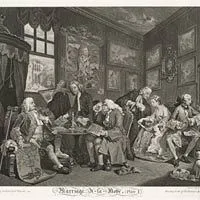
18th century English artist William Hogarth has been credited with inventing the comic strip. Yet the complexity of many of his intensely detailed satires, set in a bustling, gossiping London, with narratives created out of serial prints leave even the most sophisticated comic strips wanting. By Mark Amery Courtesy of The Dominion Post
18th century English artist William Hogarth has been credited with inventing the comic strip. Yet the complexity of many of his intensely detailed satires, set in a bustling, gossiping London, with narratives created out of serial prints leave even the most sophisticated comic strips wanting.Influenced by the new form of the time, the novel, and equipped with the dramatic skills of a great playwright, Hogarth introduced comedy in all its richness to the visual arts, and soundly rejected the classical subject in preference for the contemporary. So while an exhibition of Hogarth's prints from the Alexander Turnbull Library might sound like a dusty old proposition, it actually proves to be rather timely.
Like artists today, Hogarth was operating in a visual culture on the cusp of change. Artwork was becoming increasingly commercialised and viewed by and sold to many, old hierarchies were breaking down and new forms were beginning to emerge.
Aaron Lister's exhibition ably shows Hogarth was an astute individual operator in such an environment. Bringing together the popular satire of the English broadsheet and the high cultural capital of the opera, he asserted copyright over such material as fine art (he lobbied parliament to introduce an Engravers Copyright Act). These works were expensive in their day, and he sold 'subscription tickets' to the public for his future work (the ticket's are delightful works in themselves in how they play out wittily as 'watch this space' advertisements).
You get the impression of an artist in complete control of their editorial independence, asserting the right to move fluidly through a culture, puncturing the expected not with simple political polemical stands but with revelations of its giddy noise and conflicting dramatic calamity.
The exhibition surprises with the breadth of Hogarth's approaches. One of my favourite images is a dig at the sublime landscape tradition and the classics all in one. A bearded gangly angel smoking a long pipe (our artist) sits on a decapitated statue before a large landscape painting, a big jug of varnish by his side. The puffs of pipe smoke drift into the landscape and the angel's scythe, Grim Reaper like, has been shoved through the canvas.
Hogarth more typically provides morality plays which show some rake or harlot fall from grace after succumbing to the vices of drinking, gambling and lechery, but these basic cautionary tale narratives are then filled with a society where the social hierarchies are collapsing under the influence. The works on the surface provide nice neat moral narratives but revel far too much in giving compositional melody and dramatic choral voice to society's ocean of joyous confusion and abnormality to be read that simplistically.
From a poster on a wall providing 'A view of the gold mines of Peru' to windmills off the coast of Holland, Hogarth's prints are rich with contextual detail which allows you to understand the concerns and fashions of the day. That detail is then animated by drama. In 'The Enraged Musician' a besuited violinist cries out from a window at the melee on the street below where a mother and a baby cry, a bird sings, a man tries to sharpen his cleaver, while a boy with a crucifix in his pocket bangs a drum and a girl twirls a rattle.
Each figure is an actor with a clear action and motive. Each scene has an architecture which presents a complex but theatrical stage set designed to intensify the drama (like some fiendishly clever farce) and underline the narrative (in times of lechery furniture collapses). Within such architecture the entire surface is animated by light, texture and drama, and orchestrated by Hogarth's belief that serpentine line can bring grace to any anarchy.
Much humour may be missed on us for lack of knowledge of the mores of the times and the characters depicted, but there's no doubting the audaciousness and intelligence of the wit and how it lazers in on the ironies to be found in every social situation.
Some effort is made by Lister to connect Hogarth to recent history through the social cartoons of David Low and others, including the much-missed Trace Hodgson of Wellington newspaper City Voice in the 1990s, yet this feels a little half-hearted. Perhaps that's because to really do the comparison justice the exhibition would also have to delve into the fine arts, from the graphic novels of Dylan Horrocks and our lively zine scene, to the figures that inhabit the work of a Bill Hammond.
Cautionary Tales: The satirical engravings of William Hogarth, until 8 November, National Library Gallery
02/10/08