The Invisible Storyteller
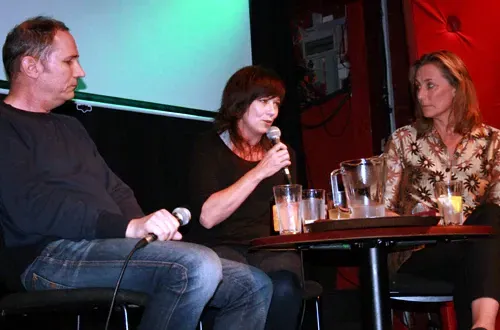
“As a director I am not just sucking up here but I cannot tell you how much I value editors,” said MC director/writer Leanne Pooley as she introduced editors David Coulson (Whale Rider, North Country) and Cushla Dillon (Beautiful Machine, This Way of Life) at the April Script to Screen Writer’s Room.
“There is only one crew member named in my contract and that’s the editor I like to work with because what an editor brings to a film is so important. As a director, I know there is a relationship that has to happen, one that is key to the film – it’s rather like a dance you do together and you have to find each other’s rhythm.”
A capacity crowd at the April Writer’s Room (co-hosted with the Screen Directors’ Guild) were treated to an intimate insight into the role of the editor as the ‘invisible storyteller’, the fashioning of the ‘final destination’ product … and some good advice about letting writers into the editing suite.
Leanne began the evening by asking David and Cushla what they bring to the table at the start of a film.
“Talking about the editing process is strange for me,” said David. “Because it’s somewhere between a reflex and something intuitive that I do, between breathing and brushing your teeth, so it’s curious to talk about this activity. I guess the editor must bring a sense of what the final intention of the project is and no matter how long that project is, there’s the underlying idea that you are creating a piece of communication that will be received by a large audience. You’re fashioning that ‘final destination’ product and the process of doing this is long and laborious but rewarding. You are the audience’s representative, defining what the end result will be.”
When asked how much of that ‘final result’ is apparent during the first read of a script, David said, “It varies. Some scripts are very prescriptive and evocative, itemising things that are seen and heard. Others might be more open ended and then there is the director’s interpretation of that script.”
Cushla said she brings her eyes and ears to the table. “I listen to the director and the material. My job is to negotiate between the imaginary audience – always with me in the edit room – and the director to make sure the audience remains connected with the story and the characters. It’s an emotional connection to the story. The audience can’t be thinking while they are watching a film. They have to be feeling because if they are thinking, then they are disconnecting. They can think about the film when it’s finished. Editing keeps that connection.”
As a screenwriter too, Cushla said she found it a challenge keeping the editor out of that process. “I find it very hard. As a writer, the words I am writing will be exploring a character and then the editor comes out and says ‘cut cut cut!’”
It is a soul-destroying fact that much of the dialogue actors have painstakingly rehearsed can be cut from a project because the words are not conveying the story.
“Bad dialogue dies!” said David. “Dialogue can be interesting because it can be said differently by different people or even by the same person. An actor may speak a great line but it may not be that good in the final analysis.” Cushla added that a clunky line in a script can be delivered well by a good actor. “Dialogue is all about rhythm – the rhythm the writer creates with the words, then the actor puts in theirs and an editor needs to get in sync with all the rhythms in a film because we all want to be on the same song.”
When asked how much an editor will refer to the script in the editing suite, Cushla said that when the rushes come in, the script is ushered out the door. “It doesn’t exist any more, it’s redundant and there’s no need to refer to it because it’s all there in the footage.”
Tough words for a scriptwriter to hear but David agreed, saying that the script had brought the project to the point of being shot and its job is done. “The only time I refer to the script is when I cannot figure out what is going on – and that means there is a problem, something’s not clicking here and that’s not a good sign. I read the script multiple times prior to shooting and am often involved in the final honing of the script so it’s not like I don’t know the story and situations.”
A clip of the opening scenes from Cushla’s documentary This Way of Life was shown and she described how the images were not scripted but selected to set up the main themes and characters for the film the audience is about to see.
“The story is about a man’s desire to live life according to his integral values,” she said, “and one of the strongest ways of conveying his character is through the loving and educational relationship he has with his son. It’s all about seducing the audience, when you are constantly surprised by a character and what they do. I chose this clip because it challenges the stereotype of a hunter as violent, monosyllabic. This is not what you see here. Peter is thoughtful, intelligent and cares about the deer he slaughters and these clues are here in this first scene, clues to the journey the audience will go on. These hunters shoot deer for survival but you may be surprised at what else you will see here.”
David had chosen a clip featuring the opening scenes from North Country.
“I see the beginning of a film, script or book as a critical transaction. Beginnings are ways of determining if you are going to be in safe hands.
“In the editing process, it’s important to think about not only what you see but also the subtext, the meaning, behind the images. In the script some of the key ideas you see visually in this clip speak to the themes of the movie as it progresses. For example, the scriptwriter noted a little girl playing with a naked Barbie doll. Thematically that is to do with the objectification of women. The deer in the back of the vehicle was also itemised in the script as a detail speaking to the universe that this film is going to be occurring in and the themes it will deal with. The little girl in the scene was four years old and the only way to achieve authenticity was to be very discreet. The child was oblivious to the fact that she was being filmed, so you’re using documentary creation skills, trying to find the appropriate images that will fulfil the story intent. It was filmed very accurately and intelligently. There was a lot of material that had to be distilled down to find the rhythm and the way for it to play.”
That word ‘rhythm’ surfaced again and Leanne asked the panel if they look for the rhythm the writer brings to a script or that which they can bring?
“My response is purely to the material,” said Cushla. “The script is just a plan or a draft. I read a lot of scripts and when you read a great one, words just roll off the page and you don’t stop and think about how it will all come together. The writer has written a great script – and here’s a tip for writers! Read good, well written scripts, look at how the writer inserts the details without dictating to me how I will cut a scene. I look at how the images respond to each other, taking time to consider and meditate on all the images and the work of the craftspeople involved in the shooting.”
David does not let the writer into the editing suite.
“The writer and I are fundamentally connected, the two processes are inter-related, but when I am working in the suite, that ends. It would be like inviting a thoroughbred horse into a slaughterhouse because what is going on in there can be mercenary and seemingly destructive. I take scenes the scriptwriter saw at the end and put them at the beginning. I’ve chopped scenes in half and put them in different places. It’s the last stop before this thing rolls out the door for the rest of its life so you have to be open to some of these seemingly destructive possibilities because new things that might not have been envisaged can come from that.”
Cushla said she has been in the room when a writer has been brought in to witness the process,
“… it hasn’t been pretty and my heart goes out to the writer. More experienced writers are well aware that they are just part of a process but for new writers it can be quite hard. The bottom line is that we are all trying to make the best film possible. Everyone involved from funding to editing wants this and in the editing room you are dealing only with the film, not the script, so the writer is redundant at that point.”
Leanne opened the floor for questions and the first focussed on the director and the extent of his or her responsibility to honour the script before the editor begins their work.
“We always honour the process,” said David. “Someone has written something, then someone has filmed it and then we need to put it all together. To do that, we have to stand back. The script exists only on paper and it doesn’t have the cadences and rhythms of actors speaking or the extraordinary shots that make up a film. The script is the navigation point and we all attempt to faithfully re-create it.”
The panel was asked if the style of editing has evolved over the years to meet the changing demands of audiences.
David replied that the technology and the consumption of visual material by a mass audience have changed.
“Storytelling has changed as a result but there are certain fundamentals that haven’t. For example, you can watch a short music video and find it totally compelling and then see something that is two hours long, put together using music video techniques and find it an unsatisfying thing to watch. So whilst durations may have changed, the need to modulate the internal dynamics of the story during the creation process has not.”
The panel was asked to define the boundaries when an editor is working with a writer/director.
“The editor’s role is that of negotiator,” said Cushla. “I see myself as the audience’s representative. I’m there to interpret the material I see so that it honours the script and the intent of the director but I’m also there to negotiate with the writer/director. If I think they’re not using the best technique to communicate or are a bit misguided, I’ll tell them. For new writer/directors, there is so much to learn and it is an intimate relationship based upon trust. Leave your ego at the door because we’re all here to honour the film and the story it tells. If things don’t work out it doesn’t mean you are a bad filmmaker but let’s use the skills we have to make the best film we can.”
David responded that it is different when the writer/director is there. “It’s hard to generalise because everyone is different but it can be tricky. Some writer/directors I’ve worked with are obsessively protective of what they’ve written and some are the opposite. We can come to a fork in the road: re-interpret a film and make it a good one, a different one, or do the best we can with an idea that really isn’t the best. Every decision that is made in the room has to be dealt with as dispassionately and yet as emotionally as possible, and that is a weird thing. I use humour in the editing suite, especially if the process is gruelling.”
When asked if directors tend to ‘micro manage’ the editor, David said, “If it is a feature film I like to feel that I am about one or two weeks behind the director. I think that is a good time for the director to go away, have a lie down and get over the process they’ve been through. If it is a short film, shot over a week, I expect to be only a day or so behind only. The important part of my process is to keep the director reasonably oblivious to what is going on in the editing room so that when they do see it, I can surprise them with things they might not have envisaged because I have approached something in the script a different way.” Both Cushla and David said they put up a ‘red flag’ right away if they see something going wrong in the rushes.
The editors were asked to share their ideas about working with sound and music.
“I used to have strict rules about no music in the edit room until I had sourced the inherent rhythm for the scene,” said Cushla. “I felt music distracted me and made things appear to be working when they weren’t. You try to keep as many doors open as you can during the process and I felt music could take me in a direction that was closing doors, not keeping them open. But I have changed my mind and I see music as something which can really blow a scene open, bring a new way of looking at a character. I think this is due to having more confidence and knowing when a scene is working and when its not.”
David expressed an initial caution about using too much music. “Music can wallpaper over serious architectural deficiencies in the material. But sound is the hidden weapon that I now use all the time to underscore, to effect the way we want to be seeing something. In the North Country clip we saw earlier, when the female character is leaving the house, I was cutting the picture forward in time so before you actually saw the house door close we were cutting to the vehicle. Tiny things, but they add a subjective disquiet to what is going on. Even at the script stage, the idea of sound needs to be present in what you are writing. When I read a script, I like to feel as if I am in a movie and a good script will take you through the page and submerge you. You are creating a world and sound can help evoke the experience of what the movie is going to be.”
And last pieces of advice for writers?
“Read lots of scripts,” said Cushla. “If it doesn’t work on the page then it will fall apart in the editing room.”
“Reading scripts is a useful tool,” said David, “especially films that you admire. Reading great work is important. It comes with the territory. When I read a script, I am oblivious to acts and transitions and turning points because I am engrossed in the film.”
“It’s all about trust,” said Leanne, “every step of the way. You need to make sure you are working with an editor that you trust because you are entrusting them with your baby.”
- Auckland Writer’s Room, 24th April 2012, transcript written for Script to Screen by Jane Bissell.
- Listen to the podcast.