The Happy Couple at Toi Poneke
Written by
Making a Splash - Courtesy of The Dominion Post - August 18
By Mark Amery
Playing with ways to describe the art world visually in diagrammatic form, the best I've thought up is a drawing of overlapping circles within circles - like crop circles, or the ripples the first plops of rain make on the surface of a puddle. Such a diagram might seek to illustrate how, no matter which pond an artist resides in, or however many rings in towards the epicentre they are, they always feel an outsider.
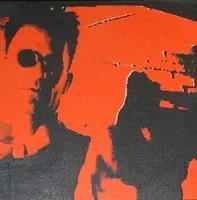
Image: Johnny with a gun (detail), 1997, by Bruce Mahalski in The Happy Couple at Toi PonekeMaking a Splash - Courtesy of The Dominion Post - August 18
By Mark Amery
Playing with ways to describe the art world visually in diagrammatic form, the best I've thought up is a drawing of overlapping circles within circles - like crop circles, or the ripples the first plops of rain make on the surface of a puddle. Such a diagram might seek to illustrate how, no matter which pond an artist resides in, or however many rings in towards the epicentre they are, they always feel an outsider.
Image: Johnny with a gun (detail), 1997, by Bruce Mahalski in The Happy Couple at Toi PonekeThat there will always be artists who are more on the inside than them - either within their own circle, or in another ripple they don't feel a part of.
In a small but lively capital city where most art dealers and institutions have a national agenda it's easy for a wide range of Wellington artists to feel on the outside. Yet after years of grizzles over the lack of space for Wellington artists, in recent years we've had a veritable flood.
While Michael Hirschfeld Gallery presents a broad selection of the best, spaces like Enjoy, Show and Massey's Engine Room showcase contemporary artist projects' unable to be supported by most dealer galleries. Thistle Hall provides a quality community gallery space, and ROAR! Gallery seeks to promote those actually dubbed outsider artists. All probably feel they sit outside of things in some way of other.
Then there's the rather smart council-run Wellington Art Centre Gallery, newly christened Toi Poneke. It celebrates its first anniversary this week. Artists pay to hire the space and exhibitions run fortnightly, with curatorial and promotional assistance available.
The fact that its booked up well into the New Year, programming is by application to a panel of visual art professionals and that the shows I've seen have generally been well presented and engaging, if not outstanding, suggests that this new space is also most welcome.
Meanwhile upstairs one of the centre's artist studio spaces, Studio 29, has recently turned into a small experimental project space. Currently only available to those with studios at the centre, it acknowledges the value of having a less public space to try out installation ideas.
Fifty percent of the programming at the gallery is reserved for the 36 artists who have studios upstairs. Note very few of these artists have dealers or strong established reputations. A year in, Toi Poneke has proven most attractive to artists looking for a community. Studio complexes with an attendant gallery space are crucial support networks in any healthy city, but I think it's worth emphasising given that this is a council run space that it will only likely ever suit certain sections of the artistic community. Artists feed off their independence and deserve support in independent communities across the city.
I suspect Bruce Mahalski feels like an outsider and likes it that way. Also a commercial designer and illustrator, he's been exhibiting in all manner of Wellington spaces for the last ten years on the outskirts of things until last year's first dealer gallery show at Mary Newton's.
The photograph that gives his current survey exhibition with Stefano Tevaga at Toi Poneke of work from the last 10 years its name, The Happy Couple, is a great take on the iconic American Gothic by Grant Wood. Pitching a couple feet firmly planted in front of their plain state house and section, sheeps' heads superimposed on their own, it's a delicious neat twist on both New Zealand's photographic and societal traditions and expectations.
The influence of Andy Warhol looms large with Mahalski, as he reasserts the validity of being a pop artist with a satirical punk spirit. Driven by environmental and political concerns, his social commentary and co-option of design with the use of wit and collage isn't so different from the British artists of an earlier era, always able to distance itself from the polemic by giving symbolic power to the object .
Combining McDonalds marketing with plastic guns, or creating an anarchy wreath out of plastic flowers and kids' play police truncheons, swords and rifles, the message is blatantly clear - sometimes it can be a little "all icing and no cake" as Mahalski himself describes his '80s band Crystal Zoom - but the concerns remain current, the work smart. Mahalski creates glittering shrines to suggest we worship false gods - money, consumer goods and guns.
The work is most enduring for me when an individual enters the frame. An abiding theme throughout is the different ways we imprison ourselves. There are photographic dramatisations focussing on misfits, with enigmatic snatches of monologue, such as the wonderful 'Rob', a colour-saturated image of a bowed man seen through prison bars. The short first-person stream of consciousness text that accompanies it (suggestive of a child's voice) talks of building a cell wall on wheels because "Anna's brother is going to jail" and that he has a shotgun under the bed, "but I don't know if it went."
Painter Stefano Tevaga is a studio colleague of Mahalski's upstairs and the strongest connection between these quite different artists' work is an interest in championing the importance of the individual to question their place in the world. It's summed up in Tevaga's portrait of a tattooed Samoan boxer, eyes looking up into the black full of hope.
Tevago's figures stare out as if in a dream-like reverie with a great raw emotional energy. This promising painting retains strong links to Samoan culture. It employs a bold use of colour and line and play with the roughed up surface of wood to suggest individuals squarely facing up to the fight of life.
The Happy Couple, Artwork by Bruce Mahalski and Stefano Tevaga, Toi Poneke, until August 24