The gift of sound and vision
Written by
By Mark Amery Courtesy of The Dominion Post 11/5/07
Gathering together recent Wellington cover art work and music videos, Radio With Pictures at Wellington's Michael Hirschfeld Gallery reminds us that that the independent art and design tradition has been well and truly alive with local music of late.
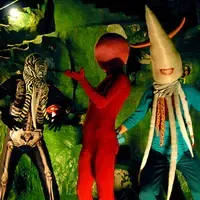
Image: Still from "Konked Out" by Mëstar, directed by Louise Clifton, 2007.By Mark Amery Courtesy of The Dominion Post 11/5/07
Gathering together recent Wellington cover art work and music videos, Radio With Pictures at Wellington's Michael Hirschfeld Gallery reminds us that that the independent art and design tradition has been well and truly alive with local music of late.
Image: Still from "Konked Out" by Mëstar, directed by Louise Clifton, 2007.Ian Jorgensen's video for the Ghostplane song "Straight and Narrow" has been a favourite artwork since I first saw it on C4 in 2003, and Taiki Waititi's work for the Age Pryor album Shank's Pony is one of the most engaging drawings I've seen this year.
These are two examples of why it's unwise to fix firm boundaries between what we consider visual and popular art and design.
Jorgensen (better known as Blink) has made almost 50 music videos without the respective bands' knowledge. Rather than finding images to match a song, in a simple yet brilliant conceptual switch he finds a song to match images he has taken. He then makes first contact with the musicians with a completed work.
In the case of this work, he shows the eye of a great documentary filmmaker, joining the very young and old in the free, ungainly movement of their dancing to a jazz band at Melbourne Zoo.
Waititi meanwhile provided his powerful apocalyptic vision of a city crumbling into the sea with office furniture floating skyward (almost a reworking of Joni Mitchell's drawing for her album The Hissing of Summer Lawns), in return for the use of a Pryor song on the Eagle vs Shark soundtrack.
There are, however, numerous reasons why video and cover artwork is, more often than not, compromised as art. It's wrapping paper after all. It often trumpets its fresh quirkiness to get noticed and be taken in quickly on the shelf; like badly devised theatre work, the band members' kooky ideas can all be stuffed in there, jostling for attention; or a record company wants the band's faces out there.
Yet there's a strong independent tradition in New Zealand music whose post-punk rise, led by Flying Nun artists, looked to rip up and collage ideas around cover art and design, coinciding with a growth of opportunities for music video broadcast. We have a rich heritage of largely unheralded visual work in this area, and true leading artists in the field like Chris Knox, Stuart Page and David Mitchell.
The exhibition gives a special privileged place to Second Fake Capricorn - a work by Campbell Kneale (Birchfield Cat Motel) which you'd be pushed to call a music video. What's on screen feels like just another stream or texture in the fabric that is principally sound. The flickering visuals are like a stretched surface scorched and stressed by the sustained driving chords of the guitar and bubbling percussive elements.
I'm reminded of something as primordial as a cave wall or as tactile as the charred remains of a film strip itself. This video is more like a device to encourage you to consider the sounds spatially, letting go of your expectations of time and musical structure.
You can then take a bean bag and watch a selection of music videos projected up large. The selection encapsulates the different strands of music video work, and also highlights how contemporary visual artists are inter-relating with the media.
Firstly there's your stock live gig montage, with the camera as documentalist and the performance captured on camera as the art. Daniel Campion captures art-rockers Cortina going through the farcicial motions of a rock concert as if it were the dirge-like ritual type of a religious sect.
Then there's your stock vaudevillian style band portrait - the group walking or playing through a series of overtly flimsy and quirky theatrical sets and scenarios. Videos for Charlie Ash and Cassette feel tired in this respect - they could have been shot any time in the last 25 years.
Another type is the lipsynching singer placed in front of a collage of elaborate folding and unfolding worlds. Julian Bryant, Nick Marrison and Jessica Cowley's clever video for Age Pryor is a case in point, but there's a genuine sense here that the world created is one representing something within the musician's head.
A common device used to tacitly acknowledge that the music video is principally about promoting the musician's image is to treat the musician themselves as art object (the video for Peter Gabriel's "Sledgehammer" a famous example). Luke Buda does this quite literally in his gorgeous pastiche of a '70s Abba video, where he is shown playing a guitar which is a double of himself that he's (with difficulty) holding.
Taking this device to full realisation as artwork is Luke Savage's extraordinary video for Sam Flynn Scott's "War Over Water". Like a Chris Knox homage, Scott's face is put through a photocopier, a shredder and then collaged back together, the chugging Johnny Cash base line in rhythm with the photocopier scanner. Not only is it beautifully executed in every way, it finds a way to reflect powerfully on the role of the promotional image itself. Like Jorgensen's "Straight and Narrow", it's an example of a filmmaker able to push a strong concept through to fine artistic realisation.
The small gallery annex is devoted to cover artwork, and it feels a little spare given the amount of strong local material available. A bigger exhibition is deserved.
Whilst it's interesting to see larger prints of cover art and the originals versus reproduction, this work wasn't created to be viewed in this way - a fact emphasised by its display here also in compact disc format.
With the increase in digital downloading, the imperative for cover artwork to provide added value becomes even stronger. In the CD format, with the jewel case providing a series of frames, it's a personal memento for the purchaser, like a contemporary equivalent of the miniature portrait painting or photograph.
I've been thrashing the Lawrence Arabia album on my laptop, but I'm still yearning to go out and buy it encased by Louise Clifton's excellent artwork.
Radio With Pictures, Michael Hirschfeld Gallery, until 27 May