The Fest Test: Artists in charge
Written by
The latest Auckland Arts Festival blog from Mark Amery
For the last leg of my week at the festival I've ditched walking, busing and cycling for that more traditional mode of Auckland transport, the car.
Clearly I'm blatantly rebelling against White Night's beautiful and successful effort to get people into buses, but the physical extent of the programme for the critic is such that, even taking in an inner city loop, I'm doing some drive by tastings.
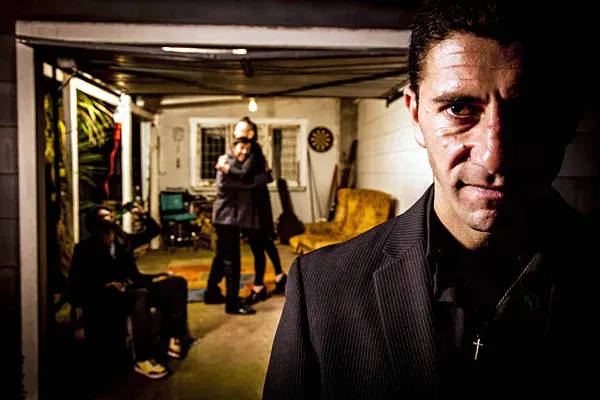
First though its a trip in from Dominion Road for the premiere of Mitch Tawhi Thomas's play Hui at Q, an event I was simply not going to miss. I was well-rewarded.
Hui is the sort of well-made play given a fairly conventional stage setting I hadn't yet seen in my Auckland Festival journey. Beautifully drawn characters bringing a family drama to a surprising but fitting ending (Paul Bushnell of RNZ's Festival Review begged to differ, but I couldn't disagree with him more on this point). Director Rachel House has drawn beautiful performances out of her cast, and the story is well-paced. The violence embedded within this whanau, as they are reunited in their old family home and struggle with their father's death, feels disturbingly real and credible. This is a story that needed to be told, and its beautiful to hear Mitch's voice in it loud and clear. It will be interesting in the future to see it given different productions, as my one criticism is that in its design its power felt quite contained by the Q Theatre mainstage - as The Factory the weekend before did.
White Night was testament to what this festival has achieved in terms of Aucklanders taking it to their hearts. The dealer galleries of the CBD and Parnell were chocka, doubtless with people who rarely step in their doors. The streets were full of activity: in effect a very large party going on. I found myself wondering about the whole concept of it lasting one night - no one person able to see more than one part of it. Yet, like the projects that returned for this night from last year's Art in the Dark programme, there's no reason why some of this activity can't happen again under its own steam. The intensity of one night gave the whole event a carnivalesque sense of the world turned upside down - in the night's best moments artists had taken over.
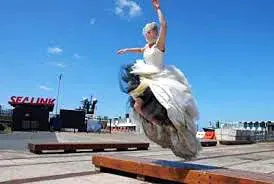
I started at Silo Park, where in one of the giant silos there was a live soundscape, performance and projections that played visually and aurally with the hard industrial resonance of the space (I didn't catch the artists' names). The entire giant silo became a resonant chamber of sound and light, that in aesthetic played thoughtfully with the materiality of the space. Stepping outside I entered for 10 minutes or so the promenading, visually splendiferous 1000 Lovers. Flag waving dancers and long train gown wearing-figures drew us by the wetland creek, the impressive gantry and on along the waterfront of the Wynyard Quarter. A friend loaned me their MP3 player for the soundtrack, complete with film of a native eel swimming. I could have done without it - I found the work's reliance on recorded rather than live sound dulling. The work operated by forms of choreographed visual semaphore, impressive in its design and strong style, and yet I felt unmoved. But really, that's a quick impression to be taken with a large ladle of salt given I only popped in along the journey. As a work that took us on a walk through Auckland's ecology and history it fitted snugly into this festival's city-mapping focus. This was a festival all about making Aucklanders more grounded in their city.
Up Parnell Rise and its clear from the impressive roll out of fairy lights that the Parnell Business Association has made a wise and substantial investment in White Night: the street is humming, student work down alleyways, fully white-stockinged bodies lurching down the street (a little been there done that, but a talking point) and some good to ho-hum installations. There were two standouts for me. Firstly, Kathryn Taylor and Jon Baxter's Globe in Park allowed the public to use a series of levers marked 'development', 'control' 'nature' and 'chaos' to change the look of the planet, and eventually cause Armageddon. It was sonically and visually arresting, as if lightning was crackling off the surface of the orb. Up top of the Rise in front of the impressive entrance to Parnell Cathedral Interrupt Collective and Kim Newall used two giant searchlights to powerful effect. Wavering in the night sky as a cross, like giant light sabres before the church, when you walked between them down a runway pathway of lights they dramatically swung down and over the ground, as if you were disturbing some psychic religious force.
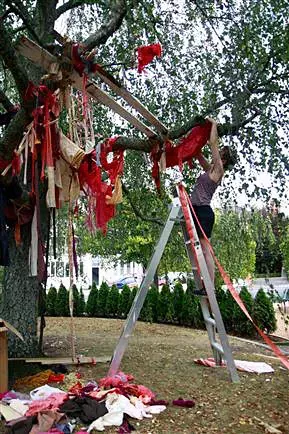
I drive by Tiffany Singh's installation in a tree next to the gorgeously lit Auckland Museum (clearly doing great business given the lack of car parks). There's a stiff warm breeze and wind chimes on ribbons under coloured lines are making an impressive racket. Its all rather beautiful.
I can't believe what the Auckland Council allowed ELAM students to do the city's central library. With their group installation That's Funny (and it was) they've gloriously run amok. A large area of carpet has been ripped up on the ground floor, and unceremoniously dumped on the first. In its place is a wonky mini putt course cum dodgy set of sculptures. Kids have drawn around it in chalk. Potted native trees have moved onto the top floor, and video interventions on computer displays are like consumerist avatar viruses. A display of learn-to-play the piano books is accompanied by a synthesiser to play along on. A bronze bust of a former dean of ELAM has been moved to centre stage. Most work shows all the hallmarks of student work - cheeky experiments which don't hold you for long but are entertaining en masse.
My favourite work was by Salmoe and John Tanuvasa. The pair invite you to choose a greeting card from a book display. Inspired by floral greeting cards from the library's collection, John has created abstract fabric patch covers, and Salome has matched them with enigmatic often amusing texts inside. Outside the students have had issued 100s of books which they have laid, opened, as a snaking pathway from the library up the hill to AUT's St Paul Street Gallery, some 300 metres away. They flap in the wind. Book lovers may wince, but it's a novel new way to read the city. Up by St Paul Street AUT students are gathered around Marcel Allen and Renne Warner's interactive projection. You dig your hand into some soil, feel for a seed and then push it down, to see it then grow into a plant on the big screen in front of you. A cute piece of instant growth, if not exactly complex.
It's 11pm and I head to a busy festival garden in Aotea Square. The thespians are still celebrating the opening night of Hui and we swap notes on shows we've seen, a buzz in the air from Everything's Ka Pai and a general good feel about the festival. I finally bump into artistic director Carla Van Zon, a neighbour from the Kapiti Coast. She looks suitably pleased, relaxed even. For a first festival two years into the job she's made great progress. This festival felt like a real turning point for the city.
I write now the next morning safely ensconced back home in Paekakariki, north of Wellington. Two beehives have arrived in my absence, and artist friend Tao Wells stumbles out of the sleep out, recovering from a wedding and dance at the local hall and early morning group skinny dip. We make up our own fun back here. There's welcome rain and an abundance of grapes dripping down above the deck. Its good to be home. If you're in the neighbourhood come and grab some.
Till next time Auckland, I love you, thanks for the party.