The Expectant Branch - Len Lye's Water Whirler a deciduous form
Written by
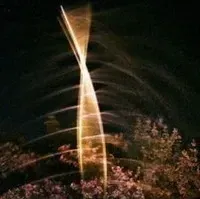
by Mark Amery Courtesy of The Dominion Post 19/5/2006
Len Lye's Water Whirler currently stands still. You'll see passers-by hanging around on the harbour edge in Frank Kitts Park at its appointed hours of performance hoping it might magically spurt back into life. Many, I'd venture, like me still have its seductive dance routine ghost dancing in their heads from their last encounter. Promise and expectation, its unpredictability due to weather and technology, are all part of its glorious tension. by Mark Amery Courtesy of The Dominion Post 19/5/2006
Len Lye's Water Whirler currently stands still. You'll see passers-by hanging around on the harbour edge in Frank Kitts Park at its appointed hours of performance hoping it might magically spurt back into life. Many, I'd venture, like me still have its seductive dance routine ghost dancing in their heads from their last encounter. Promise and expectation, its unpredictability due to weather and technology, are all part of its glorious tension.This tall nodule-covered black wand, mounted on a sleek, urbane Athfield Architects designed jetty, gently leans its long head out like a bare branch before the first flurries of winter weather, as if signalling the end of growth for another year.
The Whirler's not whirling currently due to mechanical problems, yet it still asks to be romanced as a poetic object - and its an offer I'm not alone in being unable to resist. Romanced in the way machines and the modern pace of life were by the European Futurist and English Vorticist abstract artists a century ago. Recalled in Water Whirler's form and movement, Vorticism was originally in fact a theory advanced by Descartes that saw the universe as a space filled with matter growing in ever increasing circular motion.
As a young man Lye read of these artists in the nearby Wellington public library only a few years later. It was in this city, with his head both in books and with the forces of nature at play between the hills and harbour, that Lye started to think about the idea of composing motion as one composes music - a principle he would go on over his career in London and New York to apply in his films and kinetic sculpture.
The fact that Water Whirler's having mechanical problems won't surprise Lye followers. Despite the Len Lye Foundation's years of testing and creating prototypes based on Lye's drawings and detailed descriptions (of the choreography and sensation of it as much as the look of it), his work has always tested existing design knowledge. In the 1960s, biographer Roger Horrocks reports art dealers were nervous of Lye's works' potential for failure. His was a life of constant experimentation, pushing beyond the bounds of what was previously practicable.
Lye was that tricky double act that helps makes him a great artist: perfectionist and dreamer. He wasn't interested in cutting corners, yet he was also completely out there in a rather big way when it came to his expectations. A version of Water Whirler can be seen in one of his sketches of grand environmental sculpture park ideas as one of five giant kinetic water sculptures situated lily pad-like in a lake surrounding a 'temple of lightning'.
For this pottiness and drive we should be grateful. His gift to us, taken on board fully by the Len Lye Foundation, is his charge to realise art's place to push us beyond our conceived limits. The huge investment in Water Whirler is welcome recognition of that, and part of the spirit of that art is constantly overcoming failure. Mechanical failure and the need to keep twiddling needs to be seen as an integral part of the Lye package -his work's energy is life as a constant reaching for new ideas, a perpetual work in progress.
The public realisations of Lye's vision are in many ways tame selections from Lye's visions. Witness the ferocity of sculptures like Storm King or Two Flips and a Twister for the full force of his ritualistic dances with natural energy. New Plymouth's Wind Wand is all loopy Dr Seuss cartoon in comparison, and while Wellington's Water Whirler's complex dance routine is full of disarming arching, rotating and spurting sexual shivers, shudders and climaxes, it charms rather than ever frightens.
Lye was fascinated by springs, and his kinetic sculptures often seek to emulate the same flex and strength he saw in nature. That Water Whirler could be said to resemble DNA strand is no accident. I love how it works so hard to have all the tension and flex, nay muscularity, of a branch of fern or a dazzling fish jumping, and then dancing, above the water.
It also can't help but recall Lye's memory (as found in Roger Horrocks' excellent biography) on the Wellington waterfront of sketching a "drunken old salt" swaying back and forth, "sleeping, dreaming of some swing under some faraway tree". The man promptly fell into the harbour, changing "from a rock into a propeller, spinning down into the sea". Lye jumped in after.
Len Lye was often described as like a spring - a wiry dynamo of energy, who had trouble staying still. Water Whirler is in a sense a self-portrait. Friends recount the way Lye literally danced walking down the street. American film colleague Cecille Starr recalls how in lectures he danced out his thoughts, "twisting and turning himself around in a kind of syncopation to the ideas."
The work also takes me back to the early modernism and the futurists he discovered in Wellington library. This elegant dancer is reminiscent of Marcel Duchamp's Nude Descending a Staircase. Water Whirler is very much a product of last century, and of kinetic art of the 1960s in particular.
Lye jokingly called himself an artist for the 21st century and, in a funny way, he's right. The wider public are now ready for him, his sculpture having a theme park exhibit attraction. We get a visceral thrill from the lights and motion of all the fun of the fair. This doesn't make Water Whirler any less impressive, but yet I'd suggest it does signal (as does much of the recent public sculpture in Wellington) that we're not far off the end of an interest as a society in art in public spaces dominated by singular upright monuments.