The Clinical Gaze - Neil Pardington at Bartley Nees
Written by
The Clinical Gaze - Courtesy of The Dominion Post 25-11-05
New Photographs from The Clinic, Neil Pardington, Bartley Nees Gallery, until December 3.
By Mark Amery
Neil Pardington's photography provides theatre. The actors are absent, but everywhere there are traces of past presence and detail loaded with the promise of their return. But an empty chair or operating table is there, asking the viewer in the present moment to jump up on stage.
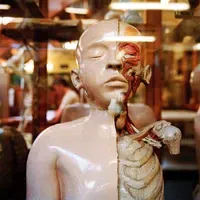
Image: Anatomy Museum #4 from Neil Pardington's The ClinicThe Clinical Gaze - Courtesy of The Dominion Post 25-11-05
New Photographs from The Clinic, Neil Pardington, Bartley Nees Gallery, until December 3.
By Mark Amery
Neil Pardington's photography provides theatre. The actors are absent, but everywhere there are traces of past presence and detail loaded with the promise of their return. But an empty chair or operating table is there, asking the viewer in the present moment to jump up on stage.
Image: Anatomy Museum #4 from Neil Pardington's The Clinic
Pardington's ongoing photographic series The Clinic has, over the last couple of years documented the interiors of hospitals. In his current exhibition at Bartley Nees Gallery there are empty but functioning operating theatres, dissection and postmortem rooms and an anatomy museum.
Typically, we enter these rooms having ceded control, numbed, unconscious, dead or dying. Pardington's temporary control of these environments, freezing time with the camera, allows us to gain perspective - entering them conscious to reflect on our lack of control in life: we decay, we die, we put our lives in others hands. The enormous elegance of equipment cantilevering down from the ceiling above an operating table for example is made uncanny by photography, hovering above full of both the menace and edge of comedy you'd expect out of something out of Star Trek. Every dental surgery should have a Neil Pardington print in reception.
This is a strong contemporary take on the tradition of vanitas - art that provides the opportunity to meditate on our own mortality. There's even that ultimate vanitas motif, the skull in images of an Anatomy Museum. You enter the frame to move around the room, imagining turning it over in your hands.
Yet in any individual work there are multiple twists on this theme. These interiors are chambers chilled for meditation, with objects within providing focus for contemplation. One single image in the anatomy museum features skulls on tables, several clocks, cabinets full of crude, battered and cracked anatomical models, and plaster reproductions of classical nudes in vigorous poses, surrounding a thriving pot plant. The only living thing in the room other than the pot plant is a fine dance of natural light across furniture and fittings.
WITH THEATRE, past events often charge up the present, propelling us with the characters into the future. In Pardington's photographs there is past and future in this way, but no present. Yet Pardington's photographs are not marked by absence but rather the presence to be found in absence. He follows in the shadow of Laurence Aberhart and his photographs of interiors in this regard.
Put figures into these images and all the drama would be driven out. These scenes are too distracting with stories of their own to be film sets, yet too real (not stagey enough) to be stage sets.
God is in the details, they say, and it's in Pardington's attention to detail that he attempts to capture the dancing traces of what it means to be human. Hospitals might appear cold and empty, but are ultimately places of urgent fundamental human transition. Surely, they are where the spirit is at its most visible. Here, more than anywhere today we hope and pray. Pardington's nothingness has a theatrical poignancy akin to that of Samuel Beckett, with Beckett's accounts of people in stasis, waiting for death symbolic of life's journey for everyman.
Photography is inherently about time because it freezes it. These works are shot with a four by five view camera on a tripod, each individual image recorded on a single sheet of film. These images take time to create then. It's as if they suck the present out of the frame.
In some images the rooms remain inert and lifeless to me, in the best future and past in the detail charge up the present. In a postmortem room for example, you speculate on the history of a large stain on the floor, a couple of rocks placed near a drainage hole, and who might use the empty coat hook on the wall. In this way you're invited to enter, inevitably becoming the image's missing figure.
Pardington subverts this idea in one new image in this exhibition, and I'm not sure it's successful. Presenting a huge body scanner, he takes the step of typing his own name, a date and time so it appears on the monitor screen that hangs above. Like an artist signature, it is suddenly as if the present has been filled in and we're prevented from entering the frame. Likewise, in another image a row of skeletons stand before us in a Dissection Room like sentries, preventing our passage into the space. It's a clever, amusing image, but it keeps us on the outside and has the appearance of being staged.
Elsewhere there's a subtler inherent tension between staginess - with objects shifted by the artist for maximum effect - and believing an environment has been photographed as found. Were the skulls sitting on the tables in the library like this, like macabre pencil sharpeners when he arrived?
I don't actually want to know whether Pardington, like some crooked forensics expert makes adjustments to his scenes for effect. I'm willing to believe in scenes this complex and trust the artist's sight because the strongest works with time spent provide such a rich meditation on life.
With The Clinic Pardington has shored up his direction as a contemporary artist. He's founded his own theatre. It calls on his experience as a designer and filmmaker -visible in his ability to find a strong structure in a cluttered room with a choreography of big and small detail - but ultimately sees him finding depth and mystery in-between.