Te Waka Toi Awards 2014
Written by
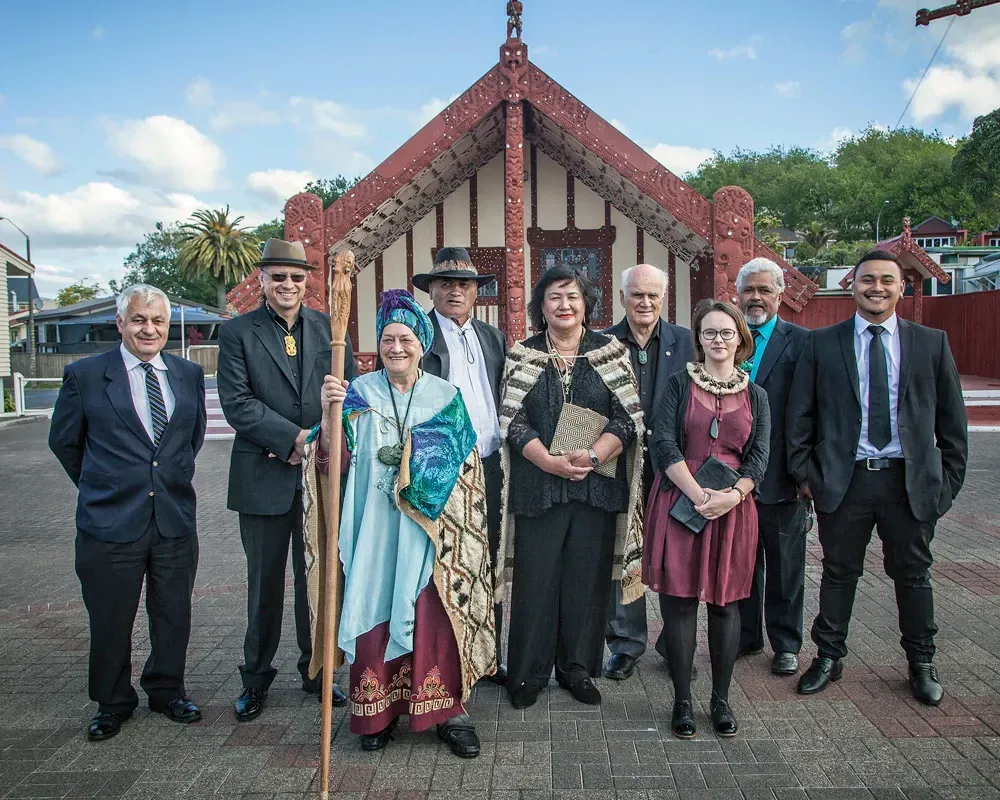
Tohunga, artists and community leaders have been honoured for their contributions to preserving and promoting the future of high-quality Maori arts.
The Creative New Zealand Te Waka Toi Awards, held in Rotorua on Saturday 29 November, celebrate the lives and successes of nga toi Maori (Maori arts) practitioners and advocates, and serve as a springboard for emerging artists.
Established in 1986, the annual awards are the only national Maori arts awards that celebrate all artforms, with awards that recognise leadership, outstanding contribution, excellence and potential in nga toi Maori.
Supreme award
Renowned Maori visual artist Sandy Adsett, MNZM, MMVA (Ngati Pahauwera, Ngati Kahungunu) has received the supreme award for exemplary contribution to nga toi Maori, Te Tohu Aroha mo Te Arikinui Dame Te Atairangikaahu. Mr Adsett is a painter with experience in carving, weaving, costume and stage design. His impressive influence and artwork can be seen in many community buildings from meeting houses, churches, art museums, government and corporate venues as well as private collections. Mr Adsett exhibits nationally and extensively throughout the Pacific, Australia, Asia, Africa, Europe, Canada and the United States.
Making a difference to Maori arts
Te Tohu Toi Ke has been awarded to the multi-talented Professor Derek Lardelli, ONZM (Rongowhakaata, Ngati Porou) for making a positive difference to nga toi Maori. Professor Lardelli is a ta moko artist, painter, carver, kapa haka performer, composer, graphic designer, researcher of whakapapa and oral histories, and kaikorero.
Strengthening the Maori language
Dr Apirana Tuahae Kaukapakapa Mahuika (Ngati Porou) has been awarded Te Tohu Aroha mo Ngoingoi Kumeroa Pewhairangi. Dr Manuika’s passion for the promotion and protection of Ngati Porou Taonga and Te Reo ake o Ngati Porou is unrelenting. Among numerous other contributions and achievements, he was one of the founding lecturers in Te Reo Maori at Victoria University (along with his whanaunga Dr Te Kapunga Dewes) as well as the founding lecturer in Te Reo Maori at Massey University.
Lifetimes of service to Maori arts
Kaumatua and kuia who have devoted their lives to strengthening Maori culture through their support of Maori arts were honoured with Nga Tohu a Ta Kingi Ihaka.
Reverend Rollo John Richard Hovell, MA, JP, 1937 – 2014 (Ngati Porou) – The late Reverend Hovell established a reputation as a kowhaiwhai artist under the guidance of Ngati Porou carving expert Pakariki Harrison. He was part of the contemporary Maori art movement, exhibiting his paintings alongside Para Matchitt and Sandy Adsett, and taking part in the activities of the Maori Artists and Writers Society and Nga Puna Waihanga.
Elizabeth Aroha Ellis, CNZM, JP (Ngapuhi, Ngati Porou) – Auckland-based Elizabeth Ellis is a visual artist with a high profile in Maori arts, the education sector and the community. Mrs Ellis has served New Zealand’s arts and cultural sector for many years and continues to have an active leadership role in arts and culture of Aotearoa.
Te Warihi Hetaraka (Ngati Wai, Nga Puhi, Tainui) – Tohunga whakairo, teacher and mentor, Te Warihi Hetaraka is known in Te Tai Tokerau and beyond as an authority on whakairo/toi Maori. He was chosen by kaumatua as a 15-year-old to represent the tribes of Tai Tokerau in the first intake of the trainees of the NZ Maori Arts & Crafts Institute, and has since worked continuously to preserve and disseminate matauranga Maori.
Dr Rangimarie Turuki Rose Pere (Ngati Kahungunu, Tuhoe) – Rose, as she likes to be called, has been involved in education, community development and language revitalisation for the past 40 years. She welcomes people from all over the world into her home to talk about the importance of learning to understand and respect different peoples, cultures, traditions and the environment around us.
Danny (Raniera) Craven Poihipi (Whanau-a-Apanui) – Danny Poihipi is a huge contributor to his iwi and his people through oral arts, performing arts (in particular kapa haka), kaupapa waka and ta moko.
Emerging Maori artists – Nga Manu Pirere
Chloe Cull (Kai Tahu) is currently completing a Master’s degree in art history at Victoria University, writing a thesis titled Maori women’s art and art history. Her thesis explores the relationship between Maori women’s art of the 1970s and 80s and political activism relating to Maori feminist and sovereignty movements.
Te Utanga-ki-Whangaparaoa Tautuhi (Ngati Ranginui, Ngai-te-rangi, Ngati Raukawa, Ngati Porou) is in his final year of completing a Bachelor of Maori Visual Arts at Te Putahi a Toi (School of Maori Art, Knowledge and Education). Through his work, Te Utanga hopes to inspire Maori people to uphold the tikanga and kawa of the various traditions in ahurea Maori (Maori culture).
Recipient bio information
Supreme award – Te Tohu Aroha mo Te Arikinui Dame Te Atairangikaahu
In recognition of exemplary contribution to the development of nga toi Maori
Sandy Adsett, MNZM, MMVA
(Ngati Kahungunu, Ngati Pahauwera)
Renowned Maori visual artist Sandy Adsett is a painter with experience in carving, weaving, costume and stage design. His influence and artwork can be seen in many community buildings from meeting houses, churches, art museums, government and corporate venues as well as private collections.
Wairoa-born Mr Adsett attended Te Aute Boys College in Hawke’s Bay and received his formal art training at Ardmore and Dunedin teachers colleges.
He became an arts specialist for the Department of Education’s Advisory Service in the 1960s, helping introduce the new “Maori Arts in Schools” programme. In 1993, he was appointed principal tutor at Tairawhiti Polytechnic in Gisborne, formatting a wananga arts direction for Toihoukura School of Maori Visual Arts. In 2002 he set up the Toimairangi School of Maori Visual Culture within Te Wananga o Aotearoa, in Hastings.
He is a member of Te Atinga (Committee of Contemporary Maori Visual Arts) of Toi Maori Aotearoa and is a past member of the former Te Waka Toi board of Creative New Zealand.
One of Mr Adsett’s central convictions is that Maori artists must work first and foremost for their own people. This belief is expressed in his contemporary work, which although often makes use of Western style and techniques, draws on customary Maori motifs, themes and forms. In particular, he is continually inspired by the visual intricacies of Kowhaiwhai design painted on meeting-house rafters, and their ability to conceptually portray culture and the environment of the tribe.
In 2005, Mr Adsett received the Order of New Zealand for Service to Art, and Te Wananga o Aotearoa cited him as adjunct professor for his contribution to art education and the Maori community.
He got his Master of Maori Visual Arts, First Class Honours, from Massey University in 2006.
Mr Adsett continues to exhibit nationally and extensively throughout the Pacific, Australia, Asia, Africa, Europe, Canada and the United States of America.
Making a difference to the arts – Te Tohu Toi Ke
In recognition of leadership and for making a significant difference in the direction of Maori art
Professor Derek Lardelli, ONZM
Visual arts, ta moko, oral arts, Maori performing arts (Ngati Porou, Rongowhakaata)
Gisborne’s Derek Lardelli is a ta moko artist, painter, carver, kapa haka performer, composer, graphic designer, researcher of whakapapa and oral histories, and kaikorero.
The focus of his work is first and foremost is his connection to home, to Tairawhiti, the Marae and his role as an arts educator and mentor at Toihoukura: School of Maori Visual Arts, EIT Tairawhiti Campus, Gisborne.
Professor Lardelli received an NZ Arts Foundation Laureate award in 2004, was the inaugural Gallipoli artist-in-residence in 2006, and was awarded the honour of Officer of the NZ Order of Merit in 2008.
Professor Lardelli is regarded as one of Aotearoa's finest ta moko artists and has been prominent in explaining the revival of the art and its spiritual significance to audiences throughout Aotearoa and the Pacific. As chairperson for Te Uhi a Mataora Ta Moko Arts collective, he has been heavily involved in the retention and development of the rituals, karakia and oral histories associated with Ta Moko.
As a designer, he has researched and directed major art components for high profile events such as the Olympic Team to Athens and the Commonwealth Games in both Melbourne and Beijing. Professor Lardelli designed the fern motif for the uniform for New Zealand's Commonwealth Games team and created background images to feature behind the original Air New Zealand koru logo. He was named the first recipient of a new artist-in-residence programme based near the Gallipoli peninsula.
As a sculptor, he has completed major projects such as the Maui Whakairo for Hikurangi as part of the Ngati Porou millennium.
Professor Lardelli is a researcher and composer of many waiata, haka and moteatea that capture the oral histories of Te Tairawhiti. Since 1995 he has been a performer and leader of Whangara mai Tawhiti Kapa Haka. He is also a cultural advisor to the All Blacks and composed their Haka, Kapa O Pango, performed at the Rugby World Cup in 2011.
Professor Lardelli is chairperson of Te Uhi, a Ta Moko Arts Collective, and is also a trustee of Toi Maori Aotearoa.
Strengthening the Maori language – Te Tohu Aroha mo Ngoingoi Kumeroa Pewhairangi: “Whakarongo, Titiro, Korero”
In honour of the late Ngoingoi Kumeroa Pewhairangi, this award recognises leadership and outstanding contribution to the promotion and strengthening of Te Reo Rangatira
Dr Apirana Tuahae Kaukapakapa Mahuika
(Ngati Porou)
Born and raised in Whakawhitira, Gisborne, Dr Apriana Manuika’s passion for the promotion and protection of Ngati Porou Taonga and Te Reo ake o Ngati Porou is unrelenting; he is committed to the self-determination of Ngati Porou whanau/hapu and to education and the pursuit of excellence.
Dr Mahuika attended Te Aute College and Auckland University, graduating with a BA. He was awarded the Elizabeth II postgraduate scholarship and went to Sydney University to gain his MA. He majored in anthropology, sociology and education with a Diploma in Theology and is an ordained Anglican clergyman.
Dr Mahuika was one of the founding lecturers in Te Reo Maori at Victoria University, along with his whanaunga Dr Te Kapunga Dewes. He then went on to become the founding lecturer in Te Reo Maori at Massey University. He also taught Te Reo Maori at the Correspondence School and Wellington Teachers’ College.
He has supported the delivery of education in Te Reo ake o Ngati Porou through the writing of stories in Te Reo about Ngati Porou tipuna and history. He is often called upon for his skills as a translator.
Dr Mahuika has also been one of the most significant influences on the shape and design of Ngati Porou’s socio-economic and political development pathway, devoting most of his life to his people. He is the Chair of Te Runanga o Ngati Porou (now Te Runanganui o Ngati Porou) – a position he has held since the establishment of the Runanga as a Trust Board on 1 September 1987.
In 1990 he received the Commemorative Medal. In 2005 he received the prestigious Heritage Award from the NZ Historic Places Trust for commitment and devotion to preservation and protection of historic places, and more recently was made an Honourary Life member of the Trust.
In 2004, Dr Mahuika was awarded an Honourary Doctorate by the University of Waikato in recognition of his “longstanding support of this University, for his work in contributing to the development of positive race relations in Aotearoa-New Zealand, and for the leadership he provides to Ngati Porou specifically, and more broadly to Maoridom.” Dr Mahuika has Chaired Te Roopu Manukura, which represents the 16 iwi involved in developing a University education base for the region and is currently a member of the University Council.
Dr Mahuika has held a large number of board and governance roles, including:
• Member of the Historic Places Trust
• Member of New Zealand Geographic Board
• Member of the Board of the Museum of New Zealand (now Te Papa Tongarewa)
• Chairman of Iwi Leadership Forum - Climate Change
• Council Member of Waikato University
• Member of Te Kawai Taumata (Te Ohu Kaimoana)
• Member of the Commissioner's Maori Focus Forum (NZ Police).
Lifetimes of service to Maori arts – Nga Tohu a Ta Kingi Ihaka (5 recipients)
Awarded to kaumatua and kuia in recognition of their contribution to strengthening the continuity of Maori culture through their support of nga toi Maori
Reverend Rollo John Richard Hovell, MA, JP (Ngati Porou)
1937 – 2014
Visual artist
The late Reverend John Hovell was born in Whitianga and grew up at Harataunga or Kennedy Bay on the Coromandel Peninsula. He attended Kennedy Bay Native School and completed his schooling at Mt. Albert Grammar starting in 1952.
Reverend Hovell established a reputation as a kowhaiwhai artist under the guidance of tohunga whakairo (carving expert) Pakariki Harrison of Ngati Porou.
Reverend Hovell obtained his BA from University of Auckland where he studied English Literature, classical languages, ancient history and anthropology.
He returned to Kennedy Bay to live until he left for Hamilton Teacher Training College in 1965 to complete an intensive one-year course. There he met Para Matchitt and painter May Smith.
Reverend Hovell lived in the East Coast from 1967 to 1982. During this time, he was part of the contemporary Maori art movement, exhibiting his paintings alongside Para Matchitt and Sandy Adsett, and taking part in the activities of the Maori Artists and Writers Society and Nga Puna Waihanga. His large-scale production turned to marae and dining halls where he designed and produced Kowhaiwhai painting and murals for marae projects in Auckland, the Coromandel peninsula and the East Coast.
Extracts from Dr Rangihiroa Panoho’s (written) obituary on Reverend Hovell:
• “He [Rev Hovell] was one of a small group of intellectuals and artists at the core of changes being brought to Maori visual and written culture from the 1950s onwards. He was involved with the organising of the inaugural meeting of the Maori Artists and Writers conference at Tukaki Marae, Te Kaha, in 1973 and he exhibited regularly with other major Maori artists.”
• “He was a dignified, quiet, intensely private man with a mischievous sense of humour and a probing sense of commentary. Yet it is in his words and his imagery that Hovell looms grand and larger than life. If anyone has doubts about that they only need look at major work like his ceiling inside the Harataunga meeting house Rakairoa, 1995.”
Elizabeth Aroha Ellis, CNZM, JP (Ngapuhi, Ngati Porou)
Visual artist
Auckland-based Elizabeth Ellis is a visual artist with a high profile in Maori arts, the education sector and the community.
Mrs Ellis was a student at University of Auckland’s Elam School of Fine Arts, trained as a secondary school teacher and taught at a number of colleges before joining the Department of Education in 1984 and the newly established Education Review Office in 1989.
Mrs Ellis has served New Zealand’s arts and cultural sector for many years. She was a member of the Arts Council of Creative New Zealand from for 12 years (1994-2006), Chair of Te Waka Toi (9 years), the New Zealand representative on the Pacific Arts Festival (10 years). She was also a Trustee of the Arts Foundation of New Zealand for 7 years until December 2012.
With the Maori Queen, Dame Te Arikinui Te Ata i Rangikahu, they led Aotearoa New Zealand delegations of 100 plus Maori artists to three Pacific arts festivals in Samoa, New Caledonia and the Republic of Palau from 1996-2006.
Mrs Ellis is a Companion of the New Zealand Order of Merit CNZM and a Justice of the Peace.
She continues to have an active leadership role in arts and culture of Aotearoa:
• current Chair of Haerewa, the Maori Arts Board of the Auckland Art Gallery, Toi o Tamaki (since 1994)
• Maori Advisory Panel Chair for Wairau MA the Maori Art Gallery (Hundertwasser Art Centre)
• Chair of Toi Iho Kaitiaki Incorporated (the Maori trademark of authentic Maori-made and high quality art and expressions of culture)
• Member of the Judith Te Tomairangi o Te Aroha Trust (Dame Judith Binney) and a life member of the Auckland War Memorial Museum
Danny (Raniera) Craven Poihipi (Te Whanau-a-Apanui)
Oral arts, performing arts, kaupapa waka, carver, ta moko
Danny Poihipi is a huge contributor to his iwi and is passionate about Te Reo.
Mr Poihipi is a strong advocate of kapa haka, in particular of local groups Te Whanau-a-Apanui, Te Whanau-a-Tutawake and Opotiki-mai-Tawhiti – two of which are in the top nine kapa haka groups at national level.
He is one of the leaders/keepers of knowledge of ta moko within Te Whanau-a-Apanui and Te Whakatohea area.
He also sits on the Whanau-a-Apanui runanga with a focus on looking after our natural resources (e.g. moana).
Te Warihi Hetaraka (Ngati Wai, Nga Puhi, Tainui)
Visual arts (whakairo)
Tohunga whakairo, teacher and mentor, Te Warihi Hetaraka is known in Te Tai Tokerau and beyond as an authority on whakairo/toi Maori.
Chosen by kaumatua as a 15 year old to represent the tribes of Tai Tokerau in the first intake of the trainees of the NZ Maori Arts & Crafts Institute, Mr Hetaraka has worked continuously since graduating – as a carver, teacher and mentor – for the preservation and dissemination of matauranga Maori.
Although he can be described as a “classicist”, Mr Hetaraka has also been recognised as an inspirational innovator through his works which adorn marae, public buildings and spaces throughout the country and overseas. Examples of his work are the award-winning Waka and Wave sculpture, pou ihi, at the Whangarei Public Library, Te Matau o Pohe Bridge and the planned Hihiaua Culture Centre.
As well as many sculptural works, Mr Hetaraka is responsible for traditional works such as the Maori Affairs select committee room in Parliament, the New Zealand Embassy in Beijing, the waka taua Te Wairoa, wharenui Kaka Porowini (Terenga Paraoa Marae) and the most recent opened at Kawa Marae, Great Barrier Island, just last week (22 November 2014).
Recognised as a tohunga whakairo Mr Hetaraka has represented his people and Aotearoa at several international symposia. He was awarded the first Creative Places Award for Outstanding Individual Contribution to the Arts in 2007.
Mr Hetaraka is actively involved with iwi affairs as an authority on tikanga and history of Ngati Wai, chosen as a lead witness giving evidence to the Waitangi Tribunal, and his role as pou whakahaere/cultural advisor for Te Puni Kokiri. He is a hapu representative on Te Huinga and Te Karearea, consultative bodies of the Whangarei District Council, is a board member and has been kaumatua of the Whangarei Art Museum since its inception.
Dr Rangimarie Turuki Rose Pere, CBE (Ngati Kahungunu, Tuhoe)
Elder, healer, leader and educator
Dr. Rangimarie Turuki Pere has been involved in education, community development and language revitalization for the past 40 years.
Rose, as she likes to be called, welcomes people from all over the world into her home to talk about the importance of learning to understand and respect different peoples, cultures, traditions and the environment around us.
Dr Pere is a Tohunga and a teacher of the Kura Huna, the traditional mystery school of the Maori. She is the elder of several major tribes and a Guardian of Earth Mother.
Internationally sought after as a speaker and spiritual authority, Dr Pere has spent her life as an educator of immense stature working in the world of Maori and non-Maori.
She was the Young Maori Woman of the Year in 1972, awarded the New Zealand Commemoration Medal (C.M.) in 1990 and became a Commander of the British Empire receiving her C.B.E. In 1996.
Dr Pere is also a highly respected conservationist. Adopted by the Cherokee nation of the United States, Dr Pere is known as White Eagle Medicine Woman of Peace. In her role as a foremost educationalist, spiritual healer and philanthropist, she is recognised internationally and has interacted with nations throughout the world.
Dr Pere is a member of Nga Taumata for Ngati Kahungunu Iwi. Fellow members of this group of esteemed leaders are Tama Huata, Pita Sharples and Piri Sciascia.
Recognising emerging Maori artists – Nga Manu Pirere
These awards are offered to young Maori students post-secondary school level. It is for those who are at an early stage of their career in the arts (across artforms and in arts-related areas such as curation, arts writing, conservation), and have a connection with a formal or informal place of learning. Unlike the other Te Waka Toi Award categories, these awards are open to applications. Two awards are offered annually. Note: formerly called Nga Karahipi a Te Waka Toi (Te Waka Toi Scholarships) from 1999 – 2013.
Chloe Rose Cull (Kai Tahu)
Art history
Originally from Dunedin, Chloe Cull is currently completing a Master’s degree in art history at Victoria University, writing a thesis titled Maori women’s art and art history. Her thesis explores the relationship between Maori women’s art of the 1970s and 80s and political activism relating to Maori feminist and sovereignty movements. She presented a paper based on her Master’s thesis at the Oculus Postgraduate Conference at the University of Canterbury this September.
Last year Chloe completed her honours degree, majoring in art history, receiving first class honours. Her Honours thesis research focused on Maori women artists and the history of Maori Modernism. Last year she also organised and spoke at a postgraduate symposium titled art/history matters, where she presented a paper titled Global Indigeneity.
Chloe intends to work in Aotearoa in the field of contemporary Maori arts. She hopes to be able to contribute to the development of Maori art histories that consider Maori perspectives (as well as being written from a Maori perspective) particularly those of Maori women.
Te Utanga-ki-Whangaparaoa Tautuhi
(Ngati Ranginui, Ngai-te-rangi, Ngati Raukawa, Ngati Porou)
Visual arts
Te Utanga-ki-Whangaparaoa Tautuhi is in his final year of a four year undergraduate degree – Bachelor of Maori Visual Arts at Te Putahi a Toi (School of Maori Art, Knowledge and Education). Through his work, Te Utanga hopes to inspire Maori people to uphold the tikanga and kawa of the various traditions in ahurea Maori (Maori culture). He is particularly interested in video as it allows him to pair the two visual mediums of video and performance, and it speaks well to the new generation.
Kapa Haka and Kura Kaupapa Maori played influential roles in his upbringing, which he brings into his work. Te Utanga intends to use performing arts as a vehicle to interact with the taiohi, kaumatua and pepi of today to elevate Maori people and culture.
He hopes to grow the traditions of Te Whare Tapere, Te Whare Maire/Te Whare Tu-taua, and Te Whare Pora, within his own art practice and bring them forward into a context of contemporary art so they can flourish in and not only Aotearoa but also in the world of indigenous art.
Media Release: Creative New Zealand
29/11/2014