TBI Q&A: Rob McLeod
Written by
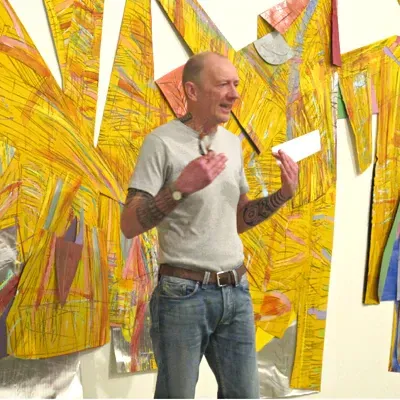
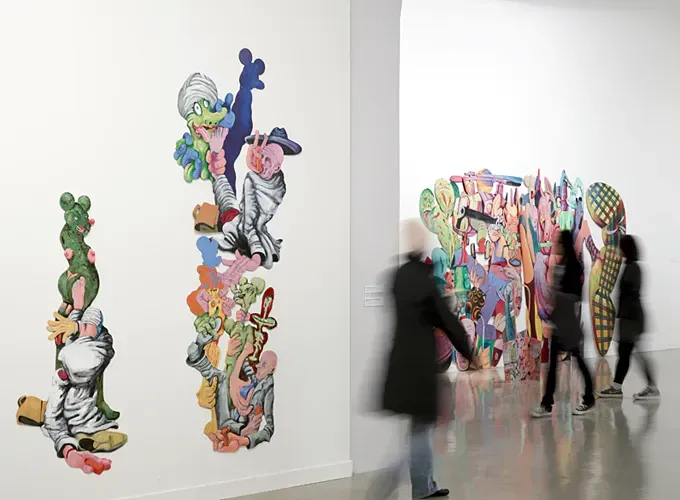
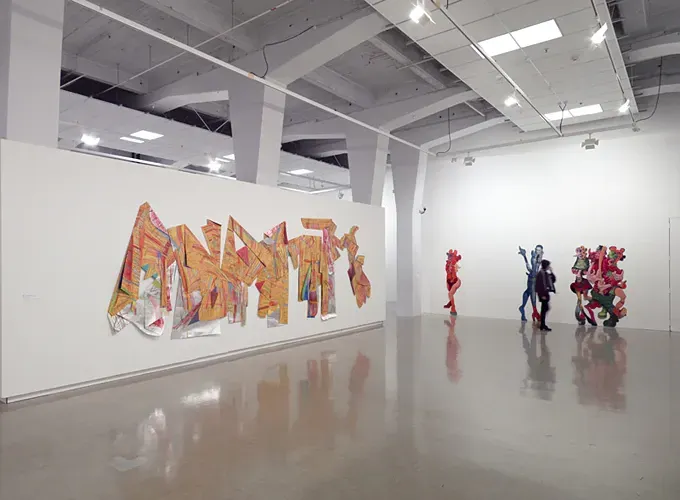
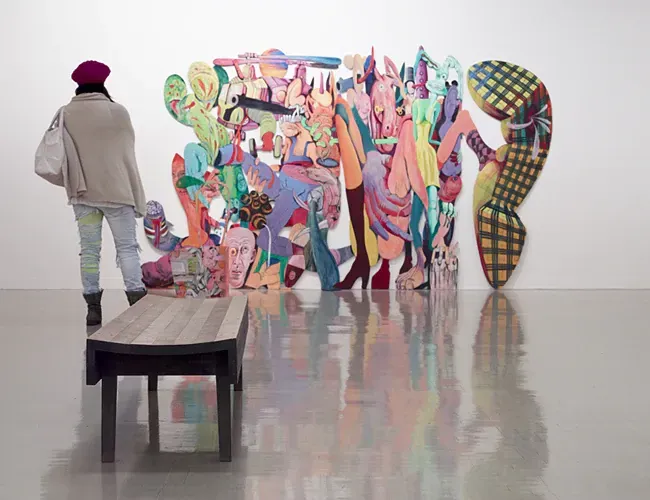
In this TBI Q&A we hear from Wellington painter and teacher Rob McLeod whose large-scale, multi-part paintings on shaped plywood have finally left the studio for his exhibition, Supporting Partick Thistle, at City Gallery Wellington.
There’s an ongoing joke in Scotland about supporting Partick Thistle, a Scottish football team who never win. No one expects them to and continuing to support them involves a rather large act of faith. For McLeod, supporting the team has obvious parallels with continuing to paint, “a medium which everyone keeps saying is dead.”
* * *
During what hours of the day do you feel most inspired?
Inspiration is one of those wonderful art myths that let you off working when you don’t feel like it. Myths like Van Gogh cutting his ear off because he didn’t want to listen to criticism of his paintings. You don’t get “discovered” til you’re dead. Great stuff.
How would a good friend describe your aesthetic or style?
My good friends would be too polite to say anything.
What aspect of your creative practice gives you the biggest thrill?
Finding an old painting from a few decades ago and thinking it’s not too bad.
How does your environment affect your work?
I live in the centre of the city (Wellington) and I think it shows in my work. Not directly, I don’t paint buildings or anything visually obvious but there are pleasures, stresses and strains that are peculiar to an urban environment. My studio is light and airy but is totally inward looking.
Do you like to look at the big picture or focus on the details?
Big picture first, then the detail, then check how they integrate/complement each other.
What's your number one business tip for surviving (and thriving) in the creative industries?
Get a real job. One that pays regular money. The art market is too fickle to rely on.
Which of your projects to date has given you the most satisfaction?
I paint continuously and exhibit regularly so no one project is ever totally satisfying. There is always something else to do: explore: improve: think about.
Who or what has inspired you recently?
Jerry Jeff Walker, Beethoven, Ray Wylie Hubbard, Sibelius, Robert Earl Keen, Carl Nielsen, Tim McGraw, Granville Bantock… I could go on and on. The big old pine trees on Mount Victoria and a very beautiful, peaceful little gully up there that someone has spent many hours weeding and clearing.
You first exhibited at City Gallery in 1981, now you’re back. How does it feel?
Good. Very good. Like I’ve been working in isolation in my hometown for the last thirty years and suddenly people can see what I have been doing.
You spent nearly four decades teaching Wellington youth art at Wellington High School. Are there outstanding students you remember from that period? Any highlights?
A huge number of good students. Many are successful in the arts. Good on them, they did it on their own when they left school. Good luck to them. It’s not an easy business. Highlights are difficult because of the number of talented students so three decades tends to blur into vagueness but I remember some negatives that I should have handled better. Best not discussed.
What do you say to the folk who keep harping on that painting is finally dead?
Go watch a good Vampire movie. Read Bram Stokers book. Read Mary Shelley’s Frankenstein.
If you could go back and choose a completely different career path to the one you've chosen, what would it be?
A politician. Another dirty business that my early years left me well suited for.
What place is always with you, wherever you go?
Glasgow, I’m afraid. It won’t go away. But when I’m there, New Zealand. That’s a much better feeling.
What's the best way to listen to music, and why?
I enjoy music most while painting and drinking the occasional good beer. Get things right and you can work up an adrenaline wave and surf it for a couple of hours. Endorphins kick in without the hassle of running a half marathon. No strained muscles or tired body so you can do it all again next day and even if the painting turns out to be rubbish, the music is still good and there to be enjoyed.
You are given a piece of string, a stick and some fabric. What do you make?
Sounds like a test. Ask the person who gave me them what I'm supposed to do next? Be creative? Join Survivor Mount Victoria? Put them in the recycling bin seems like a good option. Unless the BIG ONE has just hit, then they would be worth a fortune and my nastier side can kick in. But as ART as materials they would be useless to me.
What's the best stress relief advice you've ever been given?
Either stop doing this or stop drinking.
What’s your big idea for 2012?
Another year, another batch of paintings, another show. Might try to get rich. That would be a real challenge.
* * * The Big Idea 10th Birthday Questions * * *
What does The Big Idea mean to you?
Sometimes an answer will get me thinking.
What changes have you noticed in painting in the past 10 years?
Fashion’s recycling. Same old in a different way. Often more interesting than last time around.
What are some of the opportunities and challenges for the next decade?
The biggest challenge is to keep going. The City Gallery show has opened things up again so at the moment it’s easy. Let’s see what happens.
- Artist Biography
Robert McLeod was born in Glasgow in 1948, and studied at the Glasgow School of Art. Since emigrating to New Zealand in 1972, he has lived and worked in Wellington. McLeod has exhibited widely throughout New Zealand and Australia, and is represented in the collections of Te Papa Tongarewa, Auckland Art Gallery Toi o Tamaki, Christchurch Art Gallery, The Sarjeant Gallery, and The Dowse Art Gallery.
- Supporting Partick Thistle: Paintings, Rob McLeod 23 Jun - 23 Sep 2012 - City Gallery Wellington
Wellington painter Rob McLeod’s first and last solo showing at City Gallery Wellington was in 1981, an exhibition of expressionist and minimalist abstraction. His paintings return to the gallery in 2012 utterly transformed.
Rejecting their modernist origins and driven by an ever-pressing need to take new form and acquire new energies, McLeod’s paintings are now governed by a bawdy, cartoon-based figuration. These paintings heave with confounding imagery, amorphous figures and riotous crowds that have fled the frame and come off the wall to invade the physical and psychological spaces of the viewer. It’s all driven by McLeod’s belief that to remain relevant painting must push its own conventions and boundaries, that it can no longer sit quietly and reverentially on the wall.
Supporting Partick Thistle draws predominately from the last decade of McLeod’s practice, focused on his large-scale, multi- part paintings on shaped plywood. It makes brief forays into earlier work to insist that while this is a practice in constant evolution, it remains committed to various principles of the role of painting in the contemporary world.