TBI Q&A: Daniel Belton
Written by
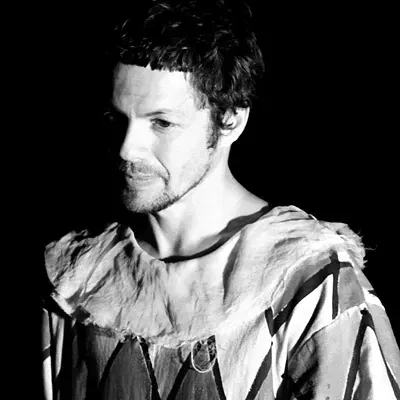
Choreographer and film maker Daniel Belton says his latest audio visual dance work is like a collection of poems reflecting on what it means to be human.
“Time Dance is about extending our capacity to be fluid and receptive instead of forcing, to be open to the mystery of things instead of confining them.”
The new work from Good Company Arts, to a commissioned score by Michael Norris performed by Stroma and conducted by Hamish McKeich, premiered at Christchurch’s Body Festival last week and is at the Tempo Dance Festival in Auckland on October 17.
Belton tells us more about the work and what he hopes the audience takes away from it.
* * *
During what hours of the day do you feel most inspired?
Difficult to predict this one. When inspiration comes, these moments take priority because they are fragile, and illusive. Sometimes I get in trouble with Donnine and the kids because I've stayed late on an edit, or I have worked through the night because the flow was there.
What aspect of your creative practice gives you the biggest thrill?
Things that I didn't anticipate, that are beautiful, and help to tell the story or convey an idea or a feeling. Things that surprise me and the team, even after all the hundreds of hours spent on a project. It's often this unplanned, spontaneous work that just quietly arrives of its own accord that's really special. When you are exhausted and everyone just is - it's like we get out of the way of ourselves. The ego takes a back seat, and a different element comes through. Sometimes we don't even realise this has happened until after the event. Revisiting the fillmed material in post production is when you really see it. “Oh yes, this dance here, this improvised section is wonderful.” Then we have uncovered or captured something truly magical. These gifts are worth all the hard work which inevitably comes beforehand.
How does your environment affect your work?
Finding and maintaining quiet spaces for our working process is essential. Sometimes you have to push very hard and the energy of a rehearsal or film shoot demands a certain momentum just to get things done on time and in budget. But we also need time to reflect and to think and ask “is it working? Are we getting what we need? Is there another way to look at this?”
Do you like to look at the big picture or focus on the details?
Both. It depends on where you are at in a making process. At the beginning of a project, the ideas stage – I always visualise the big picture. Towards the end of the process once we are in editing for example – you can spend days just working on seconds. Does that make sense?
What's your number one business tip for surviving (and thriving) in the creative industries?
Just be yourself. I met Ethan Stiefel recently, and immediately liked him. Really talented guy, really low key and just himself.
Which of your projects to date has given you the most satisfaction?
That's not easy to answer because there are many projects to look back on, and I tend to be very critical of my own work. The projects that flowed the most, or where new creative partnerships were developed such as Soma Songs with Jan-Bas Bollen and the company. This is a highlight for sure. Jan-Bas is a gifted artist.
Who or what has inspired you recently?
The music composer Michael Norris has written for Time Dance. I just love this score.
Photographs of Ruth St. Denis and Vsevolod Meyerhold's Biomechanics in action. The work and writings of R. Buckminster Fuller. Here are two great quotes from him:
“When I am working on a problem I never think about beauty... but when I have finished, if the solution is not beautiful, I know it is wrong.”
“In order to change an existing paradigm you do not struggle to try and change the problematic model. You create a new model and make the old one obsolete"
Tell us a bit about your background.
I followed my older brother to school aged three, and things just roller coasted from there. Dancing classes began aged ten, then much later Donnine and I met as students studying at the NZSD. We graduated, created works and collaborated with people like John Psathas, Taane Mete, and danced for people like Brian Carbee, Sue Jordan, and Douglas Wright. We travelled to Europe. Really exciting contracts with dance and theatre companies in the UK (mainly London) and Europe took place in the early to late 90's. We started a family together, and I wanted to make my own work again. NZ beckoned. From Dunedin we founded Good Company Arts in 1997. You can find out more about my career here or here.
Tell us a bit about Time Dance – from inception to conception
Time Dance really grew out of my 2010 project Line Dances. I realised there was so much more to examine, and a colleague recommended the book about Marey, Picturing Time by Marta Braun. Etienne-Jules Marey was a French scientist whose methods of recording movement revolutionised our way of visualising time and motion. Best remembered for his chronophotography, Marey constructed a single-camera system that led the way to the invention of cinematography. The point was not to mimic reality but to unmask it. We are working in a similar way to dematerialise the human figure - to reveal the interior essence of the dancer. In the traces left behind the body, a vibrant energy of gestures can be seen. As well as showing dance in its pure form on film, we have captured and exposed the dance between seconds. The premise with Time Dance is that we have the opportunity to expose a unique sense of curated space for dance on film. The dancer is our expanding consciousness, sliding through space, dissolving time. Here, bodies appear to be transformed by their own speed, infused with dynamism and energy. Dance exists in stillness. Stillness challenges, provokes and is the dancer.
Time Dance is like a collection of poems which reflect on what it means to be human. With a distinctive nod to the early pioneers of photography, cinematography, and modern dance – the work investigates breaking and restoring, cutting and assembling, by nature of the mechanics of the technology we have developed, to turn the lens on ourselves. Time Dance is about extending our capacity to be fluid and receptive instead of forcing, to be open to the mystery of things instead of confining them.
Time Dance is in one sense a study of the dancer in action. Sinews of time - this is the algebra. It is not only examining but also restoring - reuniting from fragments of time - these pieces of time are coalescing to make the dance. When the figure pauses, the cascading echoes created through dance catch up with it. These are the monuments. When we catch up with ourselves we create a harmonic in space time. It is another way of celebrating being human.
I workshopped with Verity Jacobsen (she was one of the original NZSD cast for my 2007 work the Stitchbirds which also premiered at The Body Festival. Time Dance is her 4 engagement with the company) - and Alex Leonhartsberger (his second project with us). Both remarkably fluid and elegant dancers and a joy to work with. Then I worked with a group of current NZSD students majoring in Contemporary Dance.
"It is great to have these young artists on board, and we are really grateful to Paula Steeds-Huston and Victoria Columbus for their co-operation and support there. Dan and I are both graduates from the school too. As students we learnt Dance History and Baroque Dance with Jennifer Shennan. Not only through the music but also in the dance there is this kind of “Baroque-ness” appearing. When I watch Verity Jacobsen dance in the film, it reminds me of Ruth St. Denis. Dan and I were also fortunate to study Limon Technique and Repertoire from renowned artist and tutor Louis Solino. So there are some very strong links through all this, coming together in the new work. I think people will love it.” Donnine Harrison
Tell us about Stroma, the score and soundscape.
NZSO players who make up Stroma are conducted by Hamish McKeich for Time Dance. There is Emma Sayers (pf), Rowan Prior (vc), Megan Molina (vn), and Anna van der Zee (vn). We also had Vesa-Matti Lepanen and Andrew Thompson come and record. Michael is working with live electronics in the show, and mixing the instruments as well.
It's Michael's feeling for textures and colours that make this music reflexive - and so exquisite. Hamish approached me several years ago with the idea to collaborate. Once I had developed the concept for Time Dance, it was clear to me that Michael Norris was the right person to ask to create the new score. Working with these brilliant artists and the Stroma ensemble is a delight. Its also really pushed me and my film team into new territory. I have gone back to the dance in this work.
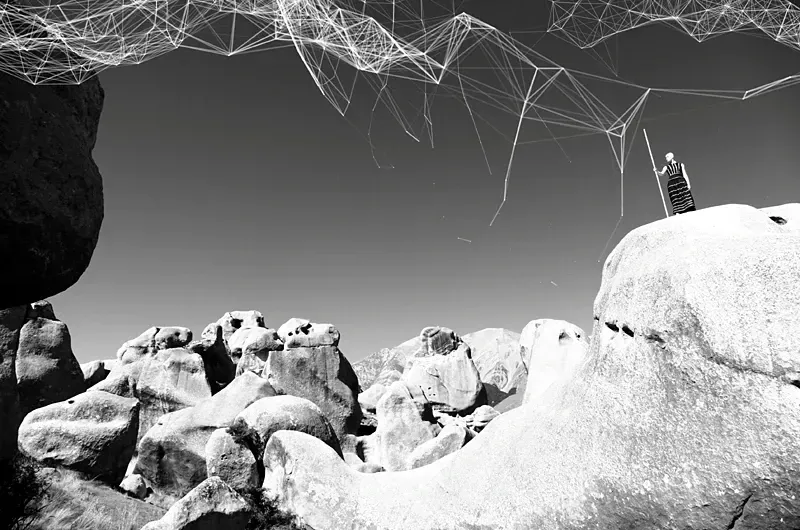
The music seems to be embedded in the black space from which it emerges and into which it folds. In the score the piano is often percussive and linear - these timbres make a synchronisation with the lines in the costume of the dancer figures, almost like looking at staves. The film suggests that the materialization of the land form has come from the dance itself. The geometrics in the space are a memory of where the dance has been. The shadows from human figures are a direct link to our ancestors and the artists of the Paleolithic.
What do you hope the audience takes away from it all?
A feeling of connectivity to each other and to the land. An appreciation of what it means to dance, and to be human.
Tell us about the web component in November.
This is scheduled to be a web broadcast which really archives the live show, and makes the work available online to a wider audience. It will be a facsimile of the live events showing Stroma in action with Hamish and myself, also shown live will be Emma Martin, as the Ruckenfigur.
What place is always with you, wherever you go?
This land (NZ) where I was born and where I have grown up.
What's the best way to listen to music, and why?
Still can't get past the mighty vinyl...
You are given a piece of string, a stick and some fabric. What do you make?
I'd make two hand held flags and practice semaphore.
What’s great about the Tempo Dance Festival?
It celebrates dance in many forms.
What's your Big Idea for 2013?
Developing a major project with the Bauhaus University and Ursula Damm. I also have a collaborative project with Buenos Aires artist Jorge Haro in the pipeline.
* * * The Big Idea 10th Birthday Questions * * *
What does The Big Idea mean to you?
Important arts network for New Zealand.
What changes have you noticed in (Dance) in the past 10 years?
An accelerating integration with new technologies.
What are some of the opportunities and challenges for the next decade?
At this time of great change for the planet and for humanity, we need stories that uplift, and give hope for our collective future, especially for our youth.
Already we are seeing many productive opportunities opening up between Arts and Science, Design Culture, and Creative Industries.
Creating a viable, sustainable future is perhaps our most pressing challenge right now. The Arts must, and I believe will play a key role in this transition period (the next decade). Dance (and all its collaborators) can be a leading light for this new generation.
TIMEDANCE / DOPPIO MOVIMENTO (excerpt) from Daniel Alexander Belton on Vimeo.