TBI Q&A: Artist Simon Glaister
Written by
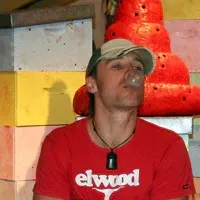
"Sculpture, unlike the other arts, is not just a function of what you can imagine but what you can actually get your hands on," says artist Simon Glaister. He clearly had no trouble getting his hands on $2,000 worth of bubble gum while making True Love Forever, but he's no Veruca Salt. "It presented a synthetic substitute for honey that was both visually engaging and of similar molecular shape," he explains.
The 28-year-old former earthquake engineer's creation is one of the finalists in the 16th annual Wallace Art Awards currently on show at TheNewDowse in Wellington.During what hours of the day do you feel most inspired?
Inspiration can come at any time. I tend to get fixated on particular objects or materials that are more or less commonplace and am continuously distracted by encounters with them throughout the day, but it's definitely at night when my mind is most active. The lights seem to go on in my head when they go off in my bedroom.
How would a good friend describe your aesthetic or style?
Definitely loud.
What aspect of your creative practice gives you the biggest thrill?
Its complete lack of boundaries, which incidentally is the same aspect that causes me the most trouble.
How do you think your environment affects your work?
Hugely. A large part of my work is direct reflection of the materials and objects I encounter every day. Sculpture, unlike the other arts, is not just a function of what you can imagine but what you can actually get your hands on.
Do you like to look at the big picture or focus on the details?
The big picture for sure. It takes a lot of effort for me to narrow things down and get specific, but in the end that's where it's at. Art works are accumulations of details and not ideas, a fact I have to relearn every time I make something.
Your entry into the 16th Wallace Art Awards features $2000 worth of bubble gum. What drew you to this unusual material, and what flavour did you use?
I'm not really sure bubble gum is that unusual. It covers the pavement, can be purchased at any corner shop, and has found its way into all our mouths at one time or another so in that sense it's really quite familiar. As for my work, bubblegum was more of a solution than a choice. It presented a synthetic substitute for honey that was both visually engaging and of similar molecular shape. Formal relationships within the work extend to a chemical scale and strawberry flavour was chosen for its hexagonal structure.
How has your previous career as an earthquake engineer prepared you for life as an artist?
Engineering is an extremely pragmatic discipline. Its purpose is to solve real physical problems and as such can be highly empirical. As an artist I am often concerned simply with whether or not an object or arrangement 'works' rather than why it may do so (at least during the making and installation phases). As such, empirical approaches to problem solving can be particularly useful. Engineering is also concerned largely with systems and relationships rather than isolated elements. Art too is concerned with relationships and the kind of critical thinking required by both is surprisingly similar. Lastly, engineering is about actually doing things and making stuff and while it might not always seem like it, that's what art is about too.
You spent time as an apprentice to British sculptor Antony Gormley. What about this experience surprised or changed you?
I guess the greatest surprise was discovering how removed from the making of their work artists like Antony can be, and that making someone else's work is easier than making your own.
What's your number one business tip for surviving (and thriving) in the creative industries?
So far I've spent around twelve grand on making work this year and haven't sold a thing so unless you like the sound of living in a cardboard box I'm not sure I'm the person to ask.
Which of your projects to date has given you the most satisfaction?
I had a kind of breakthough moment at the start of this year with a work I called Untitled (cheezel pollen). It consisted of 50 or so bags of Cheezels powdered and sieved out on the floor in a large rectangle. I wasn't really sure exactly what I'd done but I knew it worked, that contained a whole bundle of my interests, and that it some how defined what sculpture was or could or should be for me at the time. As always I was far from satisfied but I do remember thinking to myself for the first time "maybe I can actually do this".
Who or what has inspired you recently?
I'm always being inspired by my friends.
If you could go back and choose a completely different career path to the one you've chosen, what would it be?
I couldn't. I know whatever I chose would eventually lead me right back here, and as an artist I'm free to explore any field that interests me. Sometimes I think art is the default career for the indecisive.
What place is always with you, wherever you go?
Anthony Gormley made a beautiful work while he was still at school called Place in which he simply traced around his bare feet on his studio floor. It's a great idea and very comforting.
What's the best way to listen to music, and why?
With headphones so it sounds like it's coming from the very centre of your head. Like it's travelling from the inside out and not the other way round.
You are given a piece of string, a stick and some fabric. What do you make?
A torch, although I guess without kerosene and a light it would be more of a stick with a turban.
What's the best stress relief advice you've ever been given?
"Put all your troubles in a triangle." It's great advice. If you don't believe it just try putting them in a circle or a square. Allan Watts was a genius.
What's great about today?
Supermodels.
11/12/07