TBI Q&A: Actor/writer/director Stephen Bain
Written by
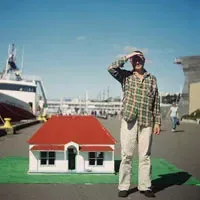
Spending six hours a day stuffed, ship-in-a-bottle style, into a miniature house and being stared at by passersby might not be everyone's cup of tea, but for the creator of Baby, where are the fine things you promised me? it's been an enlightening, if not always comfortable, experience. Not only has actor/writer/director Stephen Bain learnt how to build sash windows, but being forced to socialise for hours on end has also taught him how to be intimate with strangers. Cup of tea?Spending six hours a day stuffed, ship-in-a-bottle style, into a miniature house and being stared at by passersby might not be everyone's cup of tea, but for the creator of Baby, where are the fine things you promised me? it's been an enlightening, if not always comfortable, experience. Not only has actor/writer/director Stephen Bain learnt how to build sash windows, but being forced to socialise for hours on end has also taught him how to be intimate with strangers. Cup of tea?During what hours of the day do you feel most inspired?
I've always enjoyed evenings because of the stillness - the world seems quieter and the chaos of the day is just a memory. My best thoughts usually happen when I feel like everyone is asleep and that no matter what happens it's all going to appear different in the morning.
How would a good friend describe your aesthetic or style?
I studied architecture a long time ago but have always stayed interested in the spaces between things. There is great optimism in knowing there is a new space every direction you choose to turn. If I have a style it's one of limitless possibilities.
What aspect of your creative practice gives you the biggest thrill?
The first conception when every idea sparks a new one, and the day you get to let it all go and turn away to something else.
How do you think your environment affects your work?
Your environment is part of who you are, though it doesn't mean you're necessarily LIKE it. Being overseas is a such a great feeling because your environment lacks any familiarity, so you feel like an altered person able to see home as you never have before.
Do you like to look at the big picture or focus on the details?
Big picture. detail... big pic... no detail.... picut... no... big picture... yep... umm... yep big picture.
You've toured Baby, where are the fine things you promised me? throughout the country. What's been the most memorable response and have the public's reactions differed in each city?
'You must be some kind of king, to get strangers on their knees'. I have a letter box where people can write me notes and that's my favourite one so far - no idea who wrote it. I think that was from Christchurch. Second favourite note was 'you're a cock'. I have a rude wall inside the house where I paste all those ones. I've been blown away by the responses actually, I feel like I've learnt a lot about how to be intimate with strangers - it's not something I'd considered before. Quite a few people from the social fringes like to hang out at the house and I think part of that is the idea that the home is somewhere you're able to be relieved from a lot of other social pressures. Straight people too - all sorts of people, that's what's surprising, that so many people have this connection with a relatively specific way to live.
What was it about the idea of "the lost utopia of the quarter-acre block" that compelled you to create the installation?
I've lived mostly in inner city apartments and flats where the back yard is generally the city, so when I moved into a whole house in Footscray Ave (upper Cuba St, Wellington) in 2002 it was all a bit new, though strangely familiar because I grew up in the suburbs. The house had had very little done to it since being built in 1897 (it still had an outside loo) so it was like a little insight into the values of the people who had put it there, but also the values of every person who'd lived there over the years through what they'd maintained or let rot.
I've worked for years in theatre, so this kind of performance was very new for me. The whole idea of an installation is interesting because it implies people are going to create their own narrative which tends to be the opposite process to theatre. Ultimately I've always seen the stage as a microcosm to represent the world as you see it, so in many ways this is not so different.
What's been your biggest challenge doing Baby where - ?
Building the thing took a bit to get my head around - I had to look at a lot of sash windows to figure out how they were put together. I enjoy figuring things out though so it was a pleasant challenge. It's also been a bit of a challenge being social for six hours at a time. I've always liked getting on with things in my own space so the idea that anyone can come and hang out with me at any time puts my head in a new space. I tend to think less than when I'm alone, I really enoy hearing people's stories though so I don't get bored.
What's your number one business tip for surviving (and thriving) in the creative industries?
I went to my accountant once to ask him for advice on retirement savings. He said to me "Stephen, what do you want to be doing in 40 years time? Do you want to be sitting in a little house in the valley with net curtains, cable television and trips to housie on the weekend? Or do you want to be surrounded by your scripts, your images and your models?" I didn't have to answer that one and I've been investing for my future ever since.
Which of your projects to date has given you the most satisfaction?
I love working with other people because there's something fantastically satisfying about creating something communally. I think it has something to do with being forced to go to Sunday School as a kid. I love every project like they were my kids, some of 'em might be feistier but you love them equally. You just hope none of them land you in jail.
Who or what has inspired you recently?
HAPPY in Wellington is a hotbed of inspiration. Every time I go there I feel like I'm burning up!
Other things that have inspired me this year: bicycles, girls, music, trees, my friends, food, Bukowski, shoes, John Radford, the dissolution of mainstream television, songs about not always getting it right, Rangitoto, Jim White's drumming, open spaces, Genta Japanese restaurant, my flatmates, WiFi, Google Earth's pictures of the stars, the amazing truth about why things cost what they do, seafood, the amazing truth about seafood, those guys who pour concrete onto footpaths every week of the year, the Conchords, kiwifruit crossed with tamarillo - how likely is that!?
If you could go back and choose a completely different career path to the one you've chosen, what would it be?
Piano tuner, florist, concrete truck driver - in that order.
What place is always with you, wherever you go?
I saw an exhibition of Miro paintings once and right at the beginning there was a painting he did when he was about 10 on holiday with his family. In that picture were all the colours of his paintings for the next 50 years of his life. Apparently we don't shake off those damn colours. Mine are the chiselled brown rocks of Castlepoint on the Wairarapa coast, with flecks of fossils that you stub your toes on as you fight your way up to the lighthouse against the gales.
What's the best way to listen to music, and why?
Just listen. Don't do anything else. The best music was made to be listened to, not to wash dishes.
You are given a piece of string, a stick and some fabric. What do you make?
A machine to make free time. People could come and make as many withdrawals as they liked, obligation free.
What's the best stress relief advice you've ever been given?
Climb to the top of something. Look down. Climb back down again.
What's great about today?
I'm still here. And so are a lot of other people.
20/11/07