TBI Interview with Mark Billinghurst of HIT Lab NZ
Written by
Based in "the Silicon Valley of New Zealand" - otherwise known as Christchurch - HIT Lab NZ is a human-computer interface research centre. That might sound a little dry, until you start hearing words like 'Magic Book' and 'three-screen immersive theatre'. The Big Idea's Isaac Davison talks to HIT Lab NZ's director Dr Mark Billinghurst about a few of their exciting projects, and the important role artists play in their research.Based in "the Silicon Valley of New Zealand" - otherwise known as Christchurch - HIT Lab NZ is a human-computer interface research centre. That might sound a little dry, until you start hearing words like 'Magic Book' and 'three-screen immersive theatre'. The Big Idea's Isaac Davison talks to HIT Lab NZ's director Dr Mark Billinghurst about a few of their exciting projects, and the important role artists play in their research.Isaac Davison: How was HIT Lab NZ born?
Dr. Mark Billinghurst: HIT Lab has been at the University of Canterbury for five years. Before that there was a parent HIT Lab at the University of Washington in Seattle, which has been running since 1989. It's a very successful lab that does lots of new types of interface technologies. We are the daughter of that lab. I was there as a PhD student and a research scientist, and played a part in the creation of a HIT Lab in Christchurch.
Why was New Zealand chosen for another laboratory?
The sister city relationship between Seattle and Christchurch was just the spark. Christchurch is like the silicon valley of New Zealand. Half of the electronics industry and 40% of the software industry are here. So for a lab like ours which needs to connect with industry the Canterbury region is ideal.
Artists seem very keen to participate in computer science. Is this feeling mutual?
I do not speak for all computer scientists, but we are very keen to engage with artists, and have a long tradition of doing so. A large part of what we do is making technology easier to use, and artists provide us with new avenues and perspectives on technology.
What do artists bring to computer science?
They put technology to work in interesting terms in installations or artwork, and, of course, put technology into a public gallery space where people can react and respond to it.
When you bring engineers and artists together, the students and staff generally feed off the artists' creative side, and do a bit more lateral thinking. The artists learn how to use new tools in creative ways.
Is it fair to say that artists break up the positivist approach of scientists?
Definitely. Often engineers or scientists look at things in terms of problem-solving, while artists look at things in terms of exploration. Exploring the possibilities of technology is a very interesting approach.
Do you see evidence of artists and computer scientists working together outside of the experimental research space?
There are several examples of industries with strong collaborations between the two sectors. The most obvious is the creative input in special effects for films. The computer gaming industry and music industry are other examples of technology being put to creative use. In these industries artists are not always a cog in the machine, but often project leaders.
What difficulties arise in these collaborations?
Sometimes artists and engineers are not able to communicate. For example, engineers might want to problem-solve and artists may not be able to specify the design requirements they want. And artists may get frustrated because they want to play with the technology, and not provide a specifications sheet or project plan for how it is going to be used.
I think it boils down to how accommodating each side wants to be. If people on the creative side and the engineering side are willing to compromise, a project can be very successful.
What sort of leap do artists have to make to be involved in human interface technology?
HIT Lab helped author and illustrator Gavin Bishop make an animated book - you could turn the pages of the book, and virtual content would come out of the pages. It required him to think about how his characters would move and talk. Because he was used to two-dimensional drawing he had never thought how his characters might look from behind, or from other angles.
The technology extended him by shifting his role from illustrator to director. He enjoyed this because he was able to explore his artistic vision in a different context. That is what we are about - giving people tools to take their vision a little further.
Can you tell us a bit about Magic Book technology?
It's software that allows you to overlay computer graphics onto the real world, in real time.
Artists have used it in a number of different ways. Gavin Bishop's book Imagic is a good example. Roger Bays has built an installation where you walk into a gallery space and you can see virtual objects floating in space in front of you. Another project called Animalia by Caroline McCaw and Angela Main featured a projection screen that captured a video of the audience, but circumposed on that video were 3D virtual body parts - animals and so forth.
The idea is to break the threshold of the screen - to take digital content and bring it into the real world.
What's next for HIT Lab NZ?
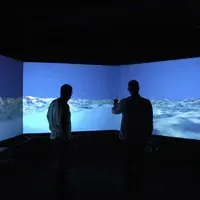
We are doing more work with large immersive projection displays. We have just created New Zealand's first three-screen, immersive theatre, with virtual content projected like a 3D Imax.
We are collaborating now with the university's school of fine arts. We used to work with three or four professional artists a year, but are now engaging with MFA and FA students. It is exciting to be exposed to younger generations of artists, and exposing them to technology at an early stage of their career.
30/5/07