Tane Lives at Art in the Dark
Written by
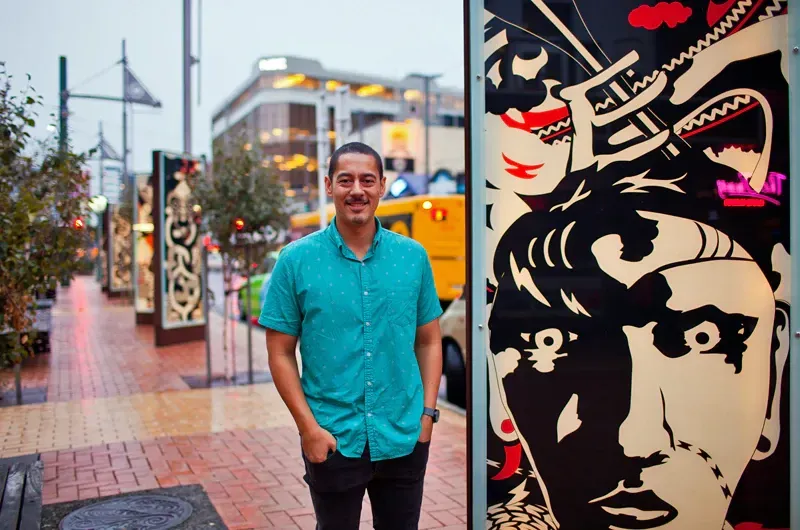
Maori artist and designer Johnson Witehira says he wanted his latest work Tane Lives to be part of Art in the Dark in Auckland because "we need more Maori-ness in the mono-cultural landscape that is Aotearoa."
With Tamahaki (Ngati Hinekura), Nga Puhi (Ngai-tu-te-auru), Ngati Haua and New Zealand European descent, Johnson’s work has a strong aesthetic that comes from combining traditional Maori form and pattern with ideas from graphic design and Western arts practice.
Inspired by the narrative of how Rangi and Papatuanuku were pushed apart, and Hone Tuwhare’s poem ‘We who live in darkness’, Tane Lives features images of the Maori god Tanemahuta projected onto trees. Tane pushed his parents apart – and out of nothing came Te Ao Marama – the world of light.
It follows The Land of Tara, where Johnson explored the whakapapa of Wellington through digital representations of Maori ancestors on light boxes along Courtenay Place.
Not to mention the larger than life series of digital works exhibited on 34 digital billboards in Times Square, New York, in 2012.
In this TBI QnA Johnson also tells us about creating the first Maori typeface and his interest in bringing Maori visual culture back into our lives.
During what hours of the day do you feel most inspired?
Either really early or really late. When your brain is half asleep and you don’t really question the weird thoughts that come into your head.
How would a good friend describe your aesthetic or style?
No idea. But if I was to generalise from a bunch of them it might be, bold, high contrast and filled with ideas.
What aspect of your creative practice gives you the biggest thrill?
Making new stuff.
How does your environment affect your work?
I can work anywhere really. It just depends on how motivated I’m feeling on the day. An environment with other people is always a good thing.
Do you like to look at the big picture or focus on the details?
Both. You need the big picture to bring it all together. At the same time the details are where the craftsmanship comes through. I think any good art or design project considers both.
What's your number one business tip for surviving (and thriving) in the creative industries?
Making good work is pretty important and this comes with practice. Networking is probably the most under-valued skill. No matter how good you are, if people don’t know what you’re doing they aren’t going to be sending you invites. And throw proposals at everything. Contests, competitions, art residencies and art projects.
Which of your projects to date has given you the most satisfaction?
Tough one. Probably the Waituhi street art project down Opera House Lane in Wellington. I wasn’t really sure if it was gonna work, as it was my first piece of street art. I had an awesome team though and the end result is pretty cool.
Who or what has inspired you recently?
Loving the mahi by illustrator, printmaker, DJ extraordinaire, James Paratii. The man has a sensitive hand.
Tell us a bit about your creative background.
A chronology of my creative background and things that influence me: painting, Bruce Lee movies, Street Fighter, Ren and Stimpy, Wolverine, Quake, Robyn Kahukiwa, Da Vinci, Josef Muller-Brockman, Hiroshige and Hokusai, Raharuhi Rukupo, Shepherd Fairey and Lisa Reihana.
Tell us about Tane Lives and why you wanted to be part of Art in the Dark?
I wanted Tane Lives to be part of Art in the Dark because we need more Maori-ness in the mono-cultural landscape that is Aotearoa. The work itself is a projected art work, shown on a large tree It gives a short account of the Maori genesis narrative from Te kore, through to Rangi and Papa and them being pushed apart.
What do you like about large outdoor works? Tell us about The New York Times Square project and what impact this had on your career?
Public art lets us bring art to the people. In saying that, I the art has to be good and it has to connect to them. Otherwise it might as well be back in the gallery.
The Times Square project was buzzy, for lack of a better word. Having your works shown on such a scale in that place of the world, and being flown to New York for a week while it all happens. Can’t imagine I’ll be doing that anytime soon.
You’ve also created smaller works – the Maori alphabet blocks and Maori typeface. Can you tell us a bit about these projects?
As an artist and designer I’m really interested in how we can bring Maori visual culture back into our lives. Before our Pakeha ancestors arrived design was on everything, our vehicles (waka of course), our tools, clothes, homes and people. Maori design was on everything. Nowadays it’s treated as ‘taonga’, distanced from us. Both of these projects were a chance to bring Maori design back.
As someone with a keen interest in typography I thought it would be great if we had some Maori typefaces, created by Maori for Maori. I’m interested in the idea of a typeface as might a vehicle for tinorangatiratanga, and how a Maori typeface might be one way to reclaim the the printed page.
What did your Doctorate explore?
Unlike the customary Maori arts (ta moko, whakairo, raranga), there are no tikanga or protocol for Maori designers. In my doctoral thesis I tried to develop a platform for Maori designers by exploring both the tikanga and aesthetics in carving. I also used a method of graphical analysis to try to identify what might be term Maori elements and Principles of design.
What are some of your other upcoming projects?
I’ve got two new exhibitions in early 2015, one at Pataka Gallery in Porirua and one in Paul Nache in Gisborne.
What place is always with you, wherever you go?
Gisborne. It’s where I spent my ‘formative’ years. Growing right next the beach as kid is winning.
What's the best way to listen to music, and why?
Loud and live if possible. Memory making stuf
You are given a piece of string, a stick and some fabric. What do you make?
A fire.
What's the best stress relief advice you've ever been given?
Other than scotch. Probably exercise.
What’s great about today?
Everything
What’s your big idea for 2015?
A playable art work which will be first shown at Paul Nache next year. I hope it’s gonna break the mould a little, annoy some people, and give us different perspective on our history.
* * *
See Johnson Witehira’s work Tane Lives at the 5th ART IN THE DARK 13 – 16 November, Western Park, Ponsonby. Free.