TalkWrite: The Point of Poetry
By Renee Liang
As promised, over the next few entries I'll be pondering some fairly basic and inherently unanswerable questions like "what is art?" and "when does it stop being art and become something else?"
This is not because I'm in any way an expert, but because it's a question I sometimes get asked, and then I either 1) get embarrassed because I'm not brainy or experienced enough to know the answer, or 2) say something off the top of my head and end up looking like a goldfish. So it might be good to work some of it out. And anyway, there's nothing more fun than lobbing this kind of question into a roomful of arty people and running off.
So, this week I start by dissecting a subject very dear to my heart - Poetry. (With a capital P.) What exactly is the point of poetry? And who gets to say what is poetry and what is not? Exactly this debate trembled the stiff upper lips of English society recently. And while I consider the assertions of the so-called "Queen's English Society" a bit retarded, there are any number of searching, beautiful and yes, poetic examinations of what makes a poem, a poem. So, that settled, on to the point of Poetry. Kay Ryan, who recently became the sixteenth US Poet Laureate, had this to say:
"In a culture like ours, where language has been completely and utterly subordinated to the task of selling people things, how do you create a little freedom? Only in art that isn't designed to sell or convince or sermonize or cajole or urge. Maybe that's poetry, or at least some poetry."
I say, hurray for a poet who isn't afraid to make a stand for what poetry really is, rather than what some people try to use it for. How many of us are poets, or at least closet poets? I'd venture that very few people haven't tried writing poetry at some stage in their lives. It comes to us often in moments of high emotion. With me, it came when someone I loved very much died. And open mic at Poetry Live always has its share of soppy love poems (and why shouldn't it be soppy? Not all Kiwis are rugbyheads, despite what the TV people tell us).
Doug McGill may well be right - there's something like a moment of shared pleasure - even ecstasy - for readers and listeners of a good poem. It's a momentary joining of minds, sometimes across time and place, which makes it all the more poignant. And it can build transient communities. I've sat in poetry slams where every person there seemed to be breathing collectively, reacting in sync to the poet on stage. This probably makes me sound like a religious nut, but it's true.
Of course, this makes some people keen to protect what they see as the temple of poetry. What, after all, is 'real' poetry? Is poetry without words real poetry? (I once saw someone nearly win a poetry slam with a poem containing no words or even sounds. It was called "Nervousness", and it was genius.) There are things like dance-poetry (again, not necessarily with words), kinetic poetry and poetry which contains only letters, images or even just punctuation. Are such things "real" poetry? And what about rap? Where does poetry end and hip hop begin? I once asked a hip hop academic (yes, there are such people!) this and she said that poetry was a subset of hip hop. I happen to think it's the other way around, but we could start a whole other blog on that, so I won't go on.
And then everyone's got their pet peeve. Although the fun chaps at the Queen's English Society didn't think that non-rhyming poetry was real poetry, there are plenty of people to whom rhyming poetry, especially rhyming poetry written by little old ladies about their cats, is anathema. Then there are the people who hate punctuation, any sort of punctuation, at the ends of lines; and still others who weed out capitals at the start of lines. And then there are those (let's call them postmodernists, at the risk of having my English degree retracted) who deride anything too obvious or clear in a poem. So you see in the end it all comes down to taste and opinion. And even the best of us (ie, me) are sometimes humbled.
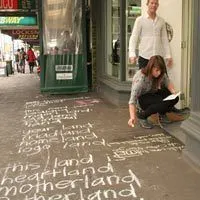
Which brings me to a discussion I had with some hairdressers on Montana Poetry Day. They were working in a swanky salon on the block of Ponsonby Rd which got chalked with poetry, and came up and asked for some chalk so they could write their own pavement poetry. Pleased, I handed them the piece in my hand, and later photographed them chalking diligently away.
I went for a close-up, only to find an advertisement for their shop on the pavement. Along the lines of: "Feel like a blowdry? come into our shop for luxury pampering. Style, cut and conditioning for a totally new you."
I said, as nicely and non-confrontationally as I could, that that wasn't a poem, not really. And they told me that they thought it was. Which left me with no answer except for a facial expression somewhere between pain and doubt. Because at the end of the day, who defines what poetry is, except for the poet? Where do you draw the line between poetry and advertising? And between good poetry and bad poetry? A lot of poetry has a message; in fact one could argue that poetry with no message is empty poetry. Maybe a message for commercial gain rules it out as poetry? But then having a message for commercial gain doesn't make it bad, or non-poetry.
Maybe New Zealand's own poet laureate, Michele Leggott would be able to solve the conundrum for me. So I talked her into answering a few easy questions, along with the problem of the hairdressers. (She agreed on condition that no one take her words too seriously - after all, she is a poet.) Here are her answers:
1. What use does poetry have for Kiwis?
It's there if you want it. sometimes people want it around rites of passage (weddings, funerals, coming and going in the world) and then it functions tribally, poet speaking with or for human family because family wants to hear. other times its function is critical, some things a poet wants the family to hear but will have to find ways of getting the message through. A poet may have to move adroitly between these poles (we want your poem / we don't want your poem) and that's probably no bad thing.
2. How do you see the delivery and enjoyment of poetry changing in this "modern" age - will this affect the poetry itself, or merely the form it takes?
Poetry is always affected by the context in which it is produced. there are a lot of poems online that mimic the page of a print book, because that's where much of our poetry has come from. but there will be more and more ways a poem can travel and manifest as information systems proliferate. the trick will be to draw in more and more people to read, listen, click, view and respond. and then bring it back into the world in interesting ways. I liked your hairdressers: they pushed back at the Poetry Day pitch. bet they'd never felt able to chalk their ads on the pavement, bet their ads had never found themselves so close to poems before. win-win?
3. Can poetry ever really be "free"?
It can decide to free itself of things it detests and do something different. the new context will have checks and balances and negotiating them becomes the next job. yes, poetry can be free. I was sad that Michele had supported the hairdressers, but very glad that she declared poetry to ultimately be free. Michele and others have done quite a lot towards "freeing" poetry in this country, actually, and I'll look at poetry off the page, guerilla poetry and transient art in a future entry. But for now, I'm off to write some more poetry. Note: Renee runs a list of Poetry events in Auckland, updated monthly by email - email her on docrnz@gmail.com to join the list or to list events, or go here for a continuously updated list. Read previous TalkWrite blogs
08/10/08