Support Blind Week and make a difference
Written by
The RNZFB's Blind Week Appeal runs from October 28 to November 3 and aims to raise $1.1 million!
This year's "See the Difference You Make" campaign is about the extraordinary difference New Zealanders' generosity can make to the lives of the Foundation's 11,700 blind, deafblind and vision-impaired members.The RNZFB's Blind Week Appeal runs from October 28 to November 3 and aims to raise $1.1 million!
This year's "See the Difference You Make" campaign is about the extraordinary difference New Zealanders' generosity can make to the lives of the Foundation's 11,700 blind, deafblind and vision-impaired members.The RNZFB's Executive Director Marketing and Fundraising Alison Wheatley says, "We're trying to raise over $1.1 million so we can continue giving our members the skills needed to do the everyday things that we all take for granted, like getting from home to work, cooking dinner or surfing the net."
"Only one-third of the Foundation's $26 million operating budget comes from Government sources, so our members rely on public support for the other $17.3 million."
Look out for volunteers in fluorescent orange vests with Blind Week collection buckets, from Friday 31 October to Sunday 2 November. You can also support Blind Week by texting BLIND to 469 to donate $3, or make an automatic $20 donation by calling 0900 4 BLIND (0900 425 463). For online donations, visit Blind Week.
What does the RNZFB do and why should I donate?
The RNZFB gives blind, deafblind and vision-impaired people the skills to do everyday things, like getting from home to work, cooking dinner or surfing the net.
Only one-third of the Foundation's $26 million operating budget comes from Government sources, so members rely on public support for the other $17.3 million.
All about RNZFB members
The RNZFB has approximately 11,700 members across New Zealand.
Every year, nearly 1,200 New Zealanders become RNZFB members after experiencing serious sight loss.
The most common eye condition that RNZFB members have is age-related macular degeneration (42%) followed by glaucoma, retinitis pigmentosa, cataracts and diabetic retinopathy. Over half of the Foundation's members are aged over 80.
Membership breakdown by age
0 - 20 years: 7%
20 - 39 years: 9%
40 - 64 years: 16%
65 -79 years: 16%
80+ years: 52%
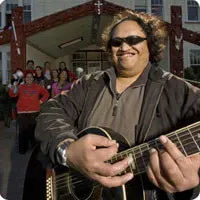
Te Reo and braille go hand-in-hand (pictured)
Nigel, 38, is big on braille, which is helping him finish his Masters in Matauranga Maori.
"I wanted to learn braille because I wanted to learn how to read music and you have to have a certain standard of braille before you learn braille music."
"The other good thing about braille is being able to access written stuff, especially now that I'm working in an environment where we do a lot of work with Te Reo. You don't always know how Maori words are spelt because it's phonetic, so braille helps to read how a word's spelt properly and where the macrons are."
"Braille's also helping with my Masters. When I type parts of my thesis, I can read it using the pop-up braille display on my computer to make sure it's spelt properly. If I didn't know braille, I wouldn't be able to check the spelling."
"I like braille! Especially now that there are Maori texts in braille."
What's with the white cane?
Di Henderson, 47, has retinitis pigmentosa and recently moved from Hokitika to Christchurch, where she's flatting with her best friend. Over the past few months, she's been learning how to use a white cane.
"I was a bit reluctant at first, because there's a real knack to it. It's hard on your shoulders and you have to get used to walking on your own without looking down."
"Now though, I've got a lot more confidence. Last month, I caught the bus for the first time on my own, before going to meet with my instructor for a coffee. It was like passing school cert!"
"I don't always need my cane, but it's good to have the skills to use it. I still have some tunnel vision, but my sight might get worse. If it does, I'm prepared."
Computer skills save Greg's career
Greg Johnson, 34, went blind in July last year, leaving him worried about how he was going to keep working. "When I enrolled in an Adaptive Technology course at the Foundation, my career depended on it."
"At first, I didn't know what to expect - it was the first time I'd ever met other blind people! But the course was brilliant. I learned how to touch type, and use programmes like Microsoft Word and Outlook."
"My new skills meant I could take on a computer-based customer service role within the same company I'd worked at before I went blind."
"The course was also a chance to make new friends. This encouraged me to go out more, and get involved in sports clubs again."
"Foundation courses like these are a great stepping stone for anyone looking to find employment - they open doors, helping you to communicate with the world."
Ruby the blind bookworm
Ruby Graves, 85, lives in Invercargill and loves to read. She talks about what the Foundation's talking book service means to her.
"I think talking books are wonderful - life would be very miserable without them."
"I've always been a reader and I think if you've always been a reader you're like a dog without a sneeze if you can't read."
"I used to be a nurse and when I went home in the holidays my mother used to say, 'Now get your bits and pieces together and never mind about that book!' But the book always came first."
"I get a variety of talking books. I like a good novel, but I read magazines as well."
"Books are something you can get lost in and I'm getting to the stage now where I should be ringing someone but I'm too immersed in a book!"
29/10/08