Strive Towards Your Destiny at Michael Hirschfeld Gallery
Written by
By Mark Amery Courtesy of The Dominion Post
City Gallery's Michael Hirschfeld Gallery seems to have acquired its own logo, and - wait for it - it comprises of three exclamation marks.
The exclamation mark is the laziest punctuation point of them all. It's in a class all of its own. Used to give something volume, it's most commonly found in advertising or in city council generated slogans, like "Hamilton - not what you'd expect!"
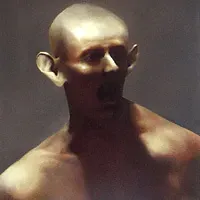
Image: Irene Ferguson, The Fly Catcher, 2007. By Mark Amery Courtesy of The Dominion Post
City Gallery's Michael Hirschfeld Gallery seems to have acquired its own logo, and - wait for it - it comprises of three exclamation marks.
The exclamation mark is the laziest punctuation point of them all. It's in a class all of its own. Used to give something volume, it's most commonly found in advertising or in city council generated slogans, like "Hamilton - not what you'd expect!"
Image: Irene Ferguson, The Fly Catcher, 2007.Quite what it's doing at City Gallery then. Usually exclamation marks have about as much a place in the presentation of art as they do in good writing. They reduce what they promote to hazard signs, drowning out the subtleties of meaning in the work itself. There's a tendency to put exclamation marks after things to reach a broader audience; to encourage us to get all playful and not read work too literally.
Perhaps here it's a nod to the fact that so much contemporary art starts with an exclamation mark: art often puts a twist on the things around us to gain our attention. Once this road sign has made you slow down, you're ripe for seeing the more subtle stuff.
The current Hirschfeld group show has a title that outside a gallery setting would be certain to get an exclamation: 'Strive towards your destiny'. It's from the work exhibited here by Douglas Stichbury, alongside another motivational slogan he uses, 'Hard work will get you anywhere'.
The phrases are already troublesome: how can one know one's destiny to be able to strive for it? Who wants to be anywhere? Painted crudely by hand in block letters what I like about the absence of the exclamation mark here is how it helps ensure that we don't simply read into the work that Stichbury is being merely ironic. An invisible question mark floats down.
Stichbury pairs 'Strive towards your destiny' with a sketchy oil rendition of a detail from Gericault's iconic painting 'Raft of Medusa' (in which people are striving just to live). 'Hard work will get you anywhere' is paired with a rendition of David's painting of the all-powerful Napoleon on horseback - an image that reminds me that hard work invading Russia got Napoleon nowhere.
Stichbury reproduces classical images that are the antithesis of everything we might imagine he'd be encouraged to make during his recently completed Bachelor of Arts at Massey. He pairs them with slogans the postgraduate might have pinned above his desk. He questions what might as an artist be considered hard work or worthwhile.
His work seems to ask whether being ironic is any better than being heroic, or romantic, and what might the artist offer in the absence of a display of technical skills. He carefully reproduces overly familiar and staged heroic and romantic dramas with exuberant action and in doing so gives them new life, asking us plainly with his juxtapositions what meaning we might gain from them now.
Both Arie Hellendoorn and Irene Ferguson, who complete this show, also play willfully with art history, but there's something else there in the present that makes their work interesting.
Hellendoorn, whose work is also currently on show at Newtown's Suite Gallery, is interested in the crackle between abstraction and the figurative, the decorative and the representative. The work at the Hirschfeld suggests he's still finding his direction, and I'm actually more taken by the strong set of works at Suite (able to be previewed at www.suite.co.nz) where the organic, chemical and geometric are playfully, poetically in dreamlike painterly conversation.
As with Stichbury there's a nonchalance in his approach to painting which is knowing in its naivety, questioning the reverence given to the art that has come before while also embracing its power (in Hellendoorn's case a hybrid of cool geometric abstraction and spooky American abstract spiritualism).
A rhythm of sloppily hand painted raindrops is added to compositions with what appear to be deliberate imperfections. In one work the drops break off before a row is even completed, as if the artist has just wandered off. In another, Hellendoorn apes Magritte's surrealism with two headless figures; their bodies reduced to elegant punctuation marks while the impression of faces are perceptible in the clouds above. It's a world of not quites, where art history's exclamations are turned into questions.
Making the biggest impression in this show however are two portraits by Irene Ferguson. Ferguson gained a Master of Arts from the New York Academy of Art, where learning a classic mastery of the figure is central to study in a way at Massey it is not. Ferguson employs these skills to produce unnerving portraits where the human in a position of emotional vulnerability is metamorphosising into the freakish creature. The work is full of Caravaggio shadows that leave the naked subjects defenceless in the flare of our eyes.
Painted at a human scale, Ferguson subtly exaggerates facial and body features using light masterfully to both attract and repulse. I was mesmerised by the complexion of emotions as much as the fleshy painterly tones.
In The Flycatcher the too round mouth is awfully alien, but the bat-like ears and suggestions of fluff on the head are attractively animal-like. In The Sister there is all the intimacy of that title in her subject's big eyes and shaven head. While the neck extends her beyond the human, a slightly accentuated nose and buckteeth attract our empathy. A gleaming shoulder blade is at once both a grotesque crag and a heart bump.
More information
Strive Towards Your Destiny, Michael Hirschfeld Gallery, until 2 March
New works: Arie Hellendoorn and Terence Taylor, Suite Gallery, until 21 February
14/02/08