Stains and erections in art
Written by
By Mark Amery Courtesy of The Dominion Post 28/11/07
Public sculpture has been male dominated, and it's often remarked that those men sure seem to like to create towers and poles that thrust upwards. Read into this as you will. As if following a Rangi and Papa sky father and earth mother analogy, the work of women by contrast in Wellington has been altogether more in touch with the ground - from Shona Rapira Davies' landscape sculpture in Te Aro Park to the paving stone works of Mary Louise Browne.
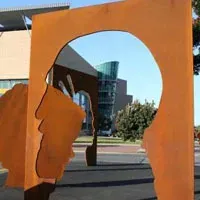
Image: Cathryn Munro, Per Capita.By Mark Amery Courtesy of The Dominion Post 28/11/07
Public sculpture has been male dominated, and it's often remarked that those men sure seem to like to create towers and poles that thrust upwards. Read into this as you will. As if following a Rangi and Papa sky father and earth mother analogy, the work of women by contrast in Wellington has been altogether more in touch with the ground - from Shona Rapira Davies' landscape sculpture in Te Aro Park to the paving stone works of Mary Louise Browne.
Image: Cathryn Munro, Per Capita.While the men seem more interested in creating less specific, more universal devices, women seem more likely to be creating connections to the history of the land and its people.
A year ago Wellington Sculpture Trust redressed the gender balance somewhat with the installation of work by two women that both do this, Cathryn Munro (on the corner of Tory and Cable Streets) and Louise Purvis (on Bunny Street). Both are also currently exhibiting work with their respective dealers in Wellington, providing wider consideration of their practices.
Good art can get richer the more time you spend with it, demonstrating its staying power. A stayer for me is Munro's Per Capita, which I have the pleasure of walking past most days on the way to work.
One of the things I like about Per Capita is the way, like some theatrical conversation, it manages to be personal and specific but also has all the smore tately gravitas we used to expect of public sculpture. While earlier in our history public memory was embodied in sculpture, private memory was captured with the studio photograph. Munro's work combines both, cleverly bringing together the personal and the public.
Per Capita comprises of four giant colonial cameo silhouette portraits made out of weathered steel plates. One pair are negative images, with the head cut out so you can walk through them (and hence enter their conversation), while the other pair are the positive image of another two different heads. The positive and negative of shadows and steel in overlap sees the work in an everchanging dialogue as you pass by. An engaging jigsaw interplay that can never be put together it's as if representatives of the city's history have stepped out of the frame and are trying to be a family on this street corner.
'Per capita' means "for each head of population" and these heads - identifiably Maori and Pakeha - relate to both Munro's own bicultural roots and our country's. The trade going on between them provides reminders of the complexities of ownership, both physical and spiritual in our city. I'm always struck by how most of silhouettes appear to be of children, engendering hope and care for our future. In a space dominated by boxy buildings the work reminds us that a city is foremost made up of people. Too bad the Museum Hotel currently spoil their sponsorship of the work by having an electronic sign placed directly behind it.
The interplay between positive and negative images, and the ghostings of ancestors is seen in Munro's show at Mark Hutchins Gallery. Faded impressions of photographs of Munro's ancestors have become blotted and suspended as part of brown marks on white, as if spirit faces are appearing in old coffee stains in heirloom tablecloths. The works are a cameo double portrait between head and some kind of residual after effect.
These images have been baked into vitreous enamel on steel panels. The use of enamel makes the images reminiscent of stains on a bathtub that refuse to be scrubbed off, while the size and shape of the panel makes them for Munro resemble pillows. "It is as if," she writes, "in our sleep our unconscious bodies had leaked ghostly images of our ancestors."
Evoking this domestic realm Munro's work is reminiscent of the interest in the uncanny and in Victorian society and early photography how a spirit might somehow leave its mark in a photograph or a stain. Munro calls these works cryptograms, as if to lead us to consider whether there are messages or meaning that may be embedded in such marks. Yet the work for me is not so much about whether stains might really absorb some memory or meaning, as how we still can't help invest significance in stains in a desire to connect with our past. How we can give abstract marks such power.
Stains here can appear like thought clouds or speech bubbles, as if the past has been reactivated. Yet there is also a powerful sense of the sealing or suspension of this, echoed in the expressions of the subjects - that strange awkwardness and ghostliness caused by people having to sit still for long periods of time while their image was captured. It is their very suspension that has become animated, adrift in a reverie beyond time.
There are too many works in this show, but in the best there's an expressive interplay between the figurative and abstract. These works are as beautiful as they are disquieting. As with Per Capita, Munro manages to bring the warm touch of the human to hard industrial materials.
An Unfamiliar Likeness, Cathryn Munro, Mark Hutchins Gallery, until 29 November 2007
Tributary, Louise Purvis, Bowen Galleries, until 1 December 2007