SPILL09: Romeo Castellucci
Written by
By James Hadley in London
SPILL09 is a Festival of Performance, Live Art and Experimental Theatre currently on in London. As there are limited opportunities to see this sort of work in NZ, and SPILL has works by several of the world's leading experimental theatre artists, I've booked to see as many of the headline shows as I could afford.
This is only the second SPILL Festival, the first being in 2007, but already it's become the main Festival of its type in the UK.
One of the biggest names in SPILL09 is Romeo Castellucci, who, with his company Societas Raffaello Sanzio presents the UK premiere of his trilogy of works inspired by Dante's 'Divine Comedy'. Castellucci has a reputation for making work that is provocatively confrontational, and while I didn't see it, I remember hearing about the stir his production of 'Giulio Cesare' caused when it toured to the NZ Internationl Festival of the Arts some years ago, with a cast including performers with physical and learning disabilities, including anorexic actors. So I headed along to the first work in the trilogy prepared to be shocked.
The first section of 'Inferno' lived up to Castellucci's reputation. Six alsatian dogs were tethered across the downstage edge of the Barbican Theatre's main stage, where they began baying as if for blood as Castellucci came out onstage and introduced himself. He put on a padded suit and then three further alsatians darted onstage from the wings and began to savage Castellucci for a minute or so. It felt like longer, for of course the audience feel a little like tourists peering at a train wreck. Like much live art, the disconcerting thing is that you can't hide behind the usual 'it's just make believe' notion, as what you're watching is what's actually happening, and there is a chance that the performer could be hurt. After all, these were unpredictable live animals, one of which kept barking at the audience members in the front row - I've rarely been so pleased I was in a cheap seat.
The next section of the performance was even more disturbing. A small room was wheeled out, its walls made of glass that is mirrored on the interior so we could see in, but those inside couldn't see out. In the room were a group of pre-school infants, playing with toys, completely oblivious of the fact that they were being watched by hundreds of people. An extremely bass-heavy soundscape created an atmosphere of foreboding as a huge black inflatable sphere was gradually inflated so it loomed larger and larger over the room of infants. And then a man enters, dressed like Andy Warhol, and stands staring at the oblivious infants through the glass. Having no idea what was about the happen, this prolonged sequence was almost unbearable through the awareness of the infants' utter vulnerability in the situation - you couldn't help but read overtones of paedophilia to the scene. Eventually the tension was released as the huge black balloon deflated and the Andy Warhol figure took a photograph of the audience.
These were the two most provocative scenes in the work. While the rest of the piece was by turns beautiful and unsettling, the atmosphere of tension had been such that it couldn't be maintained through the full work, and much of it seemed a little anti-climactic. Like a dance theatre work, we were presented with a series of scenes of movement by an ensemble dressed in brightly coloured clothing and ranging from five to seventy-five (or so) in age. The overall theme, considering the title of the work, seemed to be that 'hell is other people', as these figures repeatedly gestured as if slitting each other's throats, and died over and over, collapsing into a rolling carpet of bodies at several points. It was a non-narrative work, and because the first section of a trilogy, there was an acceptance that what didn't seem to make sense currently, might be readable once the wider context had been experienced.
Some of the images which have stayed with me include a man going backwards and forwards between two lovers; a grand piano being burned onstage; red paint being thrown over a white horse's hind quarters; a boy bouncing a ball which made the sound of buildings falling down with each bounce - and he continues to bounce regardless; the Andy Warhol figure nestling into the imprint of his body on a crashed car; an older woman seeming to savagely knaw at a ball like a wild animal; and, most strikingly, the ensemble queueing up to fall backwards off a stage building, their bodies arcing backwards in the form of a backlit crucifix as they fell backwards into the darkness. There was great precision in the way the succession of images were made, so you trusted that there were meanings there, but the overall atmosphere of humankind's inhumanity to humankind left you feeling a bit empty after a while, and the applause at the end of the work seemed somewhat on the polite side.
The second part of the trilogy, 'Purgatorio', was a complete shift of gear. Surprisingly, this was a narrative work, portrayed with detailed naturalism so that it was more like watching a film than theatre. The widescreen interior of a 1970s home was revealed onstage - and a scene of such minimal action: a woman chops some vegetables and a little boy plays with a toy - that you wonder if the work is going to be about the banality of suburbia as purgatory. Every surface within the detailed set seems to be microphoned, so that the performers' naturalistic mumbling is as easily audible as the knife chopping the vegetables. This creates a strong sense of intimacy to the performances, and attention to every little detail of business. At the end of each minimal scene of domestic interaction, the whole elaborate set is either flown up or sinks down beneath the stage like elevators, and the lines of dialogue within the preceding scene are projected onto the gauze while the next scene is set. Reading the script after each scene makes us aware of the artificiality of the scene, in contrast to the extremes of naturalistic portrayal we've just witnessed.
Then in the main, extended, scene of the piece, the stage directions of the script are projected in advance of them being followed, creating a sense of heavy inevitability to the action onstage. In this scene, the businessman father of the family returns from a trip, and after a continuing of our watching very banal interactions between him and his wife, he asks her to get him his hat. She inexplicably breaks down in tears, pleading with him 'no'. The audience laughs, thinking the tone has suddenly shifted into surrealism or something, but then, excruciatingly, the hat is revealed to be an integral part of a ritual in which the father will take his son upstairs and sexually abuse him. Thankfully this is not enacted onstage, but the fact that the offstage abuse is amplified and carried out in real time as we sit in silence watching an empty domestic interior is all the more disturbing an experience. This is the point at which you remind yourself that it's just make believe as you listen to a child's pleading and wailing coupled with his father's heavy breathing and groaning. Definitely the most disturbing scene I've witnessed.
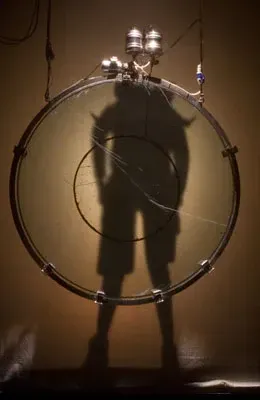
Thankfully the bleakness of this domestic hell is followed by a stunningly visual scene where the child looks through a large circular window and a procession of huge, six metre high flowers are wheeled past. These dazzlingly detailed models are floodlit in washes of colour so they appear like a dream that is by turns sublime and monstrous. It's plain that this is the child's subjective avoidance of the abusive scene we've just heard. A further scene shows the boy become man, physically confronting and overcoming an older version of his father, now played by a performer with what seems to be cerebral palsy.
I'm not going to go into an interpretation of the piece, though some colleagues and I debated it for two hours, just to try and process it in order to get rid of the images from our minds. In debating it, you realised the richness of the work, which is layered with visual and pyschological meanings once you start to disect it, and repays analysis in the same way as a great painting laden in symbolism. The third part of the trilogy, 'Paradiso', an installation in a room, with barely any performance, and lasting only a few minutes, was completely bewildering until we deconstructed its meaning and this turned out to be a key for understanding various meanings throughout the other two performances.
'Paradiso' was limited to a few audience members at a time, who could wander into a brightly lit white room inside a huge cube with what seemed to be a black circle on the wall. As your eyes adjusted, you realised the black circle was a tunnel, through which you could clamber to enter a darkened black room. This room was humid, and though you couldn't see it, you could feel and hear water falling from a height. Gradually your eyes adjusted to see the water, falling like a waterfall from a pipe, but the way the water fell shifted according to a man who was stuck in the pipe, struggling. At the time this experience, while engaging all the senses and enigmatic, was completely mystifying. Only with analysis did we interpret it as an image of a man struggling both to leave and return to the womb at the same time - birth and death in the same moment, and this symbol could then be linked in to aspects of the other two works. The complexity of the work's construction, and the profound level of reading which it required of its audience, was certainly a world away from most theatre I've seen, and gave me a sense of the, for me, largely unchartered territory of live art and experimental theatre - both disturbing and astounding.