Southwark Playhouse
Written by
By James Hadley in London
Another London theatre venue I've only recently become familiar with is Southwark Playhouse on London's South Bank - just along from the Globe Theatre. It's located in some old railway arches, which are wonderfully atmospheric, but have the downside of meaning that every twenty minutes or so the show you're watching is almost drowned out by the rumbling and vibrating of a train going through the tunnel immediately beneath you!
It's one of the larger studio-style fringe venues, with a flexible space that seems to accommodate about 150-200 audience members - the first show I saw there was an endstage presentation, the second a promenade work, the third in traverse. Like BATS Theatre in NZ, their programme is focussed on presenting cutting edge work by emerging practitioners. The space is very sparsely furnished, formed mostly by the brick archways that were already there, with an invitingly mellow bar area in one of the archways which features live music performances later in the evenings.
The first show I saw there, 'Love in (3) Parts' by Lost Dog Theatre. This emerging company had previously toured the show to the Edinburgh Fringe - as seems to be the pathway of most ambitious young companies wanting to tour their new show, and this was their London debut as a company. It was a simple relationship drama, with a singer songwriter performing onstage alongside the man and woman who were the only characters in the piece. While not without its flaws, the characters were so truthfully played and likeable, that you cared enough to get past the gag reflex of seeing two fictitious characters falling in love then breaking up then getting back together yet again.
Having seen a big budget spectacular of a show the night before that failed to make the audience feel anything in particular, this was a reminder that connecting with your audience is so much more important than just about anything else. Being quite a quiet, intimate little piece, the regular underground rumblings of trains passing underneath quite distracted me at first, but the locals are obviously entirely used to this and just phase it out as part of their automatic suspension of disbelief.
My next visit to Southwark Playhouse was to see a late night showing of a work in development called 'HOME' by Tangled Feet physical theatre company (www.tangledfeet.com/). This delightful emerging company has been hailed as one of the most exciting in London, and I could well see why. Their half hour showing featured far more inventive and playful ideas than you see in most full-length finished productions. 'HOME' is a site responsive work that they've trialled in spaces including a wood, nightclub and children's playground, before this staging in the cavernous tunnels of Southwark Playhouse. As the work is lit almost entirely by the performers' torches, this really does make you feel like you're in a cave, with the performers moving the promenading audience around the space like a band of transients.
For most of the work, performers use one person tents, of the pop-up version, like dance partners. Clearly they're primarily a symbol of home - what is it that defines a person's own territory, how do they treat it, will they let others near it etc - it's a fertile subject area for nearly wordless exploration. At one point the performers are inside the tents using their torches to create shadow plays on the tent walls, so they become like magic lantern shows. At another, the tents are inhabited like animals that are made to scurry across the floor, marking and defending their territories. The presentation reminded me of student acting days - it had that lovely energy of passionately enthusiastic performers just trying ideas out, and delighting in engaging an audience directly. It's good to see that sort of experimentation finding a home in such a central London venue, as most of it happens in obscure outer London locations more accessible to emerging talent.
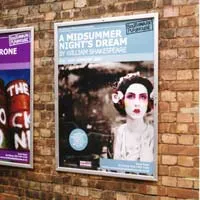
The third and most recent production I saw at the venue was a kabuki influenced production of Shakespeare's 'A Midsummer Night's Dream', directed by Jonathan Man. It was a strongly edited production, with a cast of just six performers, who were all Japanese or of Japanese descent. As well as various kabuki performance elements being integrated into the show, many lines had been translated into Japanese, giving the production a distinct character. Unfortunately most of the performers had far more conviction when acting in Japanese than they did when speaking Shakespearean verse - to the extent that it felt like the overall show would be more intelligible if completely in Japanese.
It's quite a demand upon the audience to keep switching between listening to Shakespearean language and another language which is probably even more foreign to them. The schools audience who I watched the show alongside valiantly tried to connect to the show, but it was a rather subdued impression of the work. Talking to the director afterwards with colleagues I discovered that they had only had two and a half weeks of rehearsal for the production. To me, the complexity of acting Shakespearean text is a challenge in four weeks of rehearsal in itself - add to that the added complexity of being a bilingual production and you're really setting yourself a challenge!
It's good to see there's another reasonably central London theatre which is accessible to these sort of experimentations, often by emerging artists, with the programme being as diverse as you would expect as a result.
Read previous Sets and the City blogs
Feel free to get in touch with any questions (or if you're planning a London visit and want some theatre recommendations) to jamesstuarthadley@gmail.com
Use the comment box below
02/03/09