Snowed-in at Wellington Arts Centre Gallery
Written by
Snowed-in
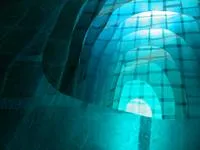
The installation Snow Cave by Wellington-based artist Gabby O'Connor is on view at the Wellington Arts Centre Gallery from 20 July to 12 August. Aptly timed for the peak of winter, Snow Cave is an installation, which explores these unique, man-made spaces usually built for survival.
Read on for the catalogue essay by Laura Preston
Snowed-in
The installation Snow Cave by Wellington-based artist Gabby O'Connor is on view at the Wellington Arts Centre Gallery from 20 July to 12 August. Aptly timed for the peak of winter, Snow Cave is an installation, which explores these unique, man-made spaces usually built for survival.
Read on for the catalogue essay by Laura Preston
Constructed out of twenty-four 2.5m square coloured and lacquered paper sheets, O'Connor's crafted snow cave acts like a life-size diorama. You will be encouraged to navigate around this multi-layered, translucent structure, viewing the changing ice colour and shifts of light, while imagining from the outside the possibilities of what it would be like to be inside.
Gabby O'Connor graduated in 1996 from the Victorian College of the Arts, Melbourne and gained a Masters in Fine Arts from the University of New South Wales in 2003. Based in Wellington since 2002, O'Connor co-founded the collective CRAFTCAMP, has exhibited at Enjoy Public Art Gallery and this year initiated the collaborative project Post Mark at the Michael Hirschfeld Gallery. O'Connor recently moved into a new studio at the arts centre, where most of Snow Cave was created.
Snow Cave will be the first major installation in the new ground-floor gallery, and follows a recent exhibition of new paintings by studio artist Sarah Mortlock, and the popular "Macro Asia" exhibition by emerging photographer Aaron Beck. O'Connor's installation will also coincide with the grand opening of Wellington's new arts centre, which will be formally opened by Mayor Kerry Prendergast on 20 July.
"Since moving into her studio space, Gabby has been consumed by the notion of shelter, polar survival, and the fabrication of this metaphorical snow cave," said Wellington City Council Arts Manager Eric Holowacz. "It should prove a most remarkable inauguration for the arts centre's gallery space."
Snow Cave has been co-organised by Laura Preston. Her catalogue essay will explore the way in which the excavated space of Snow Cave is built and experienced.
Snow Cave opens on Tuesday 19 July 2005, 6pm at the Wellington Arts Centre Gallery, 61 Abel Smith Street, Te Aro. The new centre is now home to 37 artists, performing arts organisations, dozens of community arts courses, rehearsal facilities, meeting spaces, and a growing assortment of creative opportunities.
The Snow Cave installation will be on view in the Arts Centre Gallery from Monday to Friday, 10am-6pm, and Saturday, 11am-3pm, until 12 August 2005.
Catalogue Essay by Laura Preston
What possibly lies within
(or how to build a snow cave)
If you were to spend one night in a snow cave what would exist outside? Would this outside be known from within? Or would the experience of being inside be just as removed from its site, as imagining this caved space from the outside? The diorama that is Gabby O'Connor's snow cave leaves the viewer to contemplate the possibilities of this space, as though shuffling out in the snow.
Choose the site - Consider the depth of the snow. You may need to form the snow into a large pile, and if so, allow time for this pile to bind and crystallise. Ensure the site is free from any avalanche danger. Try to arrange the entrance to the cave so that it is situated on the leeward side of a slope, facing downwind .
Gabby O'Connor's snow cave installation forms a cross-section drawing of a cave, showing the contours of an excavated space. Constructed out of twenty-four coloured and lacquered paper sheets, this life-size, three-dimensional diagram hangs in a modulated sequence.
Generally used as an explanatory or analytical device, the diagram assumes an essential method of making. O'Connor questions the definitive diagram, to affirm that any modelled ideal remains in the text of instruction. Her diagrammatic installation shows how meaning shifts through reading and again through translation. Further recognising that the context of its making, in this case viewing, has multiple and often unknown contingencies.
Snow cave illustrates the shifts of interpretation by its very sculptural shape. This installation of hanging paper sheets invites the viewer to mould a sense of the caved space within, by looking from the sides of its construction and seeing the Snow snow cave form with only the in-between-ness of a glimpse. Through confining the viewing of the inner, caved space to the interstices, O'Connor illustrates the subjective, if somewhat intangible, navigation of interpretation.
Preparing to dig - Heavy digging can be done with a shovel. Though in an emergency use whatever you can improvise with, including your hands.
This diagrammatic snow cave is further reflexive, as O'Connor has yet to make a 'real' snow cave. Like a preparatory drawing, snow cave takes its shape from investigating the terrain of snow-covered landscapes and the skills of survival required.
A snow cave is tentative ground on which to build a subjective sculpture. There are guidelines to excavating this site to ensure self-preservation. As a diagram snow cave is a structure to follow that conversely is informed by following guidelines.
In reading the advice of manuals and the suggestions of internet enthusiasts, who also trial these spaces for escapist leisure, O'Connor discovered multiple ways of making. She collaged these voices into her own particular snow cave, which both draws on and forms a drawing of space.
Tunnelling in - Begin digging a trench downward into the snow. Make the trench as deep as you are tall. Tunnel slightly wider than your body. Ideally the cave end of the tunnel should be at least a foot above the entrance and if possible make the tunnel the length of your body.
Each crafted paper section of the snow cave is cut to form a cave within its structure. The length and height of O'Connor's body determines this space. By engaging the body, both in marking the space and in calling on the viewer to physically encounter its structure, snow cave recalls performance art of post-object concern. This practice in the 1970s held a phenomenological engagement with space, centring the work's experience with the body of the viewer, who brought all the contingencies and points of politicisation to an art framed by experimentation in perception.
O'Connor shifts the phenomenological concern to show that the perception of space is also a representation to be practised. In passing across the diagram that is snow cave, the paper shuffles, recording the viewer physically writing and re-writing the caved space. This physical reading of snow cave reflects the action of excavating a cave, as though the viewer is digging with their hands and seeing its space form by their own body. The viewer is invited to form both a conceptual reading and a physical writing of the work by moving across the work, simultaneously inscribing and revealing the space within.
Shaping the Cave - The ceiling and walls of the cave should be dome shaped and smooth and large enough for you to sit upright. Initial shaping can be done with a shovel; final shaping is best done with a gloved hand.
The fragility of each paper sheet that forms snow cave holds the texture of sculpting ice, emulating the cracks and ice blue colours found deep; often in the openings that glaciers give. As though looking through one of these crevices, the viewer navigates the effect of the backlit blue to consider a shape of the caved space.
Taking up and departing from the practice of James Turrell who, in the mid-1960s started 'plumbing' the space of his light environments to bring a consciousness to seeing. Snow cave tells a self-reflexive story in domestic layers. The craft of the snow cave's making is quiet and intricate in the way it confines the representation of space to a glimpse.
There is no modernist claim here for immersion rather snow cave is open to a resourceful viewing that constructs a personalised cave, an imagined space. The dug out forms that lie out on the floor are evidence of this excavation, consolidating and crystallising under the time taken with the cave.
Finishing touches - A ventilation hole should be made in the top of the cave, with a stick, ski pole or other object. This helps to eliminate carbon monoxide if candles are used and carbon dioxide from your own breathing. Always keep your shovel or digging device next to you in a snow cave, after a storm you may need to dig your way out.
The extremity of the snow cave's proposed site - the inhabitable polar planes - heightens the installation's focus on the resourcefulness of the space. Martin Heideggar understood space in relation to the way a place is formed by a boundary. Rather than seeing it as a line, or a definitive cut, 'a boundary is that from which something begins its essential unfolding' . Snow cave is a diagram that is highly reflexive of its status as a representation, showing that interpretation is as intangible as a glimpse.
If you were to spend one night in a snow cave, afterwards, once you had left and gone, the ice would melt and the excavated space would re-consolidate. It is this potential of space that snow cave illustrates, showing the possibility of space itself - a site where meaning unfolds in a continual state of becoming.
Laura Preston
Snow Cave
Gabby O'Connor
Wellington Arts Centre Gallery
20 July - 12 August 2005