Six degrees of Separation at Jensen Gallery
Written by
Courtesy of Dominion Post
Painting Off Centre
By Mark Amery
Once our abstract painters were close to the centre of attention. Seen by some as overly precious and prim back then as well, yes perhaps, but nonetheless considered on the cutting edge - following the great example of the likes of Milan Mrkusich and Gordon Walters. Not looked upon, as you suspect they are by many now, as increasingly irrelevant next to installation and other new media and its ready appropriation of objects and concepts from the world at large.
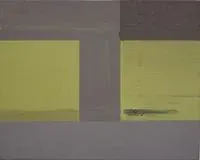
Image:Helmut Federle Basics of Composition LXII (For Gustav Mahler) 1995Courtesy of Dominion Post
Painting Off Centre
By Mark Amery
Once our abstract painters were close to the centre of attention. Seen by some as overly precious and prim back then as well, yes perhaps, but nonetheless considered on the cutting edge - following the great example of the likes of Milan Mrkusich and Gordon Walters. Not looked upon, as you suspect they are by many now, as increasingly irrelevant next to installation and other new media and its ready appropriation of objects and concepts from the world at large.
Image:Helmut Federle Basics of Composition LXII (For Gustav Mahler) 1995Has the world less and less time for those artists who carefully create their own abstract worlds of reference? Perhaps this should make us value these artists all the more. Artists who pay attention to the quiet, slow and delicate; who explore time and space through the movement of material around surfaces. Artists for whom texture, rather than text, comes first.
Ever frustrated as many such artists have been by the restrictions of a nationalist view of our art in the past, as contemporary art practise has broadened in New Zealand it has been a natural step for them to look to an international context. Principle amongst such artists is Stephen Bambury, who has longed worked against marginalisation and confinement by seeking connections elsewhere.
An artist like Bambury today operates between countries and parochially defined labels. Through group exhibition he places himself in a position of in-between; existing in a kind of transit lounge he shares with other fine, established abstract artists internationally, whose work like his is also often about the slippage between forms and definitions.
This has been echoed in the evolution of the stable of Bambury's dealer, Andrew Jensen. Formerly of Wellington and now based in Auckland, Jensen has among New Zealand dealers developed the most international of stables.
Curated by Jensen, the exhibition Six Degrees of Seperation features Bambury alongside one Brit, three Germans and one Swiss artist, all represented in New Zealand by Jensen. Originally staged (with some variation in work) in 2001, the exhibition is being presented in Wellington by new dealer Mark Hutchins Gallery, until 10 November.
As the title suggests, Jensen has curated the exhibition to encourage the viewer to find a common identification from one artist to another as they move around the space - whilst also insisting on each artist's respective sovereignity. With the exception of Imi Knoebel (who sometimes feels like the odd artist out here in his pragmatic approach to formalism), together they share common obsessive interest with surface and serial processes of exploring its manipulation. These are alchemists making mysteries out of the rigorous process of applying and removing of pigments to surfaces, seeking to transcend the ordinary through making us make contact with the ghosts of experiences laid in textures.
From a distance, the shifts in the progression of the art of these individuals from year to year can seem glacial, and rather dull, but at their best they reward time and attention taken. With these many degrees of seperation in this exhibition, viewers will quite naturally find some work that shifts them to an interesting place, and others that remain inert.
In spite of the exhibition title, in this installation Stephen Bambury's work dominates, providing the impression this is still about providing his work international context. His pieces here work with rust, gold, resin and acrylic on aluminium on multiple panels, using Bambury's familiar cruciform composition. They're at their best for me when we're drawn into the heat of their internal pools, with their bubbling and firey blemishes.
Gunter Umberg has been working with the colour black for 30 years, exploring how different forms of application of pigment to different surfaces can produce immensely different effects. His small work here floats off the wall, yet in contrast to this lightness, the attention to application of dry pigment to wood produces a depth and density that with its insistent horizontal sweeps draws you in.
Helmut Federle meanwhile feels one degree between Bambury, Innes and Knobel respectively. Federle's expressive horizontal and vertical gestures connects him to Callum Innes, and this compositional tension in turn connects Federle to Knobel on the next wall. Meanwhile, Federle's use of a basic compositional device of an 'H' on his side (or an 'I' familiar from the work of Colin McCahon), is an echo of Bambury's adoption of this compositional motif. In recognition of this Bambury brought his and Federle's work together with McCahon's for the 1997 Auckland Art Gallery exhibition Necessary Correction - providing a conversation between national and international contexts.
All of these artists work in some conscious way with the architecture of any art gallery they inhabit (hence Jensen's role). In the case of Karin Sanders there is a direct intervention. The work is literally paint applied to the wall and then polished back to provide a kind of shimmering window, white turning transparent in its luminous depth. Its recessive light is in neat counterpoint to Umberg's floating weight. Yet both sanders and Umberg's works provide similar powerful corporeal sensations, as if your body is drawn into the work's very fabric.