Single Currency - catalogue essay to Melbourne Exhibition
Written by
Single Currency - a catalogue essay by curators Danae Mossman and Christine Morrow.
Introducing a single currency between nations is a strategy for opening up borders by loosening regulatory mechanisms and generating seamless flows and exchanges. The exhibition Single Currency is part of Festival Melbourne 2006, the cultural festival of the Melbourne 2006 Commonwealth Games and brings together thirteen Australian and New Zealand artists whose playful and irreverent works reflect on the contradictions and absurdities of nationalist rhetoric.
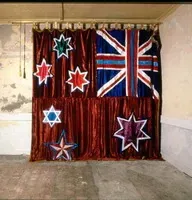
Image: Constanze Zikos, Soft Flag # 1, 1994 mixed media. Photo: Fiona MacdonaldSingle Currency - a catalogue essay by curators Danae Mossman and Christine Morrow.
Introducing a single currency between nations is a strategy for opening up borders by loosening regulatory mechanisms and generating seamless flows and exchanges. The exhibition Single Currency is part of Festival Melbourne 2006, the cultural festival of the Melbourne 2006 Commonwealth Games and brings together thirteen Australian and New Zealand artists whose playful and irreverent works reflect on the contradictions and absurdities of nationalist rhetoric.
Image: Constanze Zikos, Soft Flag # 1, 1994 mixed media. Photo: Fiona MacdonaldThe artists examine the way national identities are shaped and controlled internally through popular and official narratives, but also fluctuate according to outside forces. The dialogues that take place between the works trace the heterogeneous influences of postcolonialism and globalism on our sense of place.
Festival Melbourne2006, the cultural festival of the 2006 Melbourne Commonwealth Games, provides the motivation and reference point for this exhibition. The assembly of sporting representatives of the Commonwealth's member nations in Melbourne this month prompts us to reflect on the ways identity and nationhood are bound together. Australia and New Zealand share geographic proximity, a common language, similar patterns of colonisation, trade in goods and services, and joint military campaigns. Our relations have been so close that, in 1901, New Zealand was invited to become one of the federated states of Australia. As a kind of running joke, it's popularly thought that Australia and New Zealand are only a few years away from instituting a common currency and always will be. But recent decades have witnessed the slackening of New Zealand's and Australia's allegiances with Britain, and changes in our relationship with one another, as each nation has sought to establish itself as an economic and cultural player in the regional and global arena.
In a reversal of how national loyalties are usually sustained - through a partial suppression of individual identity and personal sovereignty in favour of group identification and collective allegiance - the artists in this exhibition foreground personal experience and emphasise individual subjectivities ahead of group imperatives. They also acknowledge how newer global networks might offer the potential of cross-border allegiances that can transform or transcend older loyalties: nationalism, colonial ties to Britain, and its legacy perpetuated through the institution of the Commonwealth.
ALIENS
Single Currency uses the motif of hybridity to examine a fragile psychological or physical positioning between two places, real or imagined. Works by Fergus Binns, Adam Geczy, Alex Danko and Daniel Malone explore subjective points of view located ambiguously between exile and belonging.
Binns' art works cut loose the tourist image of Australia and send it into free-fall. One painting, Nalanji Dreaming, depicts the aeroplane of the same name (one of the two Qantas planes adorned with dot paintings) crashing into the sea. Other paintings feature staged rituals based on masquerade. Humans are disguised as animals, a koala appears as a bear, and even a Wookiee puts in an appearance, suggesting identity is a type of performance rather than a fixed positioning. Binns' paintings question the authenticity of the tourist's consumption of place; they play with the misrepresentations produced by tourism when it commodifies cultural difference to meet the global demand for contact with the exotic.
Adam Geczy adopts multiple subjective positions, and simultaneously homogenizes them, in a work that bridges a gap between learned values and felt experience. He transforms the gallery wall into a blackboard featuring repeated handwritten lines that read I must learn to be patriotic demonstrating one way in which dissenting voices can be educated through repetitive punishment. The orthographers of Geczy's work are knowing and insincere, but they go through these motions in order to humour a system that hopes to funnel them out as loyal citizens at the other end. By using symbols of detention, punishment and control, Geczy evokes Australia's current policy of detaining asylum-seekers while also identifying patriotism as an often soulless mantra.
In the centre of Alex Danko's triptych, bright text glows against a dark field spelling out My fellow Aus-tra-aliens. The words seem impersonal, appearing as the message of an omnipresent being in the night sky. As a speech act, the phrase creates and circumscribes a national grouping of people, yet perversely it can only locate their point of commonality in their shared outsider status. The two red-faced humanoids either side of the central drawing are fair-skinned interlopers, maladapted to the harsh sun that burns their skin or perhaps they blush with embarrassment, recoiling from the role of insider that the speaker imposes on them. Danko's art work reminds us that borders are in constant need of patrolling to keep citizen separate from alien, but simultaneously demonstrates how easily these categories can break down.
Other complexities of authenticity and experience are explored in Daniel Malone's Kum of Sum Yung Gai, made in collaboration with Denise Kum. A monitor sits in the middle of a domestic wall unit replete with inexpensive Chinese consumer objects. The monitor plays a video of Malone transformed by prosthetic eyelids into a stereotyped Asian man. In an almost slapstick performance Malone tries to get inside local Chinese culture: he dresses up and wanders around new housing subdivisions with large populations of Asian immigrants, eats in food halls, and watches Chinese television programs. The work was exhibited in the late 1990s, coinciding with increasing levels of immigration into New Zealand, and the accompanying paranoia about the impact of Asian migrants. By playing the stylised role of outsider, Malone attempts to bridge cultural difference, but the uncomfortable isolation he experiences reinforces his exile.
BRAND POWER
Flags, currency, mascots and coats of arms are all recognisable symbols that have been used for centuries as branding tools. In the international marketplace these signs foster associations that are carefully managed promotional exercises - think clean, green New Zealand, and sunny, laid-back Australia. What happens when these signifiers are subverted, when the story changes?
Daniel Malone's inverted New Zealand flag blows in the wind, the blue field changed to black and the union jack curling with kowhaiwhai (a traditional Maori design most often seen on the meeting house ridgepole and rafters). This flag speaks of the contested history of a nation but also carries its own story. It was constructed in response to the removal of Dianne Prince's Please Walk On Me Flag which was exhibited in Korurangi at the Auckland Art Gallery in 1996, a time of hot debates over what constituted contemporary Maori art. A member of the public complained about Prince's flag and the police removed it from the exhibition, deeming the work was in breach of the 1983 Flag Act. The flag Malone shows here has been swapped with members of Damn Native / Heart Music crew, and was hung behind them during performances, as well as appearing in other contexts outside of institutional settings. Because the flag has been dispersed through culture in something of a viral way, its meaning is adaptable and its ownership has been collectively adopted, not enforced.
Daniel du Bern presents ice-cold beer to welcome visitors to the exhibition launch. This work, NZL, alludes to the stereotyping of New Zealand men as beer-swilling blokes. Du Bern utilises an existing product on the market (New Zealand Lager) to draw our attention to the nation's local and international brand positioning. The beer's packaging features a green fern, projecting the nation's clean, green image and a black background, an obvious link to the All Blacks, New Zealand's great sporting heroes. But the rugby team's recent headline-grabbing antics both on and off the field, subverts the aspirational message such branding seeks to promote.
Raafat Ishak's wall painting Young sailor consumed with ascent and descent, 2006 reworks national symbols to express hybridity. The two animals from the Australian coat of arms, a kangaroo and an emu, are surreptitiously engaged in sexual intercourse while camouflaged within their surrounds. What strange progeny will result? Ishak is perhaps proposing a new mythic framework to express Australia's national origin: a creation story complete with native animal versions of Adam and Eve, succumbing to their own temptations in the garden. The work spans both sweet, hedonistic pleasures as well as a darker view of contemporary life that our country's fucked. However, the depiction of reciprocity and exchange between unrelated species seems to be a hopeful one and suggest instead that our identity is fluid and multiplicitous.
If Ishak's work depicts Australia's animal mascots demonstration their mutual affection, their New Zealand counterparts don't find it quite so easy to get along. Tony de Lautour's Prize Fighter features its own revisionism as he uncovers (or invents) some of Aotearoa/New Zealand's darker historical moments, capturing a grunge aspect of our colonial way. The artist overlays the depiction of an heroic struggle onto an ancient landscape. Lautour has reworked a found canvas, using New Zealand's national symbols to tell the story of a bolshy kiwi and drunken lion brawling in Southern gothic fashion.
Jacquelyn Greenbank's practice gently poses questions about the role of the British monarch for the people of Aotearoa/New Zealand. God Speed Queenie features a British flag stitched upon a suitcase containing a pavlova topped with kiwi fruit. A whistled interpretation of the tune Pokarekare Ana (an early 1900s Maori love song made famous by opera diva Kiri Te Kanawa) floats out from inside the dessert. The work has multiple readings including that the mother country is pinching this ‘Australasian' icon as well as the idea that the Queen's colonial subjects are proudly offering her a token. Greenbank's coy and satirical homespun works reference the complex relationship between the British Empire and its colonies, and here, the pavlova becomes a symbol of the amnesiac effect of colonisation as cultures and customs become blurred, appropriated, shared and shifted.
SOMEPLACE
Our identity is inextricably tied to place; nationhood requires that we possess the land literally and imaginatively. However, in postcolonial societies, debate focuses on what it means to be from a country whose colonial settlement was based on displacing others.
Sue Guilfoyle's photographic art works document her environmental activism. She displayed mock real-estate placards on rural and urban fences as if to taunt weekend auction-goers. The artist exploits gaps between national myths and social actions with screenprinted slogans including We treat the land like dirt and The golden soil is black and blue. Guilfoyle mines a seam of humour that contrasts the way popular and official narratives revere the land with the environmental damage produced by commerce and industry as well as the displacements of colonisation. The wild and rural nature of the Australian landmass is always mythologised as sacred territory in tributes including Australia's anthem, Advance Australia Fair, and Dorothea Mackellar's popular poem, My country. But as nature increasingly shrinks back to make way for gated communities on the outskirts of the nation's capital cities, Guilfoyle exposes such myth-making as a nostalgic attachment to what is already lost.
The indeterminate place created by J.R.R. Tolkien in his novel Lord of the Rings is the subject of one of Daniel Malone's art works. Malone examines how the New Zealand production of a film based on the book symbolically overlays Tolkien's imagined world onto the nation's landmass and creates cultural tourism for New Zealand as a Lord of the Rings theme park. Demand for movie merchandise created pandemonium among fans. Who needs a Bilbao Guggenheim when you've got Middle Earth? Malone's coin, a counterfeit souvenir of the film, acknowledges the seductions of foreign money but, in true Hollywood style, it's actually a fake. It remains an empty signifier, a worthless currency propped up by hype.
Daniel du Bern's NOHWERE is also a slippery place. It's not exactly nowhere, nor is it somewhere. The artist displays an opened crate that is synonymous with touring artwork, yet the soil it contains suggests some place of origin. The crate's contents spill out, purging a live and virulent noxious weed whose common name is Wandering Jew. Growing widely across New Zealand and Australia, this introduced species is a potent symbol of colonial imperialism and diaspora, with its muddied distinctions between what is imported and what is home-grown, assembled and shipped out. Even the title of du Bern's work quotes a quotation, in a playful distancing of its own origins. The letters in the title of Samuel Butler's 1872 novel Erewhon (itself the word ‘nowhere' written back-to-front) slip so they appear here as NOHWERE, painted faintly on the wall in the typeface of the famous HOLLYWOOD sign, whispering their giant nothings.
Julie Gough's cushion-like parcels of the Australian landscape suggests another kind of fiction: the carving-up of the land as a colonial imperative. As evidence of the process, Gough presents map fragments of states and territories, equalized in size and upholstered with the flag, installed together with agricultural tools that are more suited to hobby-farming than sub-dividing. Maps represent the political and cultural designs we have on the land, but Gough's designs on the land are more literal. A pogo-stick makes an appearance in the line-up of farm tools. With this implement dipped in paint, Gough trampled the symbolic pieces of Australian landmass, subverting the common assumption that the dot is a generic Aboriginal mark and acting out a type of land-reclamation practice of her own.
HOME MAKING
Home is the realm of the personal, the domain in which individuals can act and claim sovereignty, choosing to embrace, modify or reject external influences. Counterintuitively, forces of globalism are often observed to usher in a return to the local, the domestic and the home-made rather than spreading internationally homogeneous products of processed culture. Several works in Single Currency focus on domestic space and the suburban back-yard, reflecting that the home provides a point of orientation amid global shifts and instabilities.
Jacquelyn Greenbank's crocheted high tea setting appears to carry on a British colonial tradition. But the inclusion of a local product, in the form of lamingtons, opens up this stuffy ritual and adapts it to antipodean conditions.
Sriwhana Spong's video work Muttnik offers a more poetic and personal exploratory journey. The title of the work refers to cross-breed dog included in the second Russian Sputnik satellite mission and evokes the artist's concerns with hybridity and exploring space. Spong carries a super-8 camera through her back yard and documents the bricolage of sculptures she has assembled there. Intimate totems or shrines she constructed from plastic bags, coke bottle lids, flowers and cigarettes are a reference to her Balinese heritage, which finds its outlet within her private space. In the film's dream-like sequences, Spong melds personal memories and rituals to customize her physical and psychological landscape.
Constanze Zikos repositions a flag within domestic space by presenting it as a soft furnishing. This flag sweeps the ground in a gesture designed to bring it down to earth. Created for a double bed, it highlights both how patriotism might operate as a form of seduction and also that breeding the nation's citizens is a patriotic duty. The flag's reworking in velvet gives it glam overtones that subvert the rugged masculinity of a virile and heterosexual national identity. Zikos gives the flag multiple identifications by shrinking back the Union Jack to make room for other insignia and acknowledging that even the constellation of the Southern Cross is elastic enough to incorporate the Star of David. Soft Flag #1 questions the cosiness of national security and asks how Australia's identity is currently being shaped by its international relations.
By pitching his tent in the VCA Gallery, Nathan Pohio makes a temporary home and reflects on themes of impermanence and transit. The tent walls are a screen for footage of the Maori rodeo star Merv Church, juxtaposed with floating text ‘Buenos Dias E Hoa' in an absurd melding of Spanish and Maori. This quotation is from the 1984 New Zealand film Came a Hot Friday, a comedy that explores notions of belonging and otherness through The Tainuia Kid, an eccentric young Maori man who believes he is Spanish and dreams of becoming a cowboy. Pohio reimagines the film genre of the Western, a staple of American popular culture, through a personal and local lens.
Artists are brought together in Single Currency not as ambassadors representing their countries of origin, but as individual explorers and observers, responding to the everyday, the political, the contested. This exhibition features self-reflexive explorations of what it might mean to be antipodean colonies. They create humorous slippages of meaning and question some of our national certainties without attempting to provide easy answers. The artists playfully critique imperialism's homogenising function and explore some of globalism's powerful absurdities. By subverting political, cultural, domestic and personal signifiers, the works lay bare the institutional discourses that construct national and cultural identity.
Fergus Binns (Aus), Aleks Danko (Aus), Tony de Lautour (NZ), Daniel du Bern (Aus/NZ), Adam Geczy (Aus), Julie Gough (Aus), Jacquelyn Greenbank (NZ), Sue Guilfoyle (Aus), Raafat Ishak (Aus), Daniel Malone (NZ), Nathan Pohio (NZ), Sriwhana Spong (NZ), Constanze Zikos (Aus). Curators: Christine Morrow (Aus), Danae Mossman (NZ)
Presented by Festival Melbourne2006, the 2006 Commonwealth Games Cultural Festival. Festival Melbourne2006 celebrates the breadth of culture and art from across the nations of the Commonwealth.
The Festival is an integral part of the Melbourne 2006 Commonwealth Games, and it is proudly funded and supported by the Victorian and Australian Governments.
Single Currency at VCA Gallery
40 Dodds Street
Southbank 3006
T +613 9685 9400
3 - 25 March 2006
Opening: Thursday 2 March 2006, 6-8pm
Thanks to the The Physics Room and the writers/curators for their kind permission to publish this essay