Sets and the City: West End musicals
Written by
By James Hadley in London
When people talk about going 'up the West End to see a show' they're generally meaning a musical. Like Broadway, London's West End (specifically Soho and surrounds, which is West of the actual mile square city of London) has become increasingly dominated by musicals. Hit 'straight' plays struggle to transfer to the theatre capital unless they have some celebrity names attached. The notable exception is the production of Agatha Christie's 'The Mouse Trap', which is legendarily still running after 56 years at St Martin's Theatre - a world record.By James Hadley in London
When people talk about going 'up the West End to see a show' they're generally meaning a musical. Like Broadway, London's West End (specifically Soho and surrounds, which is West of the actual mile square city of London) has become increasingly dominated by musicals. Hit 'straight' plays struggle to transfer to the theatre capital unless they have some celebrity names attached. The notable exception is the production of Agatha Christie's 'The Mouse Trap', which is legendarily still running after 56 years at St Martin's Theatre - a world record.The hottest tickets in London at the moment are to the musicals 'Wicked' and 'The Lion King' it seems. 'The Phantom of the Opera' (1986) and 'Les Miserables' (1985) are still running and still doing good business - the former recently rebranded 'London's greatest romance' and the latter now advertising its status as the world's longest running musical ever. Apart from opera, musicals charge the highest ticket prices - around sixty pounds for a good seat (around 150 NZ dollars), and are presented in some of the most lavish theatres in London. Thankfully you can usually get these seats at half price if you shop around. But you do wonder why do musicals dominate commercial theatre in London?
Now I should own up straight away: I love musicals. Whether it's Sondheim, Lloyd Webber, Rodgers and Hammerstein, Lerner and Loewe, Kander and Ebb... I'm hanging out to see 'Wicked', as, like most musical fans in NZ, I purchased the original cast recording through Amazon years ago, knowing I couldn't expect to see a production in NZ for perhaps a decade after its opening. With the huge financial risk that goes with musicals, the scale of the NZ theatre industry just can't support the multi-million dollar productions that can be seen in New York or London. I'd love to see more boutique productions of musicals in NZ, but when I looked into the costs of producing a Sondheim musical a few years ago, I too realised how prohibitive it can be (particularly if you're going to have a live orchestra!).
So straight away, there's a big reason for musicals' dominance of the West End - most of us have access to decent professional productions of plays locally, but these lavishly spectacular productions are only viable in a major city. Going to see 'Phantom' is often on a London tourist's top ten must do list, alongside the other iconic London attractions - and without the tourists who attend in their droves, none of these productions would run anywhere near as long, surely. For most, going to see one of these productions is a real 'event', and while most no longer dress up for the experience as they used to, the sheer opulence of these historic venues makes you feel a sense of occasion.
Two more of the most popular London musicals currently are 'Hairspray' and 'Mama Mia'. What's interesting is that both productions have reported increased attendance since the film versions of these shows were released - despite the fact that tickets to the live shows cost so much more than going to the cinema. It's suggested that people want to know what they're paying for before they invest sixty pounds, and if they loved the film version, experience has taught most that they're likely to have an absolute ball at the live production where the experience is so much more of a lived experience. This must explain the success of productions of 'Dirty Dancing', 'Chicago' and 'Grease', which are also enjoying long West End runs currently.
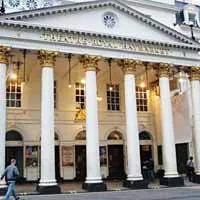
The first West End musical I went to see on this visit was the new musical Marguerite at the Theatre Royal, Haymarket. The score is by Michel Legrand (famous for songs like 'Windmills of my Mind'), the lyrics and book by the team behind 'Les Miserables' and 'Miss Saigon' - Boublil, Schonberg and Kretzmer - so that's a pretty impressive pedigree. And while it's not in the same league as 'Les Mis', this is a sophisticated and beautifully realised musical, with lovely songs, a solid and engaging plot (inspired by 'La Dame aux Camelias') and a faultless production starring (in the true sense of the word - these are two 'star making' performances) Ruthie Henshal and Julian Ovenden.
The show's set in Paris during the WWII German occupation, and is about a French singer who has an affair with a German army commander, but falls in love with a younger man who has links with the French Resistance. While it's not a spectacle in the manner of most big musicals these days - the cast is about 15 which is comparatively small for a musical, and there are scarcely any special effects - the production is beautifully realised. The set features various tarnished mirror panels that fluidly move in and out to suggest various Parisian interiors and exteriors - similarly characters and set elements generally move in on automated strips of the stage, which adds to the slick pacing. By the time a musical gets to Broadway or the West End these days, you can be sure it's had a degree of development and technical polishing we can only dream of in NZ theatre - because there's so much money invested.
Reviews have said that 'Marguerite' 'raises the bar for the modern musical', and what's unusual about the show is it's really solid and dramatically compelling plot. Most new musicals recently have been of the 'jukebox' formula that writes a linking plot around the well known songs of a popular band (like Abba for 'Mama Mia') or are of a comic nature with a lot of pastiche of past music styles. 'Marguerite' is an original work, and watching it is a classy and emotionally moving experience. It's not far from the world of the Edith Piaf biopic 'La Vie en Rose' in terms of its content, and makes for a very sophisticated date for couples. I was surrounded by middle-class, middle-aged couples in the audience - Americans on my left, French behind me - that tourists make up the majority of an audience when you see a musical is a given.
More typical of the spectacle that you can expect when you go to see a West End musical was my experience of The Lord of the Rings. Yes, if you heard anything about the fact that they were making a musical of the trilogy, it was probably a wisecrack. Many felt the show was an overambitious flop. But it actually attracted a lot of favourable reviews too, and I can see why. I got a ridiculously cheap ticket to sit in the very back row of the gods - so I literally had an almost birds eye view of the stage, but as the production was about to close in two days, I decided to give it a try. And am very glad I did.
The star of the show was its set. Staged at the Theatre Royal, Drury Lane (where Nell Gwynn caught Charles II's eye), the proscenium arch and boxes were all covered behind a thick weaving of branches, and the overall look of the production gave the feel of being in a dark forest most of the time. The most impressive stage revolve I have ever witnessed was what impressed the most. It looked like a cross-section of a tree trunk, the whole thing revolving, but its various sections were sub-divided so they could revolve at different heights or speeds. There was a circle in the middle that could rise up like a precipice, or descend like a chasm for the Ring to be thrown into, then there were about 14 subsections of the trunk which were often used to rise and fall as the whole stage revolved, creating a cross-country landscape as the Fellowship went on their journey. These various sections also allowed for lots of varied levels to the stage during scenes of combat, which made it quite dynamic.
The other design stand-out for the production was the costumes of the dark riders (I'm probably using the wrong term - I'm afraid I'm not really a LOTR afficionado!). Because of the degree of low lighting and smoke, these genuinely looked like people riding horses, and at first I thought there must be three people - two inside a sort of pantomime horse costume. Ingeniously, it was actually a single stilt walker, with a costume which sat out at the waist to create the horses back behind the rider and the horse's head in front, operated like a rod puppet. Lots of hanging black drapes and expert puppetry created an amazing illusion of a large horse beneath the rider. Less successful were the costumes of the Ents, which were impressively high stilt-walkers... though not quite believable as trees.
There was a folk music sound to many of the songs, with an interesting blend between the Icelandic folk rock group Vaartina and leading Bollywood composer AR Rahman who collaborated on the score. Only a few songs stood out, and performances were sometimes more like place-holders to remind you of those in the film trilogy. In fact they had to condense the plot so much to fit it into a three hour musical (the length of just one of the films) that you felt it relies upon people having seen the films first to make sense of the show. This means that characters were two dimensional at best, except for Frodo and Sam and Galadriel - the only characters that gave their performers a chance to shine.
Nevertheless, the four-tier audience, many of them young people and families, were behaving like they were at a rock concert in response to some of the songs. Perhaps because it was the fourth to last performance, that Thursday matinee had not a single empty seat in the house. I don't know how many seats that is, but when you consider there would have been about 1000 people on my balcony tier alone... Yet such a lavish production, with lots of explosive pyrotechnic effects and a cast of about 30 must require such a large venue to be mostly full in order to make a profit.
I don't think I would be in a hurry to be making that kind of financial gamble on a new musical, but I'm glad someone does have that kind of money, as this scale of spectacle feels like an opulent Las Vegas oasis of excess within the theatrical landscape. The sheer level of thrills to such a production means it has more in common with a visit to Disneyland than going to see a play at the National Theatre. And hence it attracts tourist audiences and young people who would normally never consider going to theatre. This is an 'experience', like going to see a touring 'Cirque du Soleil' production, and so gets past the usual preconception barriers that put many off taking a risk on smaller scale theatre productions. I have to admit that, for outright entertainment value, these large-scale musicals are hard to beat. I guess the challenge is to use such theatre-going experiences to lure confirmed non-theatre-goers into exploring what other modes of performance are on offer. And in many ways, it seems appropriate if these pure entertainment productions are what provide the financial backbone to the wider industry - sometimes we can all do with a reminder that theatre is primarily about connecting and entertaining.
Image: The Theatre Royal Haymarket where 'Marguerite' is currently playing.
Read previous Sets and the City blogs
Feel free to get in touch with any questions (or if you're planning a London visit and want some theatre recommendations) to jamesstuarthadley@gmail.com
Use the comment box below
11/08/08