Sets and the City: Puppetry at Unicorn and National
Written by
By James Hadley in London
In New Zealand, Capital E - the National Theatre for Children does an impressive job as the country's leading provider of children's theatre. As you might expect, there are a whole host of professional companies in the larger UK industry focussed on making theatre for children. I visited probably the leading London venue for children's theatre, the Unicorn Theatre, recently. By James Hadley in London
In New Zealand, Capital E - the National Theatre for Children does an impressive job as the country's leading provider of children's theatre. As you might expect, there are a whole host of professional companies in the larger UK industry focussed on making theatre for children. I visited probably the leading London venue for children's theatre, the Unicorn Theatre, recently.They do have a resident company, but most of their programme consists of visiting companies' seasons. Not just from around the UK but frequently from European companies, as was the case with my first visit.
I went with a colleague from the Arts Council to see a show called Pero, presented by Speeltheatre Holland, a children's theatre company from the Netherlands. It's won awards at an international festival of children's theatre in Florida, and you can see why. It's a totally entrancing piece, across between a Brecht/Weill cabaret and the Teletubbies.
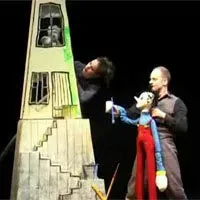
On one side of the stage sits the sun, a female opera singer enthroned and playing various wind instruments when she's not singing. On the other side of the stage sits the moon, a male singer who is similarly enthroned and plays the keyboard. Between them, are two tall and skinny houses - they look like dolls houses. One belongs to a baker puppet, the other to a washerwoman puppet. Everything is in white and grey, and as two performers emerge to animate the puppets, the story unfolds like a beautifully illustrated picture book. The fronts of the houses open to reveal the puppets about their jobs - one by daytime, the other by nighttime. Due to the impossibility of their romance, a colourful house painter comes along to whisk the washerwoman away from her baker... Every detail of the production had been beautifully designed, with a childlike imagination that had mice scurrying around the houses, washing lines being pulled back and forth across the stage, and showers of confetti-like snow.
There was also a beautiful live soundtrack - and indeed the show felt it had been designed with the sort of lavish art direction usually reserved for opera. But the visual magic of the stage mechanics was so appropriate for a production attended by 7-12 year olds. Sitting in the audience you could feel their imaginations responding, and when the show finished they flooded the stage to look in more detail at the intricate set elements and puppets.
The actual puppets in 'Pero' were effectively hand-manipulated dolls. Quite at the opposite end of the puppetry spectrum in terms of technical complexity were the puppets in Warhorse at the National Theatre.
This is a stage adaptation by Nick Stafford of the children's book by Michael Morpurgo. Its first season earlier in the year sold out completely, with rave reviews including one from 'The Times' which said it was 'So exhilarating it makes you rejoice to be alive.' Such was the response that the National brought it back for a second season which began a couple of months ago and continues into the new year. It's perfect family entertainment, but such is the appeal that the audiences are mostly adults. And hands down the stars of the show are the puppets.
As the show is a tale of a horse raised in Devon then commandeered by the army for use in the First World War, the company decided to represent all the horse characters with puppets rather than humans. As the puppets were to convey the physical presence of real horses alongside the actors playing the human characters, they had to be lifesize creations. The National commissioned a South African puppetry company, Handspring to design and operate the horse puppets, and the end result is nothing less than magical.
In the early moments of the show, a foal appears onstage. Such is the detailed naturalism of its movements that it takes several moments before you can make your brain believe that it's just a puppet, manipulated by three puppeteers. One operates the head, their hands operating it from inside, a bit like a glove puppet, the other two operate the fore and hind legs, in the manner of rod puppets. About ten minutes later (or a couple of years later in the narrative), the foal is replaced with a fully grown horse in one of those spine-tingling transformative moments. The adult horse puppet was easily the most impressive puppet I have ever seen. Again it was operated by three humans, but this time all of them are inside the puppet. One stands within the head, operating the eyes, mouth and ears. The second operates the front legs, which are fully jointed and move just like a real horse's legs, somehow attached to the movements of the puppeteer's legs with rods. The third puppeteer operates the hind legs in similar fashion, but also has the horse's tail to flick about from time to time. Somehow this three-strong team manage to convey the full movement vocabulary of a horse in perfect detail. The puppet is even designed so it can be made to gallop across the stage while carrying a human rider on its back. It was quite an astounding sight to behold, reducing the audience to childlike wonderment - and more than a few tears, I can assure you. It made you wonder why we don't more often feel such a sense of magic when we're sitting in the theatre.
Pictured: Pero
Read previous Sets and the City blogs
Feel free to get in touch with any questions (or if you're planning a London visit and want some theatre recommendations) to jamesstuarthadley@gmail.com
Use the comment box below
10/11/08