Sets and the City: Les Ballets C de la B
Written by
By James Hadley in London
London's (and in fact England's) foremost venue for dance is Sadlers Wells, which just happens to be five minutes away from where I'm working at Arts Council England's London office in Clerkenwell. I often pass trucks loading scenery into the theatre on my way to work.
The venue's programme is like having the dance components of the NZ International Festival of the Arts available year round, as it's often host to companies from around the globe.By James Hadley in London
London's (and in fact England's) foremost venue for dance is Sadlers Wells, which just happens to be five minutes away from where I'm working at Arts Council England's London office in Clerkenwell. I often pass trucks loading scenery into the theatre on my way to work.
The venue's programme is like having the dance components of the NZ International Festival of the Arts available year round, as it's often host to companies from around the globe.It was in a previous NZ International Festival of the Arts that I first experienced a production by Belgium-based contemporary dance company Les Ballets C de la B. I remember baroque musicians playing their instruments while lying on their backs on the floor, and the dancers dancing over them. The overall impression had been one of a postmodern blending of modes of artistry - all of the finest quality - that was hugely contemporary, at the same time as drawing knowingly on hundreds of years' of cultural traditions.
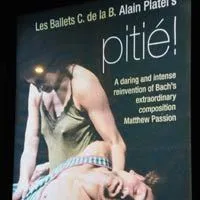
The same could be said of their latest show, 'Alain Platel's Pitie', which is one of the most stunning and challenging contemporary dance works I've ever seen. It's inspiration is Bach's 'St Matthew's Passion' chorale, but it's been adapted very broadly to become a contemporary response to this religious work which is in parts wholly secular, in others striving to transcend cynicism and reach some sort of spiritual transcendence. The company's director/choreographer Alain Platel writes on their website of their grappling with a largely atheist company's responses to the story of Christ's passion, explaining that much of the work is an exploration of compassion and the challenge of accepting human suffering and mortality.
You'll get the idea of how liberal the adaptation is when I explain that the on stage orchestra is a blend of rock group, jazz band and orchestra, with various world music sounds thrown in for good measure. The classical baroque score is sung by a mezzo-soprano, who acts as a mother figure within the work, and a soprano and counter-tenor whose voices are very similar despite one being a woman and one a man. While they mostly sing the classical score, from time to time they also speak, shriek, wail or ad lib a few bars of gospel. And then there's the African flute player who vocalises through part of the show in a manner similar to throat singing - a very abstract and emotive sound that this particular musician somehow manages to intersperse, note by note, with his flute playing.
The stage looks like some contemporary art installation from the Tate Modern gallery. Two large structures of cheap timber dominate. One like a big tower, which dancers throw slabs of rock up onto at various points in the performance, the other a more horizontal block on which the band play, which also has holes for amplification at either end, into which dancers sometimes whisper or wail confessions or prayers. Above the entire stage what look like cow hides dangle down forlornly from ropes. One conceals a noose from which a dancer spins in faster and faster revolutions like a whirling dervish at one point.
As for the dancing, it began with a virtuoso solo from the lead male dancer of the company. His movements seemed to be largely based on a study of autism - a vocabulary of spasms and eratic, almost violent flailing about of limbs, blended with amazingly supple contortions of the body, and a sort of hip hop influenced collection of flips and spins. I don't have the formal language to describe dance, but this felt like it was reinventing existing dance moves anyway.
As the company of ten dancers filled the stage, their movements often seemed to be geared towards an enhanced awareness of the body as flesh or meat. There were duets in which the dancers would grab handfuls of their own or each other's skin, or hurl their bodies against each other so you could sense the wind being knocked out of them. The performers were dressed in everyday rehearsal clothing, and it felt like these often disturbing interactions were like an antidote to the lack of contact between oblivious individuals passing in the street. Or perhaps attention was being drawn to the vulnerability of the body, to generate consideration of its mortality. Either way, it seemed to be so very much of our time. Both disturbing and sublime at the same time.
When the piece came to a climax of the mezzo soprano singing an aria with a crescendo that sounded like it should shatter glass, then hurling a huge axe into the top of the wooden kitchen table - which prompted all the lights to fall from the theatre rigging and flail around from their safety chains... Well, it was a startling moment! I think many in the audience were bemused - as was I to an extent. But aside from trying to understand and interpret such a complex piece, there was much to admire in its blending of the troubling with the transcendent.
Read previous Sets and the City blogs
Feel free to get in touch with any questions (or if you're planning a London visit and want some theatre recommendations) to jamesstuarthadley@gmail.com
Use the comment box below
16/02/09