Sets and the City: Edinburgh Fringe Festival '08
Written by
By James Hadley in London
Considering that the Edinburgh Fringe Festival is the biggest arts festival in the world, it's not surprising we hear news from it on the other side of the planet. It's still on most NZ theatre makers' wish lists of places they want to tour a show to one day, despite being so ridiculously expensive to do so. Even shows coming to the Fringe from elsewhere in the UK stand to make a financial loss on their seasons in most cases. So why present a show at the Edinburgh Fringe?By James Hadley in London
Considering that the Edinburgh Fringe Festival is the biggest arts festival in the world, it's not surprising we hear news from it on the other side of the planet. It's still on most NZ theatre makers' wish lists of places they want to tour a show to one day, despite being so ridiculously expensive to do so. Even shows coming to the Fringe from elsewhere in the UK stand to make a financial loss on their seasons in most cases. So why present a show at the Edinburgh Fringe?For NZ theatre makers, it makes more sense to tour to Australian arts festivals rather than come all this way. But what I didn't appreciate before my five-day visit in the middle of the Fringe Festival was what a rare circumstance the Fringe presents.
In London, it's very easy to feel invisible, and there's a sense of hierarchy to the theatre industry which can create a sense of exclusion. But much of the industry goes north for the Edinburgh Fringe, and somehow this creates more of a sense of community than you usually feel in London. (A little like Kiwis bonding over being from the same country when they run into fellow Kiwis in London, in Edinburgh the same thing can be true for Londoners... though perhaps not to the same extent!) The 'open access' policy of the Fringe also creates something closer to a levelled playing field where non-professionals are considered beside seasoned professionals (although there's still a hierarchy in terms of what venues they're playing in).
Perhaps because of this, it seems the Fringe really is a place that you can be 'discovered'. Every year, there are 'unknowns' who bring work to the Festival and leave with five or four star reviews or 'Fringe First' awards. Some are even approached by promoters or agents here. I didn't think that sort of thing actually happened - but, when I started chatting to the person sitting next to me on the 'Flying Scotsman' train up from London, they turned out to be a talent scout.
While there are thousands who flock to the Fringe from far and wide to watch shows, there seem to be just as many theatre hopefuls competing for their attention and money. I'd often heard that the average audience size at the Festival is about four or six, now I can see why.
It's not so much that the tickets are getting prohibitively expensive for non-professional theatre ( £10/NZ £26 on average), but more that this grey yet picturesque Georgian city is completely inundated with shows. Every spare room in the city centre seems to get turned into a theatre venue for the three weeks of the Festival. Every second person walking down the street seems to be a theatre-maker - and they literally hail from all around the world. In this year's Fringe there is a sub-festival of works from Eastern Europe, many from Poland, and another subsection is called the InvAsian Festival, with traditional and contemporary performance works from a representative cross-selection of the continent.
The only New Zealand show I'm aware of that's visiting this year is Please Don't Feed the Models byToi Whakaari - NZ Drama School graduate Sara Standring. Sara developed this satire of her experiences as an international fashion model for her graduation solo and premiered the longer version at BATS Theatre. Now she's performing at Edinburgh, after two years of attempting to get the show here. She and I caught up in London when she was passing through, and she told me about the London-based producer who has helped her get the show up to Edinburgh. It seems there are various promoters who select a stable of shows to go up - mostly comedy. In fact there are probably various NZ comedy shows on in the Festival. I have to admit I don't follow that side of the Festival as much.
This year (I think for the first time) there are more comedy shows on offer than are listed in the theatre section of the Fringe. There have been calls for the comedy part of the Fringe to be separated off into its own Festival, and certainly that portion of the programme is larger than most comedy festivals found elsewhere. The 288 page programme is of a scale that rivals some telephone directories in the number of its entries. It took me the whole four and a half hour train journey from London to skim-read the theatre section alone.
Thankfully I'd already gone through the other sections (comedy, music, exhibitions, dance & physical theatre, and musical & opera). And don't forget there's also the Edinburgh International Festival, the book festival, and a film festival going on concurrently too. In a word, the scale of cultural activity is literally overwhelming.
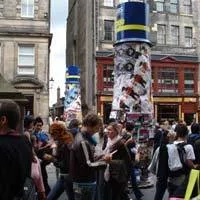
Because of this, rather than read the programme, many will just wander down the Royal Mile. This pedestrians-only, cobbled street is where performers, producers and their volunteer slaves desperately thrust flyers into the hands of anyone who'll make eye contact with them. The competition for attention creates a veritable street carnival of oddly dressed performers and spectacular behaviour. I sat down to eat my lunch, only for a performer to lay down on the pavement next to me and put a knife through his wrist. His assistant then poured fake blood over the trick knife and put up a sign saying 'He's in despair - he only got four stars'. Within literally seconds there were two press photographers snapping the scene and a crowd of bystanders. The next day, I saw many copy-cat crimes.
Another odd sighting was a two-man pantomime camel saying 'hello nuns' to a troupe of nuns wielding chairs around and singing. They duly replied 'hello camel', because nothing is extraordinary in this environment. The sheer number of such goings on are partly why there's such a sense of excitement on the streets.
The buzz around the Fringe Festival is everywhere. It's like a drug of adrenaline rush that leads you to spend far more than you can afford to on seeing far more shows in a day than you would usually attend in a month. Because everyone else is doing it, and you don't want to miss out on that elusive 'must see' experience. Like much about the practice of making theatre, it doesn't really withstand economic analysis. And that's perhaps why so many theatre makers choose to bring their work to the Fringe, knowing that they'll almost definitely lose money for the privilege of the experience: sometimes theatre just isn't about the money.
Image: Fringe posters on Edinburgh's Royal Mile
Read previous Sets and the City blogs
Feel free to get in touch with any questions (or if you're planning a London visit and want some theatre recommendations) to jamesstuarthadley@gmail.com
Use the comment box below
25/08/08