Sets and the City: Bristol and the cutting edge of theatre
Written by
By James Hadley in London
In last week's blog I talked about some of the theatre companies I met on a recent visit to Bristol. It was on the second day of my visit that I gained quite a good picture of the local industry in response to my question how similar is the theatre industry of a major UK city to its equivalent in NZ? (The short answer is: very similar. To the extent that I even bumped into visiting Wellington actor Peter Hambleton, here to research Shakespeare productions, as I was walking down Bristol high street!)By James Hadley in London
In last week's blog I talked about some of the theatre companies I met on a recent visit to Bristol. It was on the second day of my visit that I gained quite a good picture of the local industry in response to my question how similar is the theatre industry of a major UK city to its equivalent in NZ? (The short answer is: very similar. To the extent that I even bumped into visiting Wellington actor Peter Hambleton, here to research Shakespeare productions, as I was walking down Bristol high street!)My visit coincided with an Open Space forum that Theatre Bristol had organised, and which they kindly allowed me to attend. It was for members of the local theatre industry to explore 'where to next?' in response to a recent overview of the key issues it was facing. I was amazed how similar these issues were to those raised at a similar Open Space in Wellington last year, and the overview of the local industry that the day gave highlighted how much we have in common. The fact that the theatre industry in the UK is centuries older than New Zealand's means that they have more infrastructure established, particularly in terms of established venues and arts organisations. But when you look at the current UK environment for independent theatre companies it seems remarkably similar to that faced by NZ's independents.
At discussions in Bristol I heard many echoes of Wellingtonian concerns over the future of Downstage Theatre when it went through a temporary closure for part of this year. The equivalent, oldest established mainstage producing venue is the Bristol Old Vic - decades older than Downstage, yet the latter seems completely robust by comparison. The Old Vic has a similar number of seats, but suffered unpopularity (within the industry as much as audiences) under recent management approaches. It was forced into an unexpected closure a year ago due to financial straits; its resources having got so badly in need of renovation that it could no longer continue operating until funds were found to make these improvements. Unlike Wellington, which also has Circa Theatre operating on a similar scale, Bristol's industry was shell-shocked to have lost their only venue of this scale. This led to a fiery debate when an Open Space discussion was held a year ago. This year's gathering was quiet by comparison, I was told, with conspicuous absences from representatives of many of the smaller independent theatre companies. Those independents who were present suggested their peers might not feel as implicated in the actual steps for re-opening the venue, which was unlikely to house their own work, and were busy creating new work. There was a sense of fragmentation, again something I've experienced a lot in NZ theatre communities, with different subsections of what's already a small creative community not collaborating as much as could benefit everyone.
The first discussion I sat in on, about audience development, illustrated this clearly. There was a sense of rivalry between most of the established venues represented in the discussion, and very little communication or collaboration between different companies and venues in terms of audience development initiatives. We talked about some of the opportunities for local audience growth, and again it seemed a familiar array of challenges: working with schools far enough in advance to achieve group attendance; gathering data to target first-time attendees for return bookings; growing the youth market through diversity of programming being balanced with satisfying existing audience and brand; and how to reach niche minority ethnicity audiences in the region who were currently oblivious of most venues.
The health of the independent theatre in Bristol doesn't seem in question - as in NZ, there are considerable numbers of drama school graduates establishing companies and presenting innovative work. It's the gap between these emerging companies and the established commercial theatre that seems less healthy. That's where the professional development work of Theatre Bristol is clearly so key.
I must admit it was a little disheartening to find so many of the same familiar issues are stumbling blocks on the other side of the world. I've had so many discussions about the lack of rehearsal spaces and shortage of venues in NZ, that to hear the same problems being voiced here was a bit deflating. But perhaps I was just quicker to recognise these than unfamiliar concerns. What was encouraging was that there were a lot of established and emerging arts leaders at the Open Space - individuals who had stepped up and taken responsibility. One of the most innovative thinkers among these, who already runs the Watershed in Bristol - a film and multimedia complex - has come up with a vision for how the new version of the Old Vic should function, so it sounds like there's an exciting time of regeneration ahead.
And I couldn't have asked for a more exciting glimpse of the theatre's future than I was treated to that evening. Seth from Theatre Bristol had recommended I go to see the final night of a show directed by an associate of theirs, Jamie Luck. Jamie is the Head of Education and Outreach at The Egg at Bath's Theatre Royal. The Egg is a new venue attached to the historic Theatre Royal which is specifically for children and young people, and their current show was called 'Max and Beth'. Inspired by Shakespeare's 'Macbeth', the script was written by Lowkey, a 22 year old rap artist who uses rap as a contemporary equivalent to Shakespeare's blank verse. As producer and director of the season, Jamie had worked in partnership with the local Black Families Education Support Group to establish a new theatre company, Urban Arts, for this production. It's a trail blazing initiative to encourage more Black and Minority Ethnic (or BME as is the usual acronym over here) young people to participate in the activities of the egg.
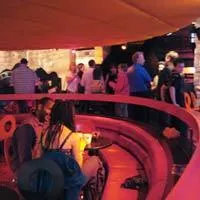
So that's the background. I entered what felt like a nightclub interior, with hip hop music pumping through the sound system, a funky cafe in one section, and the whole place packed with young people. Immediately this was a lesson in how alien a traditional theatre foyer might seem to this target demographic. I was really impressed by the approach of the venue, which had clearly gone all out to make the space one that young people would want to associate themselves with. The success of this was reflected in the presence of their target demographic - one which most theatre venues would drool over; very multicultural, with most in the 18-25 age group. When we moved through to the flexible performance space, there was a casual dynamic, with little division between performance area and audience. Many of the audience were on domestic chairs and couches which spread out and into the makeshift set. A prologue explained some of the vernacular language that might be unfamiliar to some audience members (mostly those for whom Shakespeare's language wouldn't be an equivalent barrier). Unfortunately I can't remember most of the colourful street slang explained apart from p's, which unlike most of the slang isn't a reference to drugs, but to 'papers' or money.
While it has to be admitted that the script was thin in places, the raw energy of the mostly BME cast was so invigorating you didn't care. And the transposition of the 'Macbeth' plot to the streets, amidst knife attacks and contemporary gang and drug culture, felt as relevant as 'West Side Story' must have done when it opened. The Witches became three zombie-like hip hop dancers, whose prophetic warnings were relayed in rap. Watching the full cast of 14 young people engaging in an ensemble hip hop dance, with individual passages suggesting their various characters, was more exciting than anything I've yet seen in London. And yet I've seen some amazing stage spectacles recently. But what I hadn't seen onstage until that moment was something that reflected the England that you experience walking down a city high street today - a lot of hard facades, attitude, youthful bravado, anarchic individualism, multicultural diversity that co-exists in sideways glances... A little unpalatable for most National Theatre attendees, but it was so exciting to see theatre that was totally engaged with the contemporary reality of urban UK - and in a streetwise format which I'm sure we'll see much more of here in the future.
Image: Foyer of the egg at Bath's Theatre Royal
Read previous Sets and the City blogs
Feel free to get in touch with any questions (or if you're planning a London visit and want some theatre recommendations) to jamesstuarthadley@gmail.com Use the comment box below 04/08/08