Sets and the City: Battersea Arts Centre
Written by
By James Hadley in London
Although it occupies a huge Victorian building, I could sense the affinity between Battersea Arts Centre's position within the London industry and that occupied by BATS Theatre in New Zealand. Battersea Arts Centre is one of the UK's foremost theatre laboratories, where new talent gets the opportunity to emerge, and theatre artists get to experiment on the cutting edge of theatre making practice. BAC (as it's commonly referred to here) host all sorts of workshops and creative residencies, including their Scratch programme, now much emulated internationally: an open access showcase for artists to try out work in progress in front of a friendly audience.By James Hadley in London
Although it occupies a huge Victorian building, I could sense the affinity between Battersea Arts Centre's position within the London industry and that occupied by BATS Theatre in New Zealand. Battersea Arts Centre is one of the UK's foremost theatre laboratories, where new talent gets the opportunity to emerge, and theatre artists get to experiment on the cutting edge of theatre making practice. BAC (as it's commonly referred to here) host all sorts of workshops and creative residencies, including their Scratch programme, now much emulated internationally: an open access showcase for artists to try out work in progress in front of a friendly audience.Some time ago I had a meeting with one of the BAC's two Artistic Directors, David Micklem (the other is David Jubb) - and a very charismatic man he is too. He gave me a quick tour around the building which had me drooling over its resources. The rather grand, brick Victorian building originally built as the Battersea Town Hall has been home to the BAC since 1980. From NZ I had imagined some state of the art modern building with multiple venues, a little like the Aotea Centre, but this sprawling and atmospheric maze of chambers is far more exciting.
For several months, ending in April this year, a company called Punchdrunk staged an immersive theatre event called 'The Masque of the Red Death' throughout the whole building, and many rooms have been left as they were decorated for this sprawling promenade production, inspired by Edgar Allan Poe's short stories. As David led me around, it was like walking through several sets, in between an array of airy studios and rehearsal rooms, and several small black box venues that reminded me hugely of BATS. Apparently just about every cupboard in the venue was used by the production, which I wish I had seen, with the audience wandering around in masks.
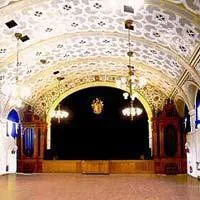
My tour of the venue ended in a huge hall, with a massive organ at one end - this is the ballroom where 'The Masque of the Red Death' culminated in a full-scale masque. Just being in this space made you want to devise theatrical experiments, not least because the building is buzzing with the creative energies of various practitioners developing their various projects in different parts of the venue.
It was the grand hall of the venue that I recently returned to for a work-in-progress showing of a new participatory theatre installation called 'Cart Macabre' by a collective named Living Structures. This company emerged from Dartington College of Arts, which has a reputation for generating experimental theatremakers.
'Cart Macabre' was a hugely stimulating production, that reminded me very much of attending a STAB commission at BATS. In the foyer you were asked to part with the contents of your pockets, which were carefully packaged and filed away, along with your jacket and bag, and then you were separated from any companions, led into a darkened area and then manipulated in the dark until you found yourself sitting down in the complete darkness of a confined space. I was left in this state of limbo for what felt like an age - a recording of lapping waves the only suggestion that I hadn't been forgotten about in some cupboard somewhere. Then another completely unseen person was similarly manipulated into the same confined space, sitting down on the bench beside me. Once there were four of us, the confined space began to haltingly move. The experience was utterly disorientating. With empty pockets and no visual sense of who your companions were, there was a strange sense of having lost your identity, which was hugely effective for priming an audience to be responsive to whatever was thrown at them.
Over the next two hours, our darkened cart was moved around a circuit of installations, some including performers, many just objects. There were twelve different carts being pulled around the same circuit in a different order - the logistics were genius. Each cart was drawn up to its next station in the circuit, at which the relevant partition was suddenly withdrawn and our darkened captivity was interrupted with the startling light of a video projection screen, or a small scene with puppets, or lit glass cases of body organs - eventually you realised the various provocations were on a theme of physical mortality. The most effective installations were those that involved some interaction between the various carts - after an hour of isolation, two carts might suddenly be drawn up to either side of the same installation, meaning the inhabitants could wave at each other across the sculpture in between them. At one point, all twelve of the carts were joined together and surrounded by shadow puppetry screens - this sudden sense of reunification of the audience was strangely poignant.
With no sense of who you were sitting beside, the inhabitants of my cart stayed respectfully silent for most of the journey, and the resulting sense of dislocation and limbo made the whole experience quite unique. Certainly it was one of the most truly experiential theatre events I've attended. The company had spent a fortnight's live-in residency at BAC while they developed the piece. Once the lights went up at the end and the stage craft of what we'd experienced was revealed, the magic of what they'd created quickly disappeared - but that's very much to the credit of how effective this piece of theatrical artifice was.
Read previous Sets and the City blogs
Feel free to get in touch with any questions (or if you're planning a London visit and want some theatre recommendations) to jamesstuarthadley@gmail.com
Use the comment box below
22/09/08