Sets and the City
Written by
By James Hadley in London
Living in Wellington it seemed there was always some cultural festival or other on. Here in London there seem to be several competing for your attention at any one time. The one which I chose to focus on this week was the LIFT Festival, held at various venues within the Southbank centre complex. Under Festival Director Angharad Wynne-Jones, the previous London International Festival of Theatre has become as much a social exploration of what a festival is as a presentation of international performances. By James Hadley in London
Living in Wellington it seemed there was always some cultural festival or other on. Here in London there seem to be several competing for your attention at any one time. The one which I chose to focus on this week was the LIFT Festival, held at various venues within the Southbank centre complex. Under Festival Director Angharad Wynne-Jones, the previous London International Festival of Theatre has become as much a social exploration of what a festival is as a presentation of international performances.On the first day of LIFT, I attended a fascinating talk on the dynamics of curating the Festival. Following an experiment in collaborative programming trialled at the Adelaide Festival a few years ago, Angharad selected various international collaborators who would each make the programming selection from their respective part of the world. From New Zealand, Lemi Ponifasio of MAU brought a work titled 'Tempest II', which featured the Maori activist Tame Iti in a contemporary ritual of encounter with audiences at the Queen Elizabeth Hall. At the discussion I attended, Lemi was articulate about the work's significance as a return to the seat of colonial government. This opened up a discussion about dynamics of oppression often being by a small group at the top of society's power hierarchy, targeting those at the bottom of the hierarchy, with the middle classes being distracted by self-interest and protecting their status quo. The question was then asked: theatre mostly reaches the middle classes, so if it's a work seeking social change isn't it then missing out those most relevant in the debate?
Questions of who was being represented by various cultural works, and the difficulty of selecting one work to represent the cultural diversity and peoples of a nation, highlighted how ambitious the aims of the LIFT festival are. I got the impression funding cuts forced the programme to be significantly reduced in development, with only four major international works being performed (including 'Murundak' a musical portrait of Aboriginal life performed by The Black Arm Band). What was more interesting to me about LIFT was all the participatory events that were part of the Festival, including a series of 'Adventures in Conversation', which brought facilitating groups together with whoever of the public turned up, to debate key contemporary issues in a variety of different formats. One of these, titled 'Micronomics' and presented by City Mine(d), was a skills-exchange event, where anyone could turn up to swap some of their own specialist knowledge in return for others - like a free knowledge marketplace.
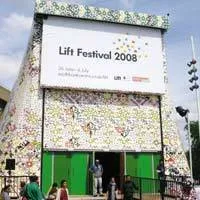
Most of these events were held in the LIFT's specially designed mobile Festival venue, the result of research into what space a multicultural audience would feel most comfortable gathering in to watch events. The result was a four-storey high, brightly multicoloured, circular tent, with a versatile interior featuring curtains that could divide the space into smaller sections, or create a backstage area. Discussions were often held in circles, either on chairs or cushions, and it certainly did feel like everything possible had been done to make the space feel as accessible as possible - right down to being offered a cup of tea as you entered! By comparison, the National Theatre and the Queen Elizabeth concert hall next door seemed like intimidating fortresses of privilege. It certainly made you think about what message the exteriors of theatre venues are giving.
The event which I attended from the series was an Open Space, facilitated by Improbable. I attended two Open Space forums in Wellington, both facilitated by creative producer Briar Monro, in pursuit of strengthening the voice of independent theatre practitioners' needs and concerns (and I understand Briar recently facilitated a similar event in Auckland). So I was fascinated to see what an Open Space would be like when most attending were general public. Improbable are the leading facilitators of Open Space technology in the UK, and it's a genius format for getting strangers quickly engaged in discussion on topics they feel passionate about, with everyone empowered to come and go between different discussions as they please. This Open Space was around the provocation 'Should Artists be Politicians?', and I chaired one of the various debates, around the question 'How do we (/makers of political theatre) reach the unconverted, rather than preach to the converted?' The main answer, unsurprisingly, seemed to be by either taking a theatre event to where the otherwise unreached audience was, or by making it free to attract a wider audience - so many of the issues voiced in the debate were exactly the same as face audience development in NZ.
Another debate in the evening returned to questions of accessibility, and the idea that the National Theatre, despite its reduced ticket prices, was programmed as if it's 'the National Theatre of Kent' (a county not known for its multicultural diversity) - as it still attracts an almost exclusively white and middle-class audience, in contrast to the strong presence of Black and minority ethnicity individuals on most London streets. The most recurring thought in my mind from the evening was 'What is the cost of not having free access to culture?'
I've been absolutely amazed by how much culture has become free in London since I was last here ten years ago. All London's major art galleries and museums now have free entrance. It really does give a sense of these amazing collections of art and artifacts being owned by the general population - recent immigrant as much as 60th generation Briton. It also seems to be encouraging a more representative mix of multicultural Britons in some of these otherwise intimidating historic heritage buildings. But clearly the change is gradual.
Most London theatres are well behind compared to this free accessibility of the art galleries and museums, and it's unfair to compare them really. It would take total operation and production costs being underwritten by the government to open up the doors for free. One person in the Open Space debate came up with a simple and not impossible idea though, which would go some way towards improving accessibility as well as strongly encouraging high quality theatre productions. They suggested that theatres trial a policy of tickets being paid for at the first interval of a show - if an audience member's interest is not piqued sufficiently to want to pay for what they've already seen and see the rest of the show, they just leave without paying. It's very risky - and isn't putting on a show financially risky enough!? - but what a wonderful thing to do for a set proportion of a show's season. It could be a wonderful audience development initiative to trial, and a great way of seeing how successfully a show is engaging audiences...
Outside of the established venues, there's still a wealth of performance that you generally just happen upon walking around London. Covent Garden has been a guaranteed place to see street performers for decades now, even if most are of the commercial fire-swallowing/music-playing/balancing on five chairs variety. The level of professionalism is impressive though; they work hard for their audiences who often swell to around 200 in this heavily touristy area. A new hub for street performance since I was last here is the area of the South Bank beside the Millennium Wheel. A lot of new tourist attractions have sprung up here, including an area which is something of a gallery of living statues - various street performers dressed up and waiting for passers-by to put some change into their hat before they'll perform a few interactions. You see people dressed up as the Statue of Liberty all over the world now. What was more impressive were those who have made being a human statue into an art form. One person was so absolutely persuasive as a monument to a WWII commander that you had to watch until they blinked to believe there really was a living human in there. No amount of donations would get them to make the slightest movement.
There are also a wealth of local government funded public entertainments, some attached to wider cultural festivals, some not. The recent London-wide Festival of Architecture saw furniture set up in various outdoors squares and parks, provoking reconsideration of how such spaces might be used as outdoors living spaces. And one day I walked down a cordoned-off Museum Street to find several architectural art installations set up, with various musicians performing around them - instant carnival! Another day I happened upon an opera being projected onto big screens set up in Trafalgar Square one summer's evening. I'm sure the throngs of people watching were not all normally opera-goers, so another fantastic audience development initiative. The recent GLBT Pride Festival also saw many of London's central streets cordoned off for a huge Parade. While the floats were a bit lacklustre, there was plenty of street theatre to be found in the individuals parading down the middle of the street - from drag queens to camp befeathered gladiators to a whole group of Amy Winehouse lookalikes. It was wonderful to witness the willingness of London's councils to allow such events to happen - often causing huge traffic disruptions in such a densely populated city; but what such events add to the lives of the populace must be invaluable. Who wouldn't want to feel that around any city corner there may be a carnivalesque spectacle awaiting you? And it may not consciously encourage non-theatre goers to buy more tickets, but it certainly does increase the presence of the performing arts in the everyday reality of anyone living in this city.
Feel free to get in touch with any questions (or if you're planning a London visit and want some theatre recommendations) to jamesstuarthadley@gmail.com
Use the comment box below
14/07/08