Sets and the City
Written by
By James Hadley in London
I wonder how many people arrive in London each day with a dream of breaking into the theatre industry while here? Walking down the West End's Shaftesbury Avenue, lined with big theatres hosting glitzy productions, it's easy to become star struck, and that fuels the huge market for tertiary training in the performing arts here. Only a minority of graduates of any course will find any semblance of ongoing professional work, but it's even rarer to find a way into the industry without training (at least for performers). There's been a bit of a backlash within the industry here over sometimes untrained 'celebrities' of reality TV shows like Big Brother using that exposure as a springboard into the industry. By James Hadley in London
I wonder how many people arrive in London each day with a dream of breaking into the theatre industry while here? Walking down the West End's Shaftesbury Avenue, lined with big theatres hosting glitzy productions, it's easy to become star struck, and that fuels the huge market for tertiary training in the performing arts here. Only a minority of graduates of any course will find any semblance of ongoing professional work, but it's even rarer to find a way into the industry without training (at least for performers). There's been a bit of a backlash within the industry here over sometimes untrained 'celebrities' of reality TV shows like Big Brother using that exposure as a springboard into the industry.Less indignance is provoked when the shows have some sort of theatrical pedigree. When Sir Andrew Lloyd Webber used his show 'How do you solve a problem like Maria?' to cast the lead role in a major new revival of 'The Sound of Music', I understand most of the finalists had been through professional training. And it was a wonderfully successful way to generate public interest in the forthcoming production, which is still running here, despite the TV show winner having completed her stint as Maria and moved on. Another of this type of reality TV show led to Lee Meads, a chorus member of various West End musicals, being plucked from obscurity to be cast in the lead of 'Joseph and the Amazing Technicolour Dreamcoat'. I saw him perform recently, at 'West End Live' - a free live showcase of excerpts from West End musicals presented in Leicester Square. The crowds gave him a pop-star type response, confirming the marketing savvy of both the people behind the TV series and those behind the free audience development event which had Leicester Square solidly packed with people all weekend.
For the vast majority, drama school is still the best option at getting a chance to break into the industry it would seem. And that's where my first industry contact here in London led me - to Mountview Academy of Theatre Arts (www.mountview.ac.uk), one of the UK's leading drama schools, with a particular reputation for training students for musical theatre. The school was founded in 1945 and is to the north-east of central London. A theatre collaborator from my days at Allen Hall, Otago University's Theatre Department, was now working at Mountview - Renee Boyer-Willison, and kindly invited me along to an open day of the technical students' work. With the scale of the London theatre industry, I'm trying to gradually build a picture of how all the different areas fit together. The question foremost in my mind this day was how do performing arts graduates find a way into the industry?
As I entered the students' exhibition I was asked who I was with. Most of the invitees were prospective employees - producers, directors, venue managers etc. I had a moment of identity crisis, no longer being able to claim affiliation to the wonderful BATS Theatre (which of course would mean little here anyway - until I mentioned that 'Flight of the Conchords' performed some of their earliest work there, for then everyone's eyes ignite with interest). Thus unknown and undefined, I was able to pass unnoticed among the various students lingering around their displayed workbooks. These books were often of an impressive standard, and I was taken with the detailed set design models that many had completed - some with the intricacy of antique dolls houses, complete with miniature props and textured stage dressings. One of these was by Renee's partner, who was in the graduating class, and I chatted with him about his prospects after the course. Like most, the intensity of completing course assessment content had left little time for setting up post-course employment - that was all ahead. What most impressed me as I heard more about the training at Mountview though, was that students had got to collaborate on several full-scale productions staged at venues out in the wider industry during their training. Design students' portfolios were for an impressive range of sizeable productions, many of them musicals like 'Titanic', 'Nine' and 'Sweeney Todd', which had been staged in regional venues around greater London. That the school didn't have a venue of its own surprised me, but it seemed quite a bonus that they had gained experience working in venues within the wider industry in this way. Some had post-graduation work lined up in these venues as a result of their experiences there.
The most organised of the students had copies of their CV and a business card beside their work, and were keen to talk about their displayed designs with anyone taking an interest. At least in this context, the course had given them a platform for showcasing their skills to interested parties. That sort of networking while affiliated with a recognised school seems to be one of the most important benefits of such courses. How true the old cliche of 'it's not what you know, but who you know' in this industry! Speaking of which, I was hugely grateful to Renee when she gave me a two-page list of individuals and companies to get in touch with that she had either worked with or seen work by. The process of meeting people in the London industry is slow, with some people's diaries booked up weeks in advance, so being able to contact people with the 21st century equivalent of a letter of introduction from someone they know is a huge help. I've been very lucky so far due to the generosity of my New Zealand industry contacts passing on their UK industry contacts to me, and bit-by-bit that opens up a network of contacts here.
I imagine finding open doors is tougher for many graduates. All the tertiary courses in the UK are finishing around now, meaning an influx of hundreds, possibly thousands, seeking employment. One good omen for some acting drama school grads is being singled out as being 'one to watch' within reviews of the various schools' graduating showcases in The Stage. I'll talk about the joys of this performing arts industry newspaper and website in a future blog. My own attempt to get to one of these graduation showcases failed. I was excited about attending a promising sounding showcase entitled 'Surge' - work by graduating students of the MA in performance making at Goldsmith's College, part of the University of London (www.goldsmiths.ac.uk/surge). Students were from all around the world, and one had staged their performance in the Greenwich foot tunnel (underneath the Thames River), which sounded intriguing. Unfortunately the sluggishness of Tube replacement buses meant I missed the performance.
No doubt many such graduates will now go on to make their own work in fringe venues around London, almost all of which seem to be black box theatres about half the size of BATS Theatre, above local pubs. Or perhaps they'll take a work up to the Edinburgh Fringe Festival (which I hope to attend). Just the other night I saw one such production - 'The Man I Cure' by Fat Content at Theatre 503 near Battersea Park This was one of over ten shows previewing at Theatre 503 before going up to the Edinburgh Fringe Festival. Described on the website as 'A love story, a Lynchian nightmare and a modern folk tale.', none of our NZ quartet of theatre-goers (current BATS programme manager Steph Walker, ex Wellington actor Alicia Sutton, ex NZ Film Commission employee Louise Rae and I) were particularly won over by the show. It could be classed as absurdist physical theatre - a disorientated soldier breaks into a deserted sanatorium and is force-fed milk by two pink-uniformed nurses. The three performers seemed to be drama school grads because they all had strong physical presence and vocal technique. What they lacked was a dramaturgical sense of how to turn their eccentric material into something that sat together as a show the audience could connect with. I think the rest of the half full opening night audience were family and friends, and even they were very quiet throughout... but of course, that sort of trial and error is exactly what the Fringe is about
Drama school graduates who had mostly achieved quite impressive professional engagements in the industry - including work at the National Theatre and with Kneehigh Theatre - were found in a not entirely incomparable show at the other fringe theatre experience I've had so far here.
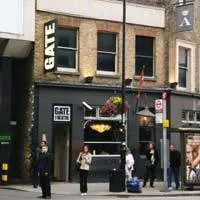
I attended Notting Hill's Gate Theatre (pictured), which is of a similar size to Theatre 503, and also situated above a pub, to see '...Sisters'. This was an adaptation of Chekhov's 'Three Sisters' by Chris Goode, who would appear to be a director to watch, having been selected as the first recipient of the New Directions award for directors and theatre-makers 'applying new levels of formal experimentation to productions of classic European plays.' The six performers (five female, one male) had taken on the terrifying task of improvising around the script of 'Three Sisters' in front of an audience. They all clearly had an in-depth knowledge of the play, and were able to paraphrase and directly quote from the script, or make symbolic physical references to some of its key imagery.
At first it was very exciting - how could they possibly manage this? - and when things seemed to be a bit lacklustre they just all switched roles within a scene; a delightfully unexpected twist.... Except at least one of the actors hadn't been attuned sufficiently to realise who was playing who after the change, and started proposing marriage to the wrong sister. It was downhill from there it seemed. Most of the audience were mystified by what was going on, particularly when they then released two live white rabbits onstage during the paraphrase of the final act. But the performers were all of a high calibre, and that's what saved this tightrope walk of a theatre experiment from being unwatchable. At one point, everything had descended into chaos with all of the characters talking at once, and none of them listening. But out of this confusion, one of the actors slipped into a set speech from the play, performing it in a continuous loop but with such emotional intensity that gradually each of the other performers joined her in the same speech, and the cumulative choral effect was surprisingly powerful.
It just goes to show that if you continue to believe in what you're doing, and persist in the efforts, the chances are that you'll eventually achieve something of what you're pursuing.
Read previous Sets and the City blogs
Feel free to get in touch with any questions (or if you're planning a London visit and want some theatre recommendations) to jamesstuarthadley@gmail.com
Use the comment box below
23/07/08