Screenwriters explore substance and truth
Written by
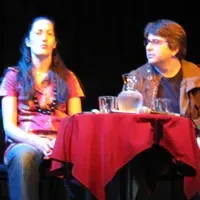
Earlier this month, many fortunate writers received a special Writer's Room invitation to hear international screenwriter Michael Goldenberg (Harry Potter and the Order of the Phoenix, Contact, Peter Pan) and homegrown writer Briar Grace-Smith (The Strength of Water) in discussion. The audience enjoyed an interactive morning analysing the essence of truthful writing, the differences between writing for theatre, film and adaptation, and the challenges of working as a writer in a collaborative and expensive medium.Earlier this month, many fortunate writers received a special Writer's Room invitation to hear international screenwriter Michael Goldenberg (Harry Potter and the Order of the Phoenix, Contact, Peter Pan) and homegrown writer Briar Grace-Smith (The Strength of Water) in discussion. The audience enjoyed an interactive morning analysing the essence of truthful writing, the differences between writing for theatre, film and adaptation, and the challenges of working as a writer in a collaborative and expensive medium.The essence of writing
Substance and truth drew Michael to Briar's project, The Strength of Water. "It was so beautiful and had an authenticity about it that is very rare," he said. "There are scripts that are just words on a page, then there are scripts that you read and you see the film."
Michael emphasised the need to visualise the film and be specific when communicating ideas - " - find that one detail; one image that spells the essence..." - and he extended this sentiment to include Peter Jackson's filmmaking success: "It's all about saying something honest and finding the truth. Peter Jackson has a strong point of view; a strong voice - ultimately that's all you have - your voice; boil it down to the essence of what expresses you."
Michael feels an "outside in" process prevails in LA. Politics and craft take precedence over the personal side of screenwriting. He recalled L.A. college summers spent reading scripts, and said, "19 out of 20 were clearly inspired by the hit from the year before. I was always grateful when I came across one that had a voice; even if the craft wasn't there and the execution wasn't perfect, those were the ones I'd recommend."
Hollywood writers are more "reactive" said Michael, "they don't take a stand, (whereas) every producer/studio is looking for someone with a strong point of view".
Briar gained a similar insight on a recent working trip overseas. She found that often the emphasis was on the craft and business of scriptwriting, rather than the heart of storytelling.
Michael said there is a skill in distinguishing an authentic tone from a 'phoney' one when reading new scripts, and quoted fellow screenwriter/producer Charlie Kaufman: "Is the reference for this from life or another film?" Capturing a truth can be done in a variety of ways - different genres will demand a different approach to communicate the heart of the story. Michael referred to his adaptation of J.K. Rowling's Harry Potter and the Order of the Phoenix as having "a heightened artifice to it, delving into the psychological to get to the emotional heart of the story". Following an intuitive selection process, Michael felt an immediate chemistry with the fifth installment of the popular series: "Teenage angst, anger and alienation - this book more than any other was right up my alley".
Michael describes himself as being "picky" when choosing projects: "I won't take every job. The distinction is an intuitive response; the best ones are where I feel instantly protective of it; when I have that feeling of 'I need to do this one; I can do it like no one else can'". Michael has worked on commercial Hollywood films as well as those he describes as 'personal films'. "People think of Hollywood films and Indie films as being different. I don't think so; it's all about saying something honest, finding the truth."
Planning a script
"Writers work in different ways," said Michael, "I consciously do less and less". He likes to have an idea of where a script is going and where the end is but "the goal and distance always end up changing". He also raised the issue of craft over substance: "There's a thing in Hollywood about which page the second act should start on. That just sounds so backwards to me. It can be quite well crafted, but it's lifeless".
Both Briar and Michael described the unpredictability of making a film and the necessity of being able to "let go of your map". The collaborative nature of filmmaking means things will inevitably change. "There is something about being in control of this little universe that is attractive," said Michael, "but the paradox is that ultimately you have to let go of that control and just give yourself over to it."
From stage to screen
Both Briar and Michael began their careers as playwrights and described the differences and obstacles they faced during their transition from theatre to film. Despite space and (real) time restrictions, Briar found theatre to have fewer creative boundaries. "All the work is done inside the audience's head," she said. Michael added, "Theatre takes place in a symbolic space, calling for audience participation in imagining and interpreting". Both expressed their fondness of language and described a struggle with the compromise that a visual medium can demand.
Briar discovered the practical restrictions of filmmaking while working on the production of The Strength of Water. She realised the old-world language she had carefully crafted for her ghost character was not going to work when it had to be said by a young child.
Collaboration and compromise
Briar and Michael took a big leap when they moved from writer-driven theatre into the multifaceted world of film. Both agreed a film takes on a life of its own so they had to be open to changes and rewrites. During the filming of The Strength of Water, Briar found it important to be on set. "The cast and crew inject some of themselves into the film. The script as written didn't always fit well."
She had to work with director Armagan Ballentyne to simplify the script while maintaining the same intention. For Michael it was a shift in perspective: "There has to be trust between you and the collaborators". He experienced an 'epiphany' when making Contact, realising that "a problem has multiple solutions; when collaborating you have to find the solution that works for everyone, a solution that plays on everyone's strengths." He added that "The auteur theory has done enormous damage - directors thinking it's a weakness to collaborate or consult with a writer." In his experience, he has found that "The better the director, the more interested they are in the writer's input".
Rewrites
Michael mentored Briar at the 2006 Sundance Screen Lab and confronted her with some hard questions and decisions. He said the expensive nature of filming has developed a 'cut and compress' instinct for him so he highlighted the importance of cutting a script down to the bare essentials. Michael learned from watching his own mistakes on the big screen: "It's so easy to delude yourself into thinking that something will work. Any false note is really emphasised on a 40-foot big screen".
The screenwriter/author relationship
Michael has adapted a number of novels for the screen, including his 1997 adaptation of Carl Sagan's Contact and more recently J.K. Rowling's Harry Potter and the Order of the Phoenix. Traditionally, the screenwriter and author have very little contact, Michael said, but this can vary depending on the project. Michael described experiences where he had no contact with the author at all.
Writing is hard!
A member of the audience asked "How do you write a script if you're not a writer?". Michael simply responded, "If you don't want to write, don't write", adding there is no point writing if it's a chore as it "hurts the script". But he said that any writer, even a good one, does not find writing easy. He dispelled the notion of writing being a fluid motion, where ideas channel into an effortless stream of words. "It's a real misconception. Writing is hard; it's one of the hardest things. Every writer feels like a fraud, like they're barely getting away with it and they're going to get caught any minute."
His advice for anyone who enjoys writing? "Push on through the struggle and write the movie that you want to see."
About Script to Screen
Script to Screen is an independent, industry-wide initiative, established to develop the culture of screenwriting in Aotearoa/New Zealand. Script to Screen's programme of talks and workshops provide opportunities for both established and emerging screenwriters to meet, share knowledge, and develop their craft.
Courtesy of Script to Screen
24/10/07
Image: Writers Briar Grace-Smith and Michael Goldenberg.