Screen Innovation Production Fund's idiosyncratic view
Lynn Freeman talks to Lydia Wevers, chair of the Screen Innovation Production Fund on National Radio's "What's Going On?"
Monday 13 June 2005
Presenter (Lynn Freeman): An idiosyncratic look at life in God's own, a film about being an Iraqi immigrant adjusting to life in New Zealand, the animated story of two Chinese lovers trying to escape an arranged marriage and a video installation involving a robot watching a TV show and then making its own new episodes for it. All these projects, and more, have just been awarded grants from the Screen Innovation Production Fund. We wondered what criteria the fund panel uses when assessing innovative scripts so we went to its chair, Lydia Wevers, to find out.
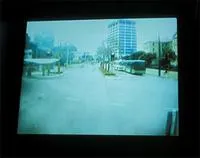
Image: Douglas Bagnall A Film-making Robot 2004. Computer software and DVD projectionLynn Freeman talks to Lydia Wevers, chair of the Screen Innovation Production Fund on National Radio's "What's Going On?"
Monday 13 June 2005
Presenter (Lynn Freeman): An idiosyncratic look at life in God's own, a film about being an Iraqi immigrant adjusting to life in New Zealand, the animated story of two Chinese lovers trying to escape an arranged marriage and a video installation involving a robot watching a TV show and then making its own new episodes for it. All these projects, and more, have just been awarded grants from the Screen Innovation Production Fund. We wondered what criteria the fund panel uses when assessing innovative scripts so we went to its chair, Lydia Wevers, to find out.
Image: Douglas Bagnall A Film-making Robot 2004. Computer software and DVD projectionLydia Wevers (Chair, Screen Innovation Production Fund): We actually try to fund innovation in a whole range of ways, including new ways of making films and new ways of telling stories in film, so we aim to be the fund that produces the kind of seedbed of the film culture. You know, we're trying to nurture the new young plants bursting into exotic flower that haven't been seen before, and I think the Screen Innovation Production Fund actually does that extraordinarily well, it's very successful. From the round before this one, ten of the films we funded made it into film festivals - A-list film festivals - so that's a terrifically good record, we're very proud of it.
Presenter: And you've supported people who have gone on to have great success haven't you?
Wevers: Yes, oh we have. I mean our most recent success is Welby Ing's short film Boy which has just qualified for an academy award nomination by wining the best short narrative film at the 2005 Cinequest Film Festival in San Jose and that is, you know, really fantastic, and that's a very innovative experimental film; has no dialogue. The story has - mostly composed of stills in fact and it's not a linear-told story so the narrative spreads out in a whole lot of ways and it's connected by phrases which sort of act like sub-titles coming across every so often, and it tells the story of a young boy coming to terms with his sexuality. But, interestingly, it's not set in any particular time or place so it's a film, which can move very easily into other societies as it obviously has done in America.
Presenter: With this fund, I mean, generally they're short films that come to you.
Wevers: Yes, they are.
Presenter: Not exclusively but -
Wevers: Not exclusively, it does do some features as well.
Presenter: Well, is it hoped that it be seen as a stepping stone because I think the case in point in this latest round, Florian Habicht with that wonderful Kaikohe Demolition, which has done so well, now is moving onto a full-length film and he's got funding from this?
Wevers: Yes. No, he has. I mean, he's the sort of perfect example, I think, of what the Screen Innovation Production Fund is trying to do. He makes digital features. The first one Woodenhead, and Kaikohe Demolition, went into A-list festivals, so he immediately got the breakthrough he needed by then, funded by Sips as we call it, into getting a film produced and then being able to take it out and tour it, and I mean he's been a raging success. He's currently in Europe and has things going through in Amsterdam and, you know, he has a sort of whole glamorous biography by now but he's still a very innovative filmmaker and this current film that he's just got a grant for, which is another digital feature which is called Land of the Long White Cloud, is going to be a wonderful look, a very kind of new fresh look at New Zealand.
Presenter: He's getting $31,500 so obviously this isn't money to make the whole film.
Wevers: No, it's not the end of the story.
Presenter: That's right, it's a contribution.
Wevers: Yes it is. I mean, he will need more than that but we give people money at the development stage, which is what that is, and then we also do a post-production, so quite a lot of films will come - you know, we will give money to make them and then they will come back to us for the post-production and get money to do that stage as well. I mean, what we hope to do - obviously, you know, we're not distributing very much money and we can't fund every wonderful project that comes to us. We have to be quite selective and it's quite a hard tough fight-out when the actual selection happens, but what we hope to do is to fund a sufficient range and depth of things to kind of grow the diversity and the experimental character, if you like, of the New Zealand film industry, which is never going to happen through commercial funding and which the Film Commission can't really do. I mean, they partly fund this, of course, but they can't do it through their mainstream programme.
Presenter: I was most intrigued, Lydia €” looking through the filmmakers who have got funding this time €” the number of migrants' stories being told. There's a large number of those.
Wevers: Yes, there's a number of very good young Asian, Korean and young Pacific filmmakers coming through.
Presenter: What made their stories stand out?
Weavers: Partly, you are attracted by cultural diversity, of course, when you're trying to sort of show a developing film world, but also they're just smart, savvy filmmakers. The panel that makes this selection is mostly young filmmakers; they're all people in the industry so it's very much a peer review thing. And they're very hip, you know. They know what is cutting edge and what isn't; they know when something is a bit tired and when it is actually coming out sort of fresh and new and these people are making - you know, not just because they represent an ethnic minority but it is also because they are good, really good at what they do.
Presenter: And these migrant stories, I mean, this is very relevant to know isn't it?
Wevers: Oh yes, absolutely, yes. We've done some wonderful Korean €” particularly, actually €” films over the last little while and it's thrilling to see this kind of talent coming out. And, I guess if you are from the migrant community and maybe English is your second language, it's easier to tell stories in images than it is to have to try and get yourself together in a new language and then use it in a sufficiently sophisticated way to tell complicated narrative. I mean, you know, film is really a medium that's terrifically suited to that and if you've got a sort of subtle visual intelligence, you're away with it, it's great.
Presenter: I can tell that many more projects that deserve funding couldn't it because you have a set amount of money?
Wevers: Yes, we don't have a big enough pool. I mean, I wish Michael Cullen had thought of us in the budget because there is a huge pool of talent out there. And I think too, film is - there's no limit to what you can do with film, really. There's so many opportunities with film through graphics, through animation, through digital image-making, through regular stories. You know, there's so much you can do with it, with stills, with photography and I think that because of that it attracts a lot of people who might otherwise have become writers or painters or something. You know, there's sort of a huge big push into using image in a whole lot of ways. I mean, et al is sort of a case in point, dismantling what you think of as kind of a regular artwork to use all kinds of other media in it and really confront you with what are you thinking about when you think about art. And a lot of these young filmmakers are doing that too. They're saying, well, what is film, and giving you a whole new look at it.
Presenter: Lydia Weavers from the Screen Innovation Fund.
ENDS
© 2005 Radio New Zealand Limited
NEWZTEL News Agency Ltd www.newztel.com