Samoan Shadowplay
Written by
By Mark Amery Courtesy of The Dominion Post
The question that must be asked when artists are grouped together by an aspect of their background rather than by their art is, quite simply, why? Given the complexity of our contemporary make up, does such a grouping serve their work, or box them away? Collectively do these artists have something to say?
It's a vital question with the grouping of 17 Samoan New Zealand artists in the exhibition Samoa Contemporary at Pataka in Porirua. Pacific Island artists are used to being lumped together, and their work today is as diverse in approaches as contemporary art practice itself. Wander through the museum and you'll be stretched to make up an easy narrative for 'Samoan art now'. By Mark Amery Courtesy of The Dominion Post
The question that must be asked when artists are grouped together by an aspect of their background rather than by their art is, quite simply, why? Given the complexity of our contemporary make up, does such a grouping serve their work, or box them away? Collectively do these artists have something to say?
It's a vital question with the grouping of 17 Samoan New Zealand artists in the exhibition Samoa Contemporary at Pataka in Porirua. Pacific Island artists are used to being lumped together, and their work today is as diverse in approaches as contemporary art practice itself. Wander through the museum and you'll be stretched to make up an easy narrative for 'Samoan art now'.Yet Samoa Contemporary most of the time proves a rewarding grouping: the artwork is given its space individually, and it has strength collectively. The loose framing of Samoa Contemporary stresses that contemporary Samoan artists' can no more easily be branded together stylistically as Contemporary Pasifika as these artists can be said to share the same upbringing. The catalogue informs us that only three of these artists are Samoan born, with the remainder being first or second generation New Zealanders. More tellingly less than half of these artists have parents who are both Samoan. The threads of their other ancestries crisscross the globe.
And yet with difference there is also commonality. Much of the work here explores ideas around identity and cultural stereotyping. Rather than celebrating heritage, these artists often seem ambivalent to it or troubled by what it represents. Like Michael Tuffery's metallic flies here, they prefer to buzz around and settle more freely on things. They deal with a sense of estrangement to tradition as well as connection.
Heritage is represented in Edith Amituanui photographs of Samoan homes by the arrangement of plastic flowers and family photos, but the camera is unsteady, the lighting glaring, and the young girls who stand before these objects look less than comfortable. What will their homes look like?
I was struck by the amount of shadow play there is within the exhibition - as if many of these artists are dealing with growing up in the shadow of others' ideas of who they are. A number of artists work with alternative associations that the stories, patterns and images they've inherited bring; be it the decorative transgressions of Lonnie Hutchinson's cut outs, or a magnetic performance work by Shigeyuki Kihara, replayed here in video. In stiff black Victorian dress Kihara is dramatically sidelit, slowing the traditional Samoan woman's dance of celebration down to a Butoh-like meditation. Turning it into a dance of sadness, emotion is delicately wrung out of every gesture.
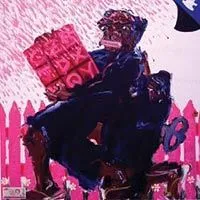
Andy Leleisi'usa's large canvases see him play out being the cheeky expressive outsider artist to the hilt, exhuberant Pacific colour allowed to drip and congeal around the wounds still left from immigrant stories. I preferred his more distinctive recent series of small jewel like canvases that abstract species into coloured data streams in a mythical place called 'the Ufological Island of Samoa'
In Graham Fletcher's paintings series The Eternals cultural artifacts have become shadowy figures of their former selves, menacing in their abstraction, as if made dangerous by their solitary confinement in the museum. More powerful though are the group of totem artefacts Fletcher has crafted himself. While too crowded in their presentation here, they have the disturbing erectile Freudian deformity of the work of Hany Armanious meeting Giacometti. More dangerous than the paintings, they resemble weapons with which to bludgeon those who seek to freeze culture in time.
While Fletcher is irreverent there are other artists included who look away for inspiration. Nestor Opetaia may have been born in Samoa but the free musical abstraction of his painting fits snugly in a European modernist tradition. While Greg Semu includes photographs of his Pe'a (customary body tattoos) in the exhibition, he describes himself as being "in cultural no-man's land" and a more recent photograph deals with issues of colonization in New Zealand for Maori, and bears the strong influence of Carravaggio and David, following time spent in Europe.
As is now familiar for a Pataka theme group show, the curation doesn't seek to theorise, and its inclusiveness is both its strength and weakness. The exhibition is overly crowded in places (it seems a shame such an important show has to share the space with other exhibitions), and the work of longer-established artists like Fatu Feu'u, John Ioane and Lily Laita feels out of place here.
Nicky Hastings-McFall's installation is entitled The Forest (Voa), which the catalogue tells us is a reference to Samoan oratory which welcomes people "from all parts of the forest". It's an apt metaphor for the exhibition as a whole. The artists in the exhibition stand together like Hastings-McFall's work: a group of second hand lampstands with shades of different shapes and sizes, talking to one another while hiding their light behind a covering of plastic flowers.
Image: Andy Leleisi'uao,
Supplement Letters to Warm the Rain, 2007
09/04/08