Saatchi & Saatchi - Award for World Changing Ideas
Written by
Award For World Changing Ideas
This $100,000 Award was created because Saatchi & Saatchi believes passionately in the power of ideas.
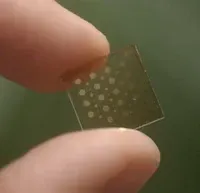
Just one of those brilliant ideas is the Bio-Solar Energy Nanodevice developed to provide continuous self-sustained energy source for Mobile communication and portable computing devices. The Nanodevice is a go back to nature idea, to the process of photosynthesis.
You can check out this and many other groundbreaking design ideas at Award For World Changing Ideas You might even think about entering yourself...Award For World Changing Ideas
This $100,000 Award was created because Saatchi & Saatchi believes passionately in the power of ideas.
Just one of those brilliant ideas is the Bio-Solar Energy Nanodevice developed to provide continuous self-sustained energy source for Mobile communication and portable computing devices. The Nanodevice is a go back to nature idea, to the process of photosynthesis.
You can check out this and many other groundbreaking design ideas at Award For World Changing Ideas You might even think about entering yourself...BIO-SOLAR ENERGY NANODEVICES
CAN SPINACH SAVE THE WORLD?
In the simplest terms, they are solar cells that use plant protein (spinach) to convert sunlight into electrical energy.
Mobile communication and portable computing devices call for a continuous, self-sustained energy source, but present technology lags behind this need.
However, PhDs, Shuguang Zhang and Marc Baldo at the Massachusetts Institute of Technology, are collaborating with others on an idea that could solve this problem and ultimately revolutionise the way we generate energy on earth.
Their Bio-Solar Energy Nanodevices go back to nature, to the process of photosynthesis. In the simplest terms, they are solar cells that use plant protein (spinach) to convert sunlight into electrical energy.
Almost all energy on earth is obtained from photosynthesis through trees, green plants and photosynthetic bacteria. The fossil fuel and coal we use today comes from solar energy stored in them millions of years ago.
There are two plant photosynthesis systems, Photosystem I and Photosystem II, and they are the most efficient energy harvesting systems there are. PS-II also produces hydrogen from water at the same time. Harnessing the energy and hydrogen these systems produce could provide us with clean and
near inexhaustible energy.
How does the Bio-Solar Energy Nanodevice work?
As a first step, the developers used the simpler PS-I system.
The raw material is available at any supermarket of course, and it's purified to create the PS-I. The individual nanodevice is only around 20 nanometers in size, so 5 trillian can be packed onto a single square centimetre,
two dimensional surface area.
Self-assembling peptide detergents stabilize the PS-I on gold surfaces, and effectively preserve its integrity in dry form for over 500 hours (3 weeks). The peptide detergent - PS-I complex system produces not only electric current but also, significantly, electric voltage.
By definition, the components of nanotechnology are 100,000 times thinner than a human hair.