Ribbon of Light: Aniwaniwa at City Gallery Wellington
Written by
By Mark Amery Courtesy of The Dominion Post
Over time a river will slowly change its course. People and nature learn to work with this. But for the people of the Waikato village of Horahora there was no such opportunity. Their village and its power station were flooded in 1947 to create Lake Karapiro, making way for a newer power station.
Sculptor Brett Graham's grandfather worked at the Horahora power station. He had scratched onto one of the power station's generators before its submersion, 'Kia kaha ake ake, Graham 1947 (forever be strong)'. And as the station was flooded, one of the generators apparently refused to shut down, a symbol for some people that Horahora had refused to die.
It's a cracker story and, rather than provide a museum display, with the installation Aniwaniwa artists Graham and Rachel Rakena propose that, in a manner akin to the carving and weaving of the Maori wharenui, recent history can be extrapolated upon to represent metaphorical experiences as well as specific stories.By Mark Amery Courtesy of The Dominion Post
Over time a river will slowly change its course. People and nature learn to work with this. But for the people of the Waikato village of Horahora there was no such opportunity. Their village and its power station were flooded in 1947 to create Lake Karapiro, making way for a newer power station.
Sculptor Brett Graham's grandfather worked at the Horahora power station. He had scratched onto one of the power station's generators before its submersion, 'Kia kaha ake ake, Graham 1947 (forever be strong)'. And as the station was flooded, one of the generators apparently refused to shut down, a symbol for some people that Horahora had refused to die.
It's a cracker story and, rather than provide a museum display, with the installation Aniwaniwa artists Graham and Rachel Rakena propose that, in a manner akin to the carving and weaving of the Maori wharenui, recent history can be extrapolated upon to represent metaphorical experiences as well as specific stories.Ready parallels may be drawn from this installation to the way Maori history and knowledge was drowned in the 20th century in the pursuit of progress. For many of us it remains alive but preserved and submerged. We are reliant in New Zealand on water for electricity, but must in the process lose things of power. Through a combination of currents chiseled by Graham by hand and electric light projection by Rakena Aniwaniwa sensually celebrates the great power of the river as an embodiment of spirit, a charged ribbon of light that is a symbol of fluidity, of connection between past, present and future, and of people's ability to rise to change.
Then there's the fact that this installation has returned from participation in last year's Venice Biennale. Venice is a city whose slow submersion echoes that of atolls of the Pacific. Venice is a city where the ghosts of past activity lie just below the surface in abandoned rooms.
Aniwaniwa uses such geographical and historical references lightly. They are stepping stones before you dive in and immerse yourself in a more timeless watery space of currents. I sometimes found this frustrating. Submerged, I'm left feeling like a swimmer not able to be changed by these stories retelling.
Aniwaniwa instead creates a powerful space between places. One to be filled by the stories brought to it; reminiscent of the way the wharenui provides a body to be filled with words.
Entering the installation you enter darkness where it takes time for your eyes to adjust and note that the bodies of fellow visitors lie on mattresses that stretch down the length of the East Gallery. You must join them in lying down to fully appreciate the work, encouraging prolonged meditation. Images above shot by Rakena spin and roar through the bottom of five wooden vessels carved by Graham that hang from the ceiling like giant light fittings.
Graham has labelled these vessels wakahuia, or treasure chests, and as such they operate as wells of memory. But as is typical of Graham's sculptural forms they may be read in many different ways.
Naturally, they are akin to power station turbines, Rakena's images forever tumbling within them, refusing to die. They are also active receptacles, like lens or eyes. With their gloss and intricate gouged treads filled with camera motion I was reminded of car tyres; a more modern symbol of momentum than water. Their pattern was inspired by the gouged path of insects gnawing through wood, which Graham records as informing the origin of the word whakairo: "to carve, or be literally like a maggot",
Rakena's images are split between abstracted images of coursing water and fire, and the action of villagers recreated by actors under water. People attempt to strike matches to keep the home fires burning, clothes are washed clean, and a telegraph pole carrying power swings in the currents. These images churn like seaweed, gentle and fluid in the meaning their beautifully orchestrated choreography elicits. Figures appear at once active and asleep, caught in a dream in this watery in-between world.
Crucial to the installation's success is also a soundscape featuring laments sung by Whirimako Black and Deborah Wai Kapohe to the slow churning trance like sounds of Paddy Free of Pitch Black.
Amongst its meanings aniwaniwa the word can relate to a state of bewilderment or confusion, as if one is tossed beneath the waters. The installation is extremely effective on this elemental level, achieving a disorientation and immersion as might be found going over the Waikato river's Aniwaniwa rapids.
Photographic stills drawn from the installation have been created by the artists and are currently being shown as a parallel exhibition with Bartley and Company, viewable this week only Thursday to Saturday in Cuba Street, and after that at www.bartleyandcompanyart.co.nz.
More information
Aniwaniwa, City Gallery Wellington until 15 June
Aniwaniwa Stills, Bartley and Company, Level 1, 33-39 Cuba Street, until 15 March.
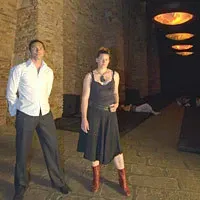
Image: Rachael Rakena and Brett Graham
Aniwaniwa (2007)
Image courtesy of Jennifer French
12/03/08