Review: Wellington Film Festival
Written by
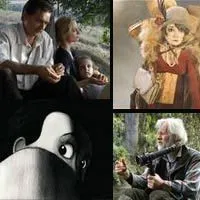
by Asni
The Wellington stage of the New Zealand International Film Festivals has come and gone - as usual, two weeks so brim full of interesting and intriguing new movies from around the world that choosing simply becomes too hard. Fortunately many movies that play in the festival have a tendency to make the rounds of the art house cinemas for the rest of the year, but I made a point of seeing some of the short film programmes that can only to be seen during the festival.by Asni
The Wellington stage of the New Zealand International Film Festivals has come and gone - as usual, two weeks so brim full of interesting and intriguing new movies from around the world that choosing simply becomes too hard. Fortunately many movies that play in the festival have a tendency to make the rounds of the art house cinemas for the rest of the year, but I made a point of seeing some of the short film programmes that can only to be seen during the festival.I had to miss the first two Homegrown programmes for scheduling reasons but was impressed with the quality and variety of the contributions to the third one, which had an emphasis on animation. There were 13 short films - most but not all of them animations - which makes it hard to pick a favourite, but the standout for me probably was the surrealistic live-action flick "Unorthodox My Balance Sheet" by Sally Tran, which depicts a very usual day at a very unusual office. I also enjoyed the beauty of the designs in "Sleeper" by Craig Gladding, the extravagantly silly "If you were Alien" by Chungmin Moon, and the dreamy sweetness of "Entropy" by Dane Jacobs.
There was quite a lavish amount of stunning visuals to be seen in the Digital Panorama which featured 3D and 2D computer animations - though some of the films seemed to focus exclusively on looks and were a little lacking in terms of narrative. Seeing that I've spent the last year learning to create things just like these, I was fascinated to see how varied the results are that people have achieved, and how many different approaches there are to using the same pieces of software.
The Animation Now! programme was, by comparison, less convincing. A number of the selected films had the distinct air of student work about them, which does not necessarily have to be a bad thing, but in the other two short film programmes the overall level of polish was rather a bit higher. To make up, the selection featured what was easily the funniest and quirkiest, and probably also the best drawn, short animation in the festival, "Sleeping Betty", by Claude Cloutier from Canada. A very different take on an old fairytale!
If you wanted to know what the current benchmark for animation is, at least in terms of sheer style, you had to go and see one of the French contributions to the recently revived "Incredibly Strange Film Festival" section. Fears of the Dark is a collaboration of six animator-directors on the overriding topic of, well, fear. What could have been quite a random mix of different narratives, styles and approaches is effectively held together not only by the common topic, but also by the fact that all animations, which are otherwise using very different styles and techniques, are strictly black and white. From Blutch's hand-textured pencil work through to Richard McGuire's clean minimalism, they are all of them a joy to watch.
The "Incredibly Strange" selection was also responsible for the one movie I didn't really like - but then I could have known that. The things that happen in Cargo 200, a contribution from Russia, are so utterly grim and depraved that I really wouldn't want to send anyone to see it. Though it is possible that the movie makes a valid point about sadistic tormentors and victims who give them exactly what they crave, and what happens to societies where those two types are let loose on each other while everyone else practises the art of looking away.
Come to think of it, the things that happen in Blind Mountain, a contribution from China, are no less grim. A young female college graduate, who has been unable to find a job in the city, takes up an offer of work in a remote rural area of Northern China, only to find that the so-called "work brokers" have sold her into a marriage with a farmer, in an area where, due to the widespread custom of "disposing" of female babies, there aren't any marriageable women available. The parents-in-law make personally sure that she stays and fulfils her wifely duties - in a scene that would be slapstick comical if it wasn't so horrifying. We witness her increasingly cunning attempts at escape with baited breath. The most depressing thing to watch is how no one, not a single adult person, least of all those in charge of law and order, has the humanity or compassion or integrity to beat the system or do anything that is not completely selfish. As far as social criticism goes, it can hardly get any more bitter.
Out of the admittedly very small selection of feature films I managed to see, the one I liked best was another film from Russia, The Banishment - a tragic family tale about guilt, forgiveness, and the meaning of love, the Russian, deeply metaphysical way. Watching a film like that, one must assume that the spirit of Dostojevski is still alive and kicking in that country! The story is told in slow, intense images, steering towards a strong emotional and - for lack of a better word - spiritual climax, although perhaps the resolution in the end is just a little too glib. Plus, the film is beautifully shot with stark, clean images of rural Russia contrasted with the drabness of city life - and the soundtrack by Estonian composer Arvo Part is an extra bonus.
Sadly, I did not make it to either Vincent Ward's Rain of the Children or Sima Urale's Apron Strings, though both New Zealand contributions to the festival had been very high on my list of priorities. I did attend the lively question-and-answer session with Sima that had been organized by WIFT. The filmmaker was passionate about the need to not let yourself be restricted by your cultural background when considering what stories to tell, and told some entertaining stories about her rebellious time at film school - apparently her main ambition at the time was to prove that she could do most of the things she was told one couldn't do in film. She definitely made the impression of someone whose films I'd love to watch! I am shamefaced to admit that I didn't make it to the screening the next day. This shall be remedied at the earliest possible opportunity.
The one movie I was not going to miss on any account was Barefoot Cinema, a documentary about the life and work of Alun Bollinger, cinematographer (slash camera operator) for kiwi movie classics such as "Vigil", "The Piano", Heavenly Creatures", and most recently, "River Queen", and a founding father of the local film industry. I harbour this pipe dream of one day working a film camera myself - the first time someone gave me a camera to play with some ten years ago, I fell in love with it at first sight, and that fascination hasn't dulled. I get high on great cinematography. Is it too late in my life to turn myself into a camera person? Well, one can always dream. In any case, there was absolutely no way I was going to miss out on a biopic about one of the cinematographers whose work I most admire.
When I got to Te Papa on Sunday afternoon just in time for the start of the movie, to my consternation there already was a lengthy waiting list for tickets - obviously I had forgotten to take into account that the screening was also going to be one big family party for the local film industry! But I got lucky - in fact I suspect that I ended up with Peter Jackson's spare ticket, for I sat rubbing shoulders (literally) with Geoff Murphy on one side, and two seats over there was Gaylene Preston on the other side, and Vincent Ward a little further down the row, while the subject of the movie was sitting right behind me - and I was feeling rather somewhat out of place among all those illustrious New Zealand film makers. All three directors had been interviewed for the documentary, and so had Peter Jackson, who evidently hadn't been able to make it to the screening.
Apart from presenting a concise history of New Zealand cinema from the late 1970's to the present day, the film also offered insights into the unique life choices of Alun Bollinger - Albol to his friends - and his wife Helen aka Helbol. Faced with the impossibility of earning a steady income - or much of any income - making films in New Zealand in the 1970's and 80's, the Bollinger family and the Murphys bought a piece of land in Hawke's Bay (back in the days when you could still do that with very little money), where they lived a self-sufficient lifestyle, growing their own food and making their own clothes and bringing up their children, while being busy laying the foundations for what has since become a multi-million dollar film industry based in New Zealand.
Even now that success - or what most people would define as success - is there, Albol still considers his family life to be more important than winning Oscars. He turned down work on "Lord of the Rings" because he didn't want to commit to being away from his family and home in Black's Point on the New Zealand West Coast for such a lengthy period of time - although Peter Jackson credits him with shooting the "single most important piece of film in his life", the 30 minute demo reel that the Jackson/Walsh team presented to New Line when the "Lord of the Rings" project was in limbo after being dropped by Miramax, and which prompted New Line's boss Bob Shaye to commit to making three movies out of Tolkien's fantasy classic, rather than the two that had originally been envisaged.
The film also made me realize just how much of New Zealand cinema's distinctive visual style is due to this man. I have been a fan of New Zealand films (no, not just "Lord of the Rings"!) for quite a while before I ever even set foot in this country, and it feels very special indeed to be able to share this movie screening with some of the people whose work I have admired for such a long time. It seems like a good place to be if you want to learn about the art and craft of film making.
On that note, my personal highlight of this year's film festival season was not any film screening or talk or party - I spent the last festival weekend wielding a boom mike, and tramping up and down Cuba Street and Courtenay Place trailing nightlifers, helping out on a documentary film project which turned out to be my first (sort of) paid gig as crew on a film shoot. I guess it's not too late in my life to turn into a filmmaker after all.
06/08/08