Review: Paper Sky - A Love Story
Written by
Review by Zhou Ting-Fung
Review by Zhou Ting-Fung
We walked into the three-quarters empty theatre to the swooning croon of Dean Martin. An old couple: his meager strands of hair patted down to his nearly bald pate, her flushed cheeks shrunken with frowning; sat hushed near the middle of the amiable little theatre, their hands held in the tenderness of years of practice. Dean Martin swelled in exquisite agony, the old vinyl disc crackling:
Just remember, darlin’, all the while
You belong to me
This was the most romantic moment on the evening that saw Paper Sky – A Love Story, make its debut. The latest offering from Red Leap Theatre, whose remarkable immigrant piece The Arrival stole so many hearts, and with such disarming charm that it worried Don Juan, Paper Sky is an ambitious work which shares with its predecessor an obsessive predilection for cardboard and the unattainable longings of the human heart, albeit on a (slightly) more intimate scale. Like The Arrival, it is full of unexpected moments of imaginative wonder, and in fact, I am sure that Kate Parker and Julie Nolan, the directors of Red Leap Theatre, could perform imaginative feats that are faster than a locomotive and leap tall buildings in a single bound. Modestly, with cardboard, paper, and the limited angular possibilities of the human body, Parker and Nolan are somehow able to create worlds that reflect, with absolute clarity and insight, our own. Paper Sky is no different. The problem isn’t that it lacks their perfidious sense of rapturous wonder; it is that it doesn’t keep the promises it makes.
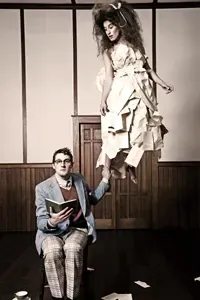
Paper Sky follows Henry, (so I am told from the publicity material; neither the programme nor the play makes mention of our endearing protagonists’ name, nor is it of all that much importance, except for ease of syntax), an agoraphobic writer who is immediately endearing in his tweed coat, chequered pants, and thick rimmed glasses. Terrified of the outside world, Henry never leaves the house, and certain of the inadequacy of even this precaution, he is terrorized by the open windows, the senseless violence of cars and construction work and bicycles and people immobilizing him utterly, presented to the audience in a relentless assault of sound. Any intrusion from the outside world is treated with panicked retreat: his neighbour Louise, with whom he is nervously infatuated (nervous to the point of paralysis) and with whom he may have had a previous romantic relationship, who slips weeks of unattended mail through his door and tries to invite him out; telephone calls from his mother, who hasn’t seen him for an eternity, and from his publisher, who is demanding the third draft of the book he is working on. The only respite is that he is not lonely: his interior life is personified by three characters who keep him company, each who wears some variation of his preferred tweed and plaid, and who attend assiduously to his daily needs – one pours him a cup of tea, one covers his mouth with a handkerchief when he sneezes, and one turns the pages of whatever book he has immured himself in.
The set is beautifully constructed; essentially no more than four folding, and infinitely mutable pieces of cardboard that constantly transform. Out of these four pieces of cardboard, we are presented with Henry’s apartment, brought to life with meticulously hand-painted patterned floral wallpaper with blue and pink petunias, a couch that is immediately familiar as belonging to every grandmother, (except of course, that this one is made of cardboard), and a typewriter that is as constant and noisy as snoring. An old vinyl record player provides instructions for a waltz that Henry cannot dance because he does not have a partner. The nostalgia of the set design, as with the costume, is not to transport us to a date, but an emotional space: a swooning kind of romanticism that no longer exists.
Henry survives, because in his writing, he is able to voyage to the land of his imagination, a phantasmagoric place that is inhabited by a beautiful paper doll, Luna (puppeteered, as with all the other props, by on-stage actors who do double-triple-innumerable duty). Parker and Nolan note the parallels between paper and the properties of love, and indeed, Luna represents in her fragility a quality which Henry does not possess – resilience. When then, Luna appears to him – in his apartment, come to life but still as a paper doll, Henry promptly does what any virtuous agoraphobic would do: he falls in love with the physical manifestation of the character that he himself created. It is an idea that has been explored in other work in recent time in Guo Xiaolu’s How is Your Fish Today? and Charlie Kaufmann’s Synechdoche, New York (which adds another layer of detachment in being a film about a director who makes a theatre piece based on his own life): a modern kind of despair, wherein we recognise that our fantasies of love are simply fantasies, and in acknowledging that, we must fall in love with an imagined person, rather than the obviously false imagined scenario of falling in love with a real person (real people are too messy, too unpredictable, too inclined to let us down).
Like an unreliable lover, Paper Sky never fulfils this dazzling promise, set up in its first twenty minutes. Instead of the woozy, delirious heedlessness of swooning, of things that happen that you’ve always known will happen, except never happening in the way you expect because that is what happens in real life, Paper Sky stumbles into plodding convention and formula, of what is supposed to work (like doing the dishes), of Obstacles with Mythic overtones (with capital ‘O’s, and capital ‘M’s). The Russian writer and dramatist Anton Chekhov, contemplating the merits of what makes a good story, once declared that if there is a gun at the beginning of the story, it had better go off at the end of the story. By no means am I suggesting that Paper Sky needed to give resolution to all of its charming, disarming moments, of which there are many. But some of its moments – Louise devotedly slipping his letters through the door, the phone call from Henry’s mother, the instructions for a waltz which cannot be danced alone; are filled with such accurate longing and suggest a narrative significance to say nothing of a psychological one, that it can’t but set up an emotional expectation. The play never picks up on any of these things and the truth of my disappointment was not that they were not resolved (contemporary audiences, usually cynical, would find this to be false), but not explored. Chekhov, in his plays about love, as all his plays inevitably in some way are, often leaves his audience with a feeling of frustration because he deliberately denies catharsis, and there are countless works of literature that intentionally frustrate, prolong, obfuscate, or deny emotional release – Beckett, Ionesco, Dario Fo, Havel among them; but as with Chekhov, this frustration is its very point, it is built into the very structure of those plays, its denial of catharsis constructs the very fabric of its meaning. It is clear that from the final images of Paper Sky that this was not the intention here, and indeed, it is lamentable that the these images lack the visceral impact they would have if only they had been earned. Because the play takes a metonymic, or metaphoric structure (that is to say, the imaginary world Henry frantically writes himself into, and the obstacles he then has to endure, represent the inadequacies and tortures he struggles with in his daily life as a human being afraid to leave his apartment), it is especially important that we do not lose our reference point, which must be grounded in real, relatable things (for example, a nagging mother, or a girl with whom we are so infatuated we can barely breathe). They are there, at the beginning of this work – but subsequently abandoned, and in being so, the rest of the play simply becomes a series of phantasmagoric events with no emotional bearing, like a love letter written to someone else.
The props transform, but not the characters, or at least, not in a way that penetrates emotionally. As a play about transformation, transmogrification, and the power of imaginative faith to overcome, the most crucial transformation never happened. I kept hoping that Luna, the paper doll, would become a real person, or that a connection would be drawn to Louise, like the moment at the end of Shakespeare’s A Winter’s Tale, where, before our eyes, Hermione is restored from a statue to a living, breathing, beautiful woman, of flesh and bone, of suffering and loss, resulting in an impossible catharsis. I am certain the performers would have been capable; as a piece of physical theatre, all of them inhabited the whimsically absurd world of the work with sincerity and surefooted spontaneity, and in particular, Emmett Skilton, who played Henry, delivered a performance that, removed from skilful artificiality, brimmed with truth. He had gone on a real journey, and an imaginative one, full of risks and obstacles and heartbreak. From the audience, we could see his tears, and I only wish we could have been let into his inner world a little more in the devising of the play. There is a play in here, that is ebullient, that is profoundly affecting as well as unrestrainedly imaginative, and I wonder whether the team at Red Leap ran out of time in the devising process. Moments in Paper Sky’s exposition and rising action that are so sweetly affecting, with such irresistible imaginative potency, that I was swept off my feet – but the promise is never kept. If, at some point, Paper Sky does keep that promise, I would swoon to see it again.