Review: Flintlock Musket
Written by
By Jodi Yeats
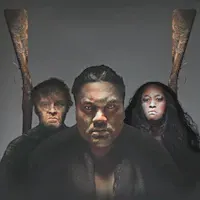
Flintlock Musket is an ambitious and brave production, although by no means a light evening’s entertainment.
Outrageous Fortune star Kirk Torrance’s second play, after Strata, is set in the harsh and dangerous period of first contact.
This is New Zealand in the early 1800s, just prior to the Musket Wars and characters are put through life and death situations.
Kirk’s story explores traditional Maori tribal systems, and the protocols, loyalties and values underpinning them. There is only one pakeha on the stage, a wily Scotsman, Mason (Jason Whyte), who jumped his whaling ship, hoping to gain land, only to be taken as a mokai (slave or pet) by local iwi.
After a battle where Mason does the iwi proud, the chief Aoraki (Maaka Pohatu) gifts him a wife, Hine (Nancy Brunning).
Hine is a high-born woman whose whanau and lands were conquered by Aoraki. She has lived as daughter and slave to the chief and has been used and abused. Consequently, she has gained an evil streak and here parallels with Lady Macbeth begin as she manipulates her flawed husband into murdering his way to the top.
Macbeth references succeed
Flintlock Musket’s storyline is inspired by Macbeth and the synergies work really well. Kirk was inspired at school by similarities between warring Scots clans in Macbeth and tribal Maori. At critical points, characters even quote lines from Macbeth and this also works surprisingly well. Having a Scotsman as a main character further strengthens that connection.
For poetry of language, Kirk has way to go before he equals the Bard, but there are some poetic lines, for instance when Hine taunts her husband in sexualised language, inciting Mason to act boldly, decisively, even badly, to convince her of his manhood.
Poetry in production
The production overall has poetry and beauty in it. In particular, I enjoyed the choreography for the ensemble, a group that metamorphosed from iwi to magical spirits, as required. And they did a particularly spine-chilling haka. Movement director Jack Gray said afterwards several have danced with Atamira Dance Collective, but others are from acting backgrounds. They moved low to the ground to evoke a barren landscape.
The costumes, designed by Native Agent’s Rona Ngahuia Osborne and Paula Collier, added to the magic, with grass around the shoulders looking a bit like fairy wings, and cloth wraps evoking both kilts and piupiu - without the burden of cultural tokenism the souvenir industry has bestowed on actual "grass skirts".
Lighting by Jeremy Fern added to the drama, evoking a strong interplay of light and dark as the central figures grappled with those influences, as well as Maori motifs.
Music written and performed by Tama Waipara and Sean Lynch, along with saxophonist Lewis McCallum, was a real treat, mixing new technology and music with traditional Maori music.
Potential to travel overseas
Flintlock Musket gained support from The Edge and Creative New Zealand because of its potential to represent New Zealand theatre overseas. It certainly has promise, showcasing Maori participation and leadership in the arts, and telling a story inspired by historic events. Also, the Maori-influenced music, costume and story would export well.
I felt a few aspects needed tweaking before the play is ready to head offshore. It may have been an opening night glitch, but it was occasionally difficult to hear what the actors were saying. And, I was uneasy about how often Mason was standing in one place delivering his lines. It may have been done intentionally to show his weak character, but I somehow felt there was more “show than tell” at similar points in Macbeth.
Nonetheless, these are quibbles that by no means marred a fabulous production and one that does Aotearoa proud.
Flintlock Musket
Written by Kirk Torrance
Directed by Rachel House
Showing at Lower NZI, Aotea Centre, THE EDGE
Tuesday, 17 to Saturday 28 November
Tickets $20 to $45 (plus booking fee) from THE EDGE www.the-edge.co.nz or 09 357 3355