Remaining the stranger for it - The public practice of Kah Bee Chow
Written by
By Kate Brettkelly-Chalmers
Courtesy of Public Good, Enjoy Public Art Gallery
A terrarium's humid tangle of plants - a mini-forest of horticultural specimens jostling under cover of glass - offers an apt point of reference for Auckland artist Kah Bee Chow's practice. Engaging with Chow's performative and conceptual work is much like peering into an overgrown biosphere. We are met with a jungle of quotations; a garden of entwined images and allusions. Moon-gates, romance novels, fairy lights, Mi Goreng noodles, French modernist cinema, dancing sequences, water features and insidious weeds all make an appearance in the artist's lyrical assemblage of citation and reference.What is most important for Chow in these horticultural endeavours is the intriguing and somewhat absurd paradox that the terrarium operates. A transparent glass case is needed to achieve its ideal growing conditions; nature's perfection is made ironically possible in its separation from the organic, in its synthetic seclusion from that which lies beyond the pane . This tightly wound knot of contradiction is an example of the kinds of interlocked oppositions that lie at the heart of Chow's work. Her whimsical yet shrewdly conceptual practice bears a fondness for the often dramatic, romantic and emotive qualities of such insoluble contradictions and innate paradoxes.
Chow's interest in paradoxical set-ups also shapes the way in which her works engage with the public sphere or determine participation by their audiences. This play of inverted contradictions offers the artist a mode of destabilising notions of a shared communal space or activity. Furtively shrouded in a somewhat cute and endearing mode of performance, Chow's practice seeks to quietly undo (and re-do) some of the knots that bind our preconceptions of familiarity and strangeness, absence and presence, with regards to ideas of place and public.
In a practice that is specifically situated within the social sphere of communal spaces - of contemporary art galleries, artist-run spaces and public pavements - an inclination to remain paradoxically remote from these realms is evident. If one were to squeeze the last drops out of the terrarium metaphor, we might conclude that the artist draws on the potential of the unfamiliar by keeping her viewers at a distance and behind a pane of transparent glass. Such dalliances with moments of strangeness and elements of unfamiliarity lend a quietly unsettling quality to Chow's work.
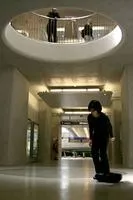
Nine Dancing Ladies (2004) takes Auckland's Britomart precinct as a stage set for a series of performative activities. This previously forsaken downtown area is currently undergoing a process of urban renewal under the auspices of council and commercial groups, and now features a collection of sculptures and newly constructed architectural spaces. Donning a pair of dark sunglasses and matching black attire (a scruffy version of Maggie Cheung's latex cat-suit in Olivier Assayas' 1997 film Irma Vep) with portable stereo and pink umbrella close to hand, Chow performed a trio of choreographed dances to the soundtracks of a few 1960s French New Wave films.
Nine Dancing Ladies saw the artist utilize the potential dramatics of Britomart's modern spaces as a backdrop for her whimsical pursuits. The transport hub's giant skylights throw massive circles of sun on its underground passageways offering Chow a perfectly theatrical spotlight for a goofy version of the famous Madison dance from Jean-Luc Godard's Bande à part (1964). The film's grungy Parisian cafe is replaced with the sturdy burnished concrete and cool modern surfaces of Auckland's downtown area. Like the film's heroine, Anna Karina, who is eventually abandoned by her Madison dance-partners, Chow is left alone in these echoing spaces, pattering away to the jazz beats with passers-by and commuters casually ignoring her oddballactivity.
Remaining at arm's length, Kah Bee Chow takes the role of a stranger in the midst of a flux of communal activity. Her performative persona - the sweet kid swinging a suitcase full of instant noodles through the bright lights of the big city - will never really settle down, will never completely curry favour with the metropolis, and will always sustain a kind of theatrical unfamiliarity with her surroundings. Items for travel - suitcase, umbrella and sunglasses - allow for a fleeting engagement with location; she could just pack up and go. The durable permanence of Britomart's urban spaces is placed in distinction to a temporal fragility and the cultivation of an impermanent sensibility.
Nevertheless, contradictory oppositions such as these can be turned inside out, and Chow's practice seeks to reveal how such incongruous elements might inform one another. Does encountering that which is alien and unfamiliar - a fleeting glimpse of a black-clad girl swinging an umbrella through the jets of a city water-feature - solicit a reconsideration of one's own conception of familiarity? Here, the potential instability of place, public and communal, is brought into sharp relief by the artist's adherence to a timbre of strangeness. Chow's work obliges a review of how we engage with the spaces or activities of the modern metropolis, and how the kind of cozy stability brought by familiarity might be subtly undone (and refastened in different ways) by the recognition of an element of foreignness.
Moving from public pavements to public gallery spaces, Chow continues to explore notions of the familiar/foreign in works such as Emotional Snack Bar (2004) and Fall Out (2006) which celebrate the convivial social environments that artist-initiated projects often develop. Emotional Snack Bar involved Chow hosting a noodle eatery from the confines of Auckland's Canary Gallery. Replete with the types of fairy lights often found adorning the windows of the city's Chinese restaurants, for one day only the gallery served 2-minute Mi Goreng meals to its visitors in exchange for a quick photo of them downing the Malaysian snack. Chow's work constituted a documentation of the community that surrounded the gallery - a network of faces and people engaging in the most sociable of activities: eating.
Similarly, Fall Out involved the renovation of another artist-run space located in the Britomart precinct, SPECIAL. Foreshadowing the forthcoming refurbishment of the building as part of the urban development of the downtown area, Chow cut a massive circular hole in the wall that separated the makeshift gallery from the artists' studios surrounding it. In effect, this cavity (a nod to Gordon Matta-Clark's 1970s building cuts) amplified the gallery space and allowed it to flow into neighbouring studios. From these chaotic spaces, Chow cleared a horde of wood off-cuts and spare materials, sanded the floors bare and hung plants from the ceiling. The diminutive stature of SPECIAL's infamous half-walls always allowed a glimpse of a frenzied studio space beyond, but now no longer kept the opening night crowds at bay.
Chow's Fall Out reminded me of the "haha", a curious eighteenth-century English ditch that encircled a landowner's domestic garden. The ditch did away with the need for an unsightly fence while keeping cattle and other unwanted bodies out of the cultivated grounds. The haha, supposedly named after the exclamation (Ha!) made by the unwary when stumbling into it, allowed an uninterrupted view of the landscape beyond the garden while maintaining important property boundaries. The haha meant that this power structure was physically inverted without reversing its intention. A gentleman could enjoy the unfolding wilderness of the English landscape beyond his fence while keeping its uncultivated chaos at arm's length .
Chow similarly plays with the conventional boundaries separating gallery and studio, artist and audience. As visitors crept into the studio/gallery space on Fall Out's opening night, a feeling of cautious delight, something that comes with stepping 'over the line' or approaching taboos, was evident. It was enjoyable walking through Chow's circular void and into the studio spaces that had supported SPECIAL as a working gallery for the years that it was open, nevertheless these spaces were still in use by the artists and Chow's installation thereby imparted a sense of encroachment.
Such elements of friction always remain in Chow's socially engaged works; interactions between audience and artist are not always smooth affairs. As an artist, Chow is careful not become purely an agent of interaction or to allow her sweet-kid persona to disappear into a flux of social activity. There must be a star of the show, albeit a somewhat reluctant one, and she ensures a kind of theatrical isolation will allow her to remain distinct from her audiences. Unlike Rirkrit Tiravanija's open gallery meals, we must press our noses at the window awhile before a steaming bowl of noodles gets placed in our hands.
This paradoxical relationship with an audience, a love-hate affair sparked by a bittersweet logic, might be easily aligned to the appeal and repulse of celebrity culture. Slovenian philosopher and theorist Slavoj Zizek describes how a delight in the mundane or trashy activities of celebrities is inextricably bound to their enigmatic appeal: "the thirst for as many sordid humdrum details of their lives as possible - the lowest yellow-press trash secretly sustains its opposite, charismatic dignity." The extraordinary and beguiling qualities of the modern celebrity are made all the more attractive in relation to those intriguingly repulsive ones; we need the trash to experience the charm. Extending this vein of thought, we might conclude that Chow's relationship with her audiences - the way in which public commuters or earnest gallery goers interact with her work - is a liaison characterised by this appeal/repulse, an enchanting mix of fascination and unease.
Such unpleasant twists always emerge in Chow's practice and propagate an uncomfortable pathos that seeps into its reception. We are lulled by a play of appealing and stylish references only to be brought up sharp by an abrasive surface - one of Chow's sandpaper bound books erasing the pages of others as it is pulled from the shelf. A similar sense of shrewd pathos exists in what is perhaps the artist's most poignant work, Afterlife (2006). This performance piece involved Chow launching a series of delicate paper parachutes over Christchurch's well-known suicide sites. Watching the video and photographic documentation of these flimsy, airborne forms fluttering across the location of multiple deaths - a Cantabrian cliff top covered in yellow gorse blooms - reminds us that some public spaces are painfully conspicuous in their absence from public discourse.
Of all the works that engage with the public or communal realm, Chow's Afterlife best articulates the suggestion that no space is neutral. Through a whimsical language of entwined contradictions - moments of strangeness and familiarity, absence and presence - Kah Bee Chow quietly examines the histories, idiosyncrasies and mythological qualities of the shared space we inhabit: it's a jungle out there.
A journal published by Enjoy Public Art Gallery, Wellington, Aotearoa/New Zealand
Edited by Paula Booker and Marnie Slater
ISBN 978-0-473-13698-7
Only $18 from Enjoy and selected stockists (including Gambia Castle and the Physics Room)
Wellington launch 19 July 4pm at Enjoy
For more information please email paula@enjoy.org.nz
This new publication by Enjoy questions expected notions of art in public, and asks what alternatives may be offered. Considering the increasing amount of funds and energy being directed towards the commissioning of art sited within public space, and the continual civic development of the urban landscape, we thought it timely to attempt a collected discussion into the obviously political, and forever elusive notion of The Public.
Public Good is a collection of critical essays, artist's pageworks and prose pivoting around an exploration of The Public. The journal draws from local and international contributions and sees the coming together of diverse voices and interpretations from practitioners locally and internationally to form a varied thesis, offering a springboard for argument, thought and discussion. Public Good was made possible by funding from CNZ. It is the first in a series of Enjoy journals, of different themes and formats.
Contributors: Fiona Amundsen (Auckland) Christina Barton (Wellington) JC Borrelle (Melbourne) Kate Brettkelly-Chalmers (Auckland) Kah Bee Chow (Penang/Auckland) Tim Corballis (Wellington) Harold Grieves (Christchurch) Rudolph Hudsucker (Wellington) Tushar Joag (Bombay) Dane Mitchell (Auckland) Kate Newby (Auckland) Rachel O'Neill (Wellington) Spiros Panigirakis (Melbourne) Chaitanya Sambrani (Canberra) Shuddhabrata Sengupta (New Delhi) Simon Sheikh (Berlin/Copenhagen)
17/07/08