Recycling for art's sake
Written by
by Mark Amery Courtesy of The Dominion Post 9/3/07
Contemporary artists are great recyclers. Look around current national survey exhibition Prospect 2007 and you'll find previously unthought of applications for used materials that'd impress even the local refuse transfer centre.
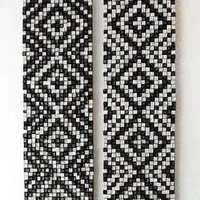
Image: Gina Matchitt Patikitiki I & II (detail)by Mark Amery Courtesy of The Dominion Post 9/3/07
Contemporary artists are great recyclers. Look around current national survey exhibition Prospect 2007 and you'll find previously unthought of applications for used materials that'd impress even the local refuse transfer centre.
Image: Gina Matchitt Patikitiki I & II (detail)In a time of consumer disposability many artists are gathering the found object and letting them speak in new, more resonant ways in their connection to people, space and time.
Recent exhibitions by Gina Matchitt at Mary Newton and David E Thomas at Avid were good examples. In E kare, you're so colonised Matchitt showed tukutuku panels made out of the keys from recycled computer keyboards. The action might initially seem gimmicky but aesthetically they chattered together with the tactility of bones, drawing you into (as with Rachel Rakena's past work) a deeper consideration of the changing ways we access and distribute information culturally.
David E Thomas wove kete out of recovered 16mm black and white and coloured film strips of traditional Maori performance and archetypal New Zealand landscapes (much from what was the National Film Library), the work animated by the light boxes they sat on. Again aesthetically the illuminated rhythmic beauty of the weaving drew you in, but they also simply but neatly shone a light through the touristic representations woven into the fabric of our received knowledge.
At Aaron Laurence Gallery currently are three kinetic works by emerging artist Belinda Curran. Comprised of a range of composite welded or melded materials they don't have the utopian dreaming of the work of Len Lye, but rather have a darker and more sinister wit and edge evocative of '50s sci-fi. These are creaky robotic domestic pets that hint at darker purposes. Impressive is a new work in which two arm-like appendages reach out from the wall. At times in their dance they have the grace of flowers as they unfurl or hands courting each other yet, alternately, with a jerky twisting motion or two they are suddenly your home plumbing, Triffid-like, come to life.
Dunedin artist Mary McFarlane finds ways to expose old mirrors to the reflections of an elemental experience of the world and time. Painting, distressing and aging the mirror's plate she is able to capture fleeting clouds and engraved landforms. Looking into her works in the exhibition Halfway to Paradise at Janne Land Gallery I'm drawn into a personal landscape where I'm traveling through gouged ravines full of shadowy past traces or afloat in the glittering atmosphere.
These works are inspired by Colin McCahon's Waterfall works of the mid 1960s and dramatic places in Central Otago, from which works like Chasm, Arcadia and Chute are named. There is this grand poetry to them but the mirrors anchor them within a personal domestic sphere. The ribbon waterfall motif adopted from McCahon that is present in most works can resemble a road, a walking stick or an elegant typeset letter.
Yet the work is often for me at it strongest beyond the formal division of the picture plane by this familiar motif. It is the way the surfaces feel like they have been marked by the world, the sense of nature and culture recorded in the intensity of interior personal experience. In the work Widow's Tears it is as if the mirror has become cracked and stained by the experience over time of looking at one own's memories within it.
Contained as they are the works have a brittle sculptural intensity in their beautiful exploration of surface and a painter's joy in their expressive swoops and atmospheric impressions. Beyond the black depths and white glimmers of the night sky the other predominant colour here is rust, the russet of age. Time has patinaed and carved paths through them, the work opening out our own image to that of the elements beyond
McFarlane's work has received limited attention beyond that created with her husband, Ralph Hotere. Their powerful 1998 sculpture Ruamoko, on the corner of Ballance Street and Lambton Quay in retrospect shows McFarlane's elegant, metallugical influence. The pillars and letters for this sculpture were salvaged from a nearby building demolished ion the early 1980s. Halfway to Paradise suggests she deserves further attention on her own merits.
Belinda Curran Aaron Laurence Gallery
Halfway to Paradise, Mary McFarlane, until 17 March