Reading faces in paint - Mark Amery on portraits
Written by
Face to Face - Courtesy of the Dominion Post - 29-04-05
By Mark Amery
What do you see in a stranger's face in a painting - the sitter, the artist or yourself? Perhaps there's a memory of an encounter, or an idea produced from the representation of an archetype. Or does it remain a few strokes of paint?
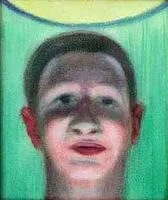
Image: Richard McWhannel's Limelight - tender yet troubling.Face to Face - Courtesy of the Dominion Post - 29-04-05
By Mark Amery
What do you see in a stranger's face in a painting - the sitter, the artist or yourself? Perhaps there's a memory of an encounter, or an idea produced from the representation of an archetype. Or does it remain a few strokes of paint?
Image: Richard McWhannel's Limelight - tender yet troubling.The human face introduces complexity into a painting. It can be a powerful device for contemplation of the conditions of being human. Alternately, the face can be used to put us at a critical distance from the painting's other elements - a mask, to reflect back the artist's references. Either way a stand-off between viewer and subject takes place: What are you looking at? Do I know you? How do you read me?
This week I was struck by a face in a group show at dealer Janne Land's new gallery space in Jessie Street. In fact, I think I've fallen in love with Richard McWhannell's small quiet painting Limelight from 1980. I don't as a rule find pasty, ruddy-cheeked men with cauliflower ears attractive, yet I felt a tenderness for this fresh face. A tenderness as captivating as the mystery the painting also has for me as an abstract composition.
The face is as bathed in direct, bright light as it is shaded from it. Shining up from directly below, it's as if this is a face from the music hall caught in the glow of footlights. Put under such close dramatic attention to perform, there's exquisite anticipation in the vulnerable wide-eyed expression. Is that fear, or excitement? I continue to enjoy trying to put my finger on it.
I don't know who the person in the painting is, yet there's a troubling feeling that there's pressure being applied. Is this a self-portrait about being put under the spotlight, or something even more sinister? Shadow falls like a bruise over the face, resembling a Batman mask. In balance with this a bold yellow sun-like shape creates a glow of promise above, and sees the bottom half of the face become a swirling ball of light. The ears are so flowery and ruddy red that they could be the bloodied flaps of organs. Yet set against such a luminescent green they're also beautiful in the abstract. For me there is a tension in this face's complexion, between portrait and object, the real and the abstract, expectation and dread which sustains my interest.
I was reminded of this painting seeing the work of Daisy Wood in Kissed, a group exhibition of two women painters (Wood and Kirsty Morison) and two poets (Hinemoana Baker and Helen Heath) at Pataka. Kissed is themed loosely around domesticity and community. These concerns are explored subtly through the sharing and attunement of four different experiences and expressions of intimacy.
Wood's and McWhannell's paintings both rub back the face to something quite raw and emotionally direct. In their expressionist play between the abstract and the figurative they provide affecting psychological portraits. Colours may sometimes be violent and faces and bodies pulled into expressive, almost clown-like gestures, but there is always both light and dark in equal measure - a complexity of emotion in these faces complexion.
As Kissed the exhibition provides as a whole, there's a sense we've stepped into close physical proximity to the subjects and are sharing a private psychological space. Wood gets us on tender ground as voyeurs. In 'Resolution' for example there's joyful abandon in a naked figure lolling back, belly shining out and arm outstretched. Yet this intimacy can make us feel uneasy, aware of the threat as well as love we represent. There's tenderness in these paintings summed up in the wider meaning of 'kissed', as to be lightly touched.
This emotional intimacy is in contrast to the expectations of the portrait by a prior generation, as expressed in one of Hinemoana Baker's featured poems:
'There is a way to draw a pretty lady, Nana said.
A way to join the eyebrows to the nose
the angle the profile should be.
You don't need to be looking
at it to draw it, Poppa said.'
In contrast in these paintings are often caught off-guard vulnerable, private moments. We are taken off somewhere else into someone's thoughts, be it through the abstract space in a painting or a line in an accompanying poem. In 'Elegy' a young women bites her bottom lip and looks elsewhere, but we go with her, the backdrop glass awash with her uncertainties.
Always we're unsure whether the emotion is over something trivial or serious - are the children in 'Ode to Broad Beans' hungry for love or just beans? Ultimately, we're left considering that feelings are felt as strongly in the ordinary domestic moments as they are in the extraordinary dramatic points in your life.
Pieces for Collectors, Janne Land Gallery, until May 14
Kissed, Pataka Porirua Museum of Culture, until May 1