Re-Telling Tales at Museum of Wellington City and Sea
Written by
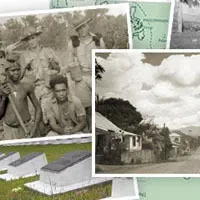
By Mark Amery Courtesy of The Dominion Post 24/10/07
The way the story is told of New Zealand soldiers in New Caledonia between 1942 and 1945 in War in Paradise at the Museum of Wellington City and Sea is at least as interesting as the story itself. Equal parts installation, photographic essay and collation of historical text, there is no single storyteller with this exhibition; none of the usual anonymous wall texts by museum staff that carry with them the institutional authority that leads us to swallow whatever is offered as the facts.The facts instead must be gleaned through experiencing a theatrical montage of voices; curator Brett Mason bringing together an artistic team who use sound, light, text, image and sculpture to recreate memory as an environment.
These voices represent the stories of the more than 20,000 New Zealand troops stationed in New Caledonia during the Second World War as part of a buffer in the Allied Campaign against Japan's spread into the Pacific.
The exhibition will leave you none the wiser as to military action conducted by these soldiers, or the vital statistics of the campaign and what was considered its significance or success. The exhibition is at pains not to make historical judgements or to feature any official statements of facts. Rather, explicitly calling itself the 'unofficial story', its fragmentary approach provides the viewpoint of the soldier, but one that is more concerned with recalling how women soldiers fashioned bathing suits out of khaki towels than soldiering.
War in Paradise is most successful as a collaborative artwork exploring how slippery history is. Along the walls are fragments selected from the "unofficial history of the Third Division". It's unclear from the way this history is written as to whether there are single or multiple authors involved (the answer logically is both, with soldiers' recollections edited into one text), creating an uneasy relationship between statement of fact and personal recollection.
Furthermore, large blocks of text have been included which are struck out, as if they have been censored by officialdom. Yet the author of this editing is unclear - were they struck out on their passage back to New Zealand? On the way to this unofficial history being officially published? Or have they been randomly struck out by Mason to question the way history is censored?
The texts and accompanying historic photographs have been printed onto galvanised steel, a reflective material lit sensitively in the darkened space, which has allusions to the industry of war. This is carried through into the central installation where steel towers allude to trees and communication devices, and two concave steel screens face each other like radar devices. These are planted into a cruciform shape of white gravel surrounded by packed New Caledonian clay.
Together with photographs by Paul Thompson projected onto the screens, and a soundscape by Plan 9 full of the sounds of the islands and the songs of soldiers there is an evocation of the memories embodied in the cemetery at Bourail, where 32 New Zealand service personnel are buried.
While the walls of the gallery represent the past, this central area represents the present.
In its collection of small visual details of the cemetery, grafitti and the bark of trees and surrounds, Thompson's camera questions what we can truly learn of the past from what we can experience of it in the present. It's a meditation true to the kind anyone has at a memorial; the way we meditate on the past through small seemingly insignificant detail.
As an exploration of how we evoke history and be true to its voices, War in Paradise is a brave and fascinating exhibition, but in questioning the authority of official history I'm not sure that it's any more effective in actually teaching us anything. As storytelling the installation can be nice theatre set dressing sometimes at the expense of the clear provision of information. It disturbed me that whilst the memorial plays such a central role in the exhibition I left unsure how, why or where those lives were lost.
The Museum of Wellington City and Sea has been distinquished by creative curatorial vision under Brett Mason. Exhibitions have found new, interesting ways to frame the city's collection and tell stories from a spread of perspectives, often involving collaboration with artists. There's an overt interest in how we weave stories around the museum object, and how those stories differ depending on the teller and the time they are created within.
Also part of the current exhibition programme, Found Beneath the Bypass sees WELTEC art students creating fictitious stories around objects unearthed during excavations for the Te Aro bypass. From a notebook of erotic prose by Katherine Mansfield and a voodoo doll belonging to Carmen, to a ballet shoe containing the recipe for Pavlova many of these well-researched stories do such a delightful and clever dance with history that you want to believe them. Meanwhile, the storytellers' constant use of words like 'likely' and 'maybe' remind you again and again of the slipperiness of history.